Always There, Rarely Seen: The Onggi Potters of Chosŏn Korea
When you walk through a neighborhood in South Korea today, you might see rows of dark brown earthenware jars lining the apartment balconies or the entrances of traditional restaurants, although most families now ferment their kimchi in electric kimchi refrigerators.[1] These jars are called onggi and have a history as old as Korean pottery itself, and during the Chosŏn period (1392–1910) the term was used for everyday earthenware vessels, distinguished from fine porcelain.[2] In 1895, the British traveler Isabella Bird Bishop visited a village on the Han River where potters made “the great purple-black jars and pots which are in universal use.” She concluded that their method “is primitive.”[3] Even sympathetic outsiders shared this view. Yanagi Muneyoshi, the Japanese founder of the mingei folk craft movement, who began studying Korean ceramics in 1916, admired them but described their aesthetic as crude, undeveloped, and rustic, tied to a yearning for the past. Bishop’s judgment showed the long-term perspective of how outsiders viewed onggi: necessary but crude and made by common laborers. However, onggi-making was neither simple nor easily learned. Onggi potters worked at the margins of Korean society, yet their craft depended on a sophisticated body of knowledge passed through apprenticeship and carried in the body. Their low status and indispensable skill were two sides of the same story, one that Korea began to recognize only when plastic containers and vanishing apprentices threatened to end it.
Bishop’s judgment showed the long-term perspective of how outsiders viewed onggi: necessary but crude and made by common laborers. However, onggi-making was neither simple nor easily learned. Onggi potters worked at the margins of Korean society, yet their craft depended on a sophisticated body of knowledge passed through apprenticeship and carried in the body. Their low status and indispensable skill were two sides of the same story, one that Korea began to recognize only when plastic containers and vanishing apprentices threatened to end it.
Life at the Margins
Onggi was made far from the center of power. During the late Chosŏn period, the jars were made in private rural workshops called chŏmch’on, typically located in the countryside, and their presence was not advertised.[4] Potters were considered low rank in Confucian society, and their wares carried no signature or marks of authorship. This created an invisibility that has extended into modern scholarship, with Robert Sayers observing how art historians devoted their attention to Korea’s celadons and porcelains, while onggi received almost none.[5] This is similar to the Ming connoisseurs we discussed in our September 17 lecture, who acted as gatekeepers of elite material culture and wrote manuals about objects without understanding how they were made; Korea’s collectors and scholars valued finished luxury wares while overlooking the everyday vessels and the labor behind them.
The low status of the craft also made it a refuge. In the nineteenth century, the Chosŏn state launched repeated campaigns against Korean Catholics because their faith was seen as a threat to the Confucian order. Official proclamations in 1801, 1839, and 1866 portrayed Catholics as rebels and even animals in order to justify arrests and executions on an unprecedented scale.[6] Many believers fled to remote mountain areas, where, according to Sayers, they found safety in the despised occupations of potters and peddlers.[7] The trade was suited for hidden communities since it only required earth, wood, and water. Family histories still preserve this connection, with one modern Seoul potter able to trace his craft to a great-grandfather who became an onggi maker after fleeing persecution into the mountains.[8] By the 1980s, Sayers found that most onggi potters were still Catholic.[9]
The work inside the workshops was organized by rank, with an owner, who was often a retired potter, overseeing skilled wheel-turners (taejang), who also loaded and fired the kiln. Below them, assistants prepared clay coils and glazed finished pots, while other workers handled odd jobs. Typically, workers lived with their families near the site in housing that the owner provided.[10] This arrangement made the workshop a small, self-contained community in which both the craft and the Catholic faith could be passed down through generations.
Knowledge Carried in the Body
What Bishop called “primitive” was actually a demanding body of knowledge that potters acquired not from books but from years of work. It began with the clay, with potters classifying clay not by appearance alone but also by how it behaved: sandy clay that held its shape on the wheel was called “standing clay” (seoneun jil), sticky clay was “lying clay” (nuun jil), and the best clay was said to “laugh” (unneun jil).[11] One master tested clay by wrapping a coil around his finger to see whether its surface cracked, and many workshops aged their clay for months or even years before use.[12]
Forming the jar then required even more tacit knowledge, as potters built the walls from coils or slabs of clay, then beat them with a wooden paddle on the outside while holding an anvil against the inside. There was an old saying that onggi walls should be as thin as a blade of grass, and the potters who were able to do this were seen as the most skilled.[13] According to Kim Jae-ho, the outer paddle simply follows the hidden inner hand, which controls the thickness, height, and width of the wall. Kim calls this a “body technique,” since it is a skill that potters themselves struggle to put into words.[14] This is an example of the tacit knowledge we discussed in our September 15 lecture: skill that resists being written down, as onggi-making was learned through apprenticeship, observation, and repetition.[15]
However, the final stage, firing, was the most uncertain. Over the span of several days, potters raised a kiln’s temperature by judging the fire’s color, the weather, and the state of the pots without a thermometer. Firing was difficult and a failure could ruin a workshop financially, so some workshops employed a separate fire master, and potters said one could not leave the kiln even if a parent died. One potter told Kim that onggi has no teacher, since even experienced potters are fooled by the fire again and again.[16] Even the glaze recipes were closely guarded;[17] however, knowing the recipe alone was useless without the experience to apply it.
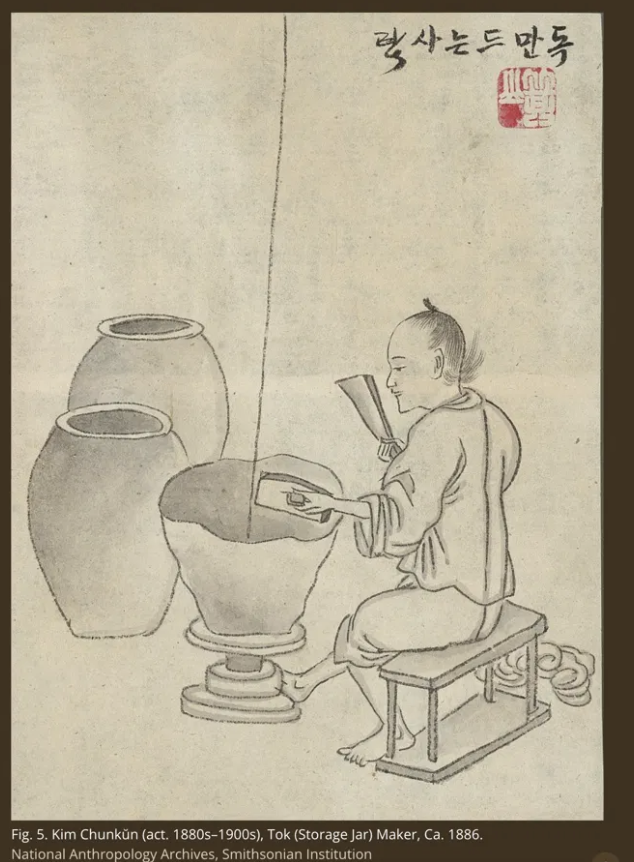
Fig. 1. Kim Jun-geun, Tok (Storage Jar) Maker, ca. 1886, National Anthropology Archives, Smithsonian Institution; reproduced in Clements and Sang, Stories of Clay, Room 1, fig. 5.
Picturing the Potter
Kim Jun-geun’s Tok (Storage Jar) Maker (fig. 1) is one of the rare images of a Chosŏn potter at work.[18] Here a man sits barefoot on a low bench and turns the wheel with his foot, just as Bishop described. In his right hand he holds a wooden paddle, while his left hand reaches inside the jar. The painting thus captures the technique Kim Jae-ho identifies as the core of the potter’s skill: the hidden inner hand guiding the paddle outside, with two finished jars standing behind him as evidence of his work.
This painting also helps reveal what an image cannot record. For example, it shows the posture of the potter, but not his judgment and thought process: how he chose the clay, how thin he made the wall, or when he decided the fire was hot enough. The background around him is blank, reducing the whole system of labor to a single figure. This simplification reflects the painting’s purpose, as Kim Jun-geun worked in the treaty ports and sold his genre scenes mainly to foreign visitors, diplomats, and merchants, which is why most of his works are now in museums in Europe and North America.[19] Much like Bishop’s travel account, the painting presents onggi-making as a picturesque Korean custom for outsiders. In a way, it preserves the craft’s appearance while leaving its knowledge, carried in the body, invisible.
From Necessity to Heritage
Onggi survived the twentieth century because it remained useful. Even when Sayers visited in the early 1980s, mass-produced plastic and stainless steel containers had already been available for about a decade; nonetheless, many women still preferred the taste of food fermented in earthenware. Each fall, in neighborhoods, groups of women prepared their winter stores and set sauce jars on raised platforms called changdoktae, partially burying the kimchi jars so they would not freeze.[20] As we discussed in class, cooking in Chosŏn households was considered “womanly labor,” even though the royal kitchen was staffed almost entirely by men, with 388 male chefs and only 12 women. The skill of fermentation, like the skill of making the jars, belonged to people whose work was rarely recognized. Yet the foundations of the craft were weakening. Ralph Rinzler, who first saw onggi clustered outside village homes in 1971, returned and found a decade later that many rural workshops had closed or merged and that few young people were becoming apprentices, even as collectors began buying older jars.[21] Some of the knowledge disappeared with the work itself: the laborers who once trampled and cleaned clay by hand were replaced by machines, and with them their methods were largely lost.[22]
The state responded by redefining onggi as heritage. In 1990, onggi-making (onggijang) was designated a National Intangible Cultural Heritage, and the government began honoring master potters and supporting apprenticeships.[23] A craft once practiced by outcasts and dismissed as “primitive” became a protected national tradition, but the recognition also changed what onggi was. Jars made for kitchens now sit in museum cases, such as the two made by potter Shim Sang-un at the 1982 Smithsonian Folklife Festival, one of which was fired in North Carolina with a substitute glaze.[24] Onggi became something to look at rather than to use.
Conclusion
Isabella Bird Bishop saw a primitive method when she watched potters at work on the Han River. This essay has argued that she was actually looking at something far more complex. Onggi potters stood at the margins of Chosŏn society. Their names rarely entered official records, their wares carried no signatures, and their workshops sheltered persecuted Catholics when they had nowhere else to go. However, their craft depended on an extensive body of knowledge, from classifying clay by how it behaved, to shaping the walls to be as thin as a blade of grass, to learning to read a fire without a thermometer. This body of knowledge mostly lived in the potter’s body and resisted being written down, which is why even Kim Jun-geun’s painting could only show the potter’s hands but not his knowledge. Sadly, it was only when plastic containers and disappearing apprentices threatened the craft that Korea redefined it as national heritage. The jars that once held every household’s food are now a reminder of a skill that was always there, but rarely seen.
Works Cited
Bishop, Isabella Bird. Korea and Her Neighbors. Fleming H. Revell, 1898. Project Gutenberg, www.gutenberg.org/ebooks/69300.
Clements, Rebekah, and Seung Yeon Sang. “Room 1: Origins.” Stories of Clay: Discovering Chosŏn Korean Potters in Tokugawa Japan, Universitat Autònoma de Barcelona, aftermath.uab.cat/stories-of-clay/room/room-1/.
Kim, Jae-ho [김재호]. "옹기장인의 옹기제작기술과 전통지식" [Techniques and Traditional Knowledge of the Korean Onggi Potter]. Munhwajae, vol. 48, no. 2, 2015, pp. 142–57.
Kim, Jun-geun. Tok (Storage Jar) Maker. Ca. 1886, National Anthropology Archives, Smithsonian Institution. Stories of Clay: Discovering Chosŏn Korean Potters in Tokugawa Japan, Room 1, fig. 5, aftermath.uab.cat/stories-of-clay/room/room-1/.
“The Korean Genre Painter Better Known Overseas than at Home.” Best of Korea, [day Month year], bestofkorea.com/the-korean-genre-painter-better-known-overseas-than-at-home/.
“Last Onggi Maker in Seoul’ Still Spins History.” Korea JoongAng Daily, [day Month year], www.koreajoongangdaily.com/lifestyle/last-onggi-maker-in-seoul-still-spins-history/10746592.
“Onggi Crocks: From Onggi Crocks to Kimchi Refrigerators.” Modern Material East Asia, University of Hong Kong, mmea.hku.hk/onggi-crocks-from-onggi-crocks-to-kimchi-refrigerators/.
Pang, Inah. “Onggi Pottery from Korea to D.C.: Household Necessity to Health Trend.” Smithsonian Folklife Magazine, Smithsonian Center for Folklife and Cultural Heritage, folklife.si.edu/magazine/onggi-pottery-korea-to-dc-necessity-to-health-trend.
Rausch, Franklin. “Like Birds and Beasts: Justifying Violence against Catholics in Late Chosŏn Korea.” Acta Koreana, vol. 15, no. 1, 2012, [pp. Pages].
Sayers, Robert. “Rediscovering Korea’s Onggi Potters.” 1982 Festival of American Folklife, Smithsonian Institution, 1982, pp. 42–45, folklife-media.si.edu/docs/festival/program-book-articles/FESTBK1982_19.pdf.
Younger, Erin. “Korean Onggi.” Storied Objects, Smithsonian Folklife Festival, 2023, festival.si.edu/storied-objects/korean-onggi.
