Beyond the Pantry: Jang Damgeugi as Science, Gendered Labor, and Heritage
Introduction
Most everyday Korean food practices produce short-term side dishes. The craft of Korean jang damgeugi (장 담그기) was more of an annual commitment. Making jang meant managing a material transformation across an entire calendar year. The process started with harvesting beans in late autumn, hanging mold blocks in the winter, bringing them inside in the spring, before aging in outdoor jars for months, or even years. This entire tradition is centered around jangdokdae (장독대), an open outdoor stone platform where women monitor the weather, seasonal changes, and the clay walls of their storage jars. Making jang wasn’t just about stocking up on pantry staples like doenjang (된장) and ganjang (간장). It organized female labor in the home, created practical knowledge, and established a living material craft that is recognized today as cultural heritage. Craft, in the context of jang damgeugi, means working directly with nature, seasonal timing, and living ferments. By balancing weather conditions, clay jars, and household labor, Korean families turn plain harvested beans into the foundation of their daily food culture.
Materials, Tools and Spatial Infrastructure
Meju (메주), a dried block of boiled soybeans that starts the fermentation for all traditional soy pastes, stands at the center of jang damgeugi. Preparing meju began right after the autumn harvest during the tenth lunar month. Records of fermented soybean products go back thousands of years in Korea, even appearing in early court chronicles like the Samguk Sagi (삼국사기, History of the Three Kingdoms), as standard gifts in royal wedding ceremonies (Kim et al., 2023). To make the blocks, women boiled yellow soybeans in large cast iron cauldrons for six to eight hours until the beans were soft and dark. They then crushed the warm beans with wooden mortars, mashed them into a thick paste, and shaped them into firm rectangular blocks using wooden frames or by pressing down with their feet.
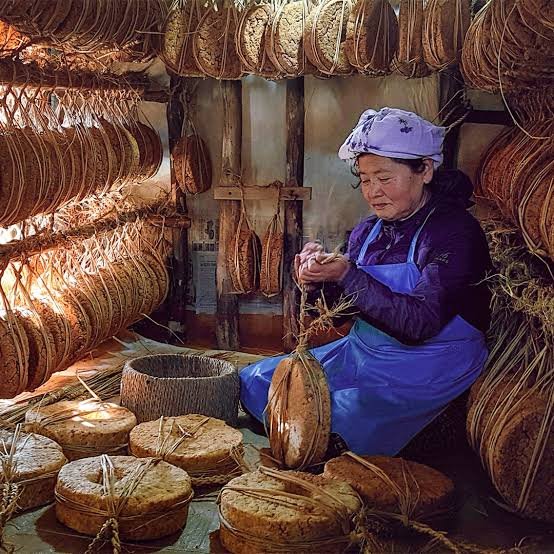
Meju. Korea Tourism Organization New Delhi Office, Facebook
Contrary to modern fermentation, jang damgeugi doesn’t rely on lab cultures or store-bought yeast. Makers tied the fresh blocks of bean paste with dried rice straw and hung them from wooden ceiling beams before stacking them in rooms heated by the ondol (온돌) floor heating system. The rice straw was an essential tool because wild microbes naturally living on the straw moved into the moist blocks, growing visible mold, or beneficial bacteria and wild fungi, on the surface, and breaking down the dense beans inside (Kim et al., 2023). After several weeks in the warm environment, the blocks were moved outside so the surface mold would stop spreading while the inside continued to cure slowly.
The entire process was heavily dependent on onggi (옹기), the traditional earthenware jars made from coarse local clay. Onggi jars were fired with natural ash glazes that left tiny pores throughout the clay walls (Mazur, 2023). These small gaps allowed gas to escape during the fermenting process, while also keeping additional moisture, dust, and other contaminants out.
Jang was made on the jangdokdae (장독대), a stone platform built in the sunniest and windiest portion of the household yard. The raised terrace kept bugs and dampness from the ground away from the jars. The open location allowed the jang to get the most sunlight and wind, which women managed every day by opening the heavy lids on clear mornings and closing them before dusk or rainstorms (BIROSO, 2024).
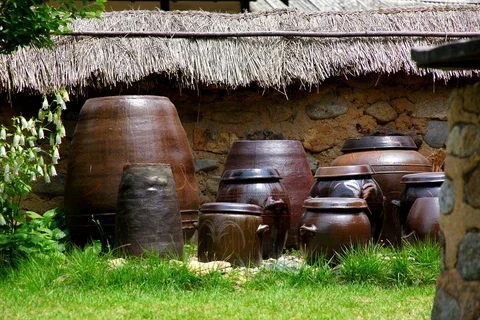
Jangdokdae (장독대). BIROSO
The Seasonal Steps of Production
People usually start the jang damgeugi process in the first lunar month. They chose this time because the cold weather keeps harmful bacteria and flies away from the meju while the salt dissolves. Women scrubbed the dried meju bricks clean to remove dust and the thick layer of outer mold, dried them in the sun, and then arranged them inside clean onggi jars.
It was difficult to get the salt water ratio correct. Since they didn’t have any modern measuring tools or chemical kits, women used simple floating tests to check the salinity. They stirred coarse sea salt into water to create a brine, and dropped a raw egg or a lump of wood charcoal into the mixture. If the egg floats to the top with a coin-sized circle appearing in the water, the brine has enough salt to preserve the beans properly. Once they poured the prepared brine over the meju blocks, they floated dried chili peppers, jujubes, and pieces of hot charcoal on top. These bright red and black items were believed to chase away bad luck and evil spirits. However, they served practical purposes too. Charcoal naturally soaked up bad odors and foreign particles, while spicy chili peppers stopped cloudy films from growing on the surface of the brine (Kim et al., 2023).
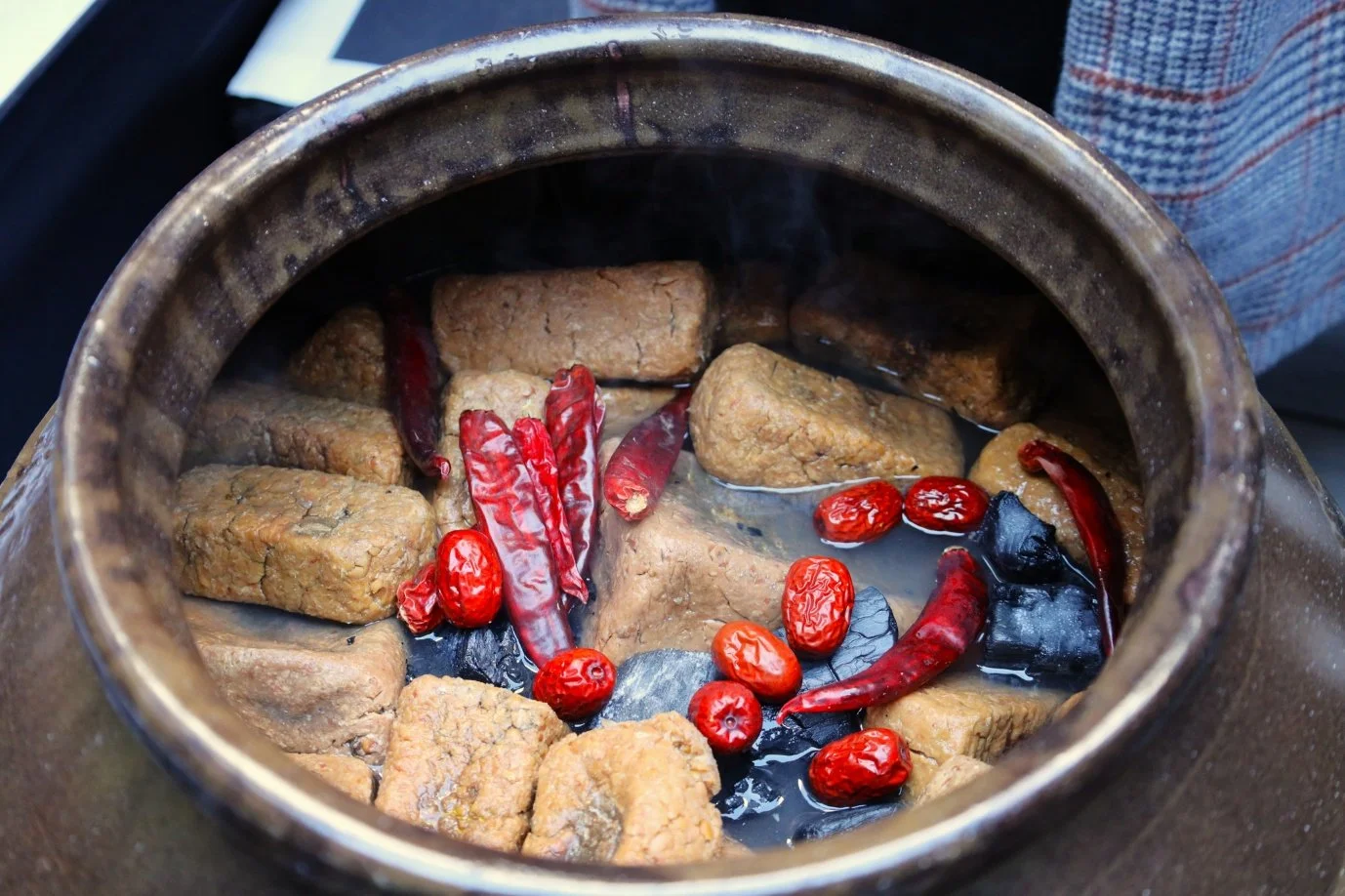
Chili Peppers, Jujube, and Charcoal with the Meju. Korean Cultural Center
After soaking the blocks for 60 days, the process reaches an important stage called jang tteugi (장 뜨기) (Kim et al., 2023). Women pulled the softened bean blocks out, mashed them with extra salt, and packed them into separate onggi jars to age into doenjang. The leftover dark brine was then poured through a cloth strainer and boiled in an iron cauldron to stop it from spoiling. Once cooled, this dark liquid went into its own jar to age into traditional soy sauce, or ganjang (간장).
Written Records in Late Joseon Treatises
During the late Joseon dynasty, scholars in the Practical Learning movement began writing down these everyday home practices in detailed household guides and framing encyclopedias. An example of this is the Chŭngbo Sallim Kyŏngje, written in 1766 by the court doctor Yu Jung-rim. The book organizes daily survival skills into clear practical sections.
In the section titled Chi Seon (치선, 治膳, Culinary Management & Dietetics), which focuses on managing food and dining, the book calls jang the leader of all hundred flavors (Hong & Yu, n.d.). Yu Jung-rim argued that if a household’s jang tasted bad, even the best meat and fresh vegetables could not make a decent meal. The book laid out lucky calendar dates for setting up the jars, exact proportions of beans to water, and tips for fixing batches that started to sour.
Another section, Jap Bang (잡방, 雜方, Household Technologies & Material Craft), gave specific instructions for how to clean, patch, and waterproof the clay onggi jars so that the food wouldn’t leak. The text shows how Korean fermentation evolved over time by including an early recipe for gochujang, called Jo-manchojang-beop (조만초장법). The recipe details how to blend powdered meju with sweet rice paste, ground chili pepper, and aged soy sauce before leaving the mixture to ferment in a clay pot.
This record shows how home cooks took chili peppers, which had only arrived in Korea a couple of centuries earlier from the Americas, and worked them directly into their traditional bean fermenting methods. Instead of replacing their old ways, women used their craft skills to turn an imported crop into an everyday Korean staple (Kim et al., 2023).
Gender, Household Labor, and Village Life
The way people organized jang reflects how Joseon society separated men and women. Neo-Confucian rules split the world into an outside sphere run by men and an inside domestic world run by women. Managing the jangdokdae became one of the clearest signs of a head matriarch's practical skills and standing within the home.
As historian Ro Sang-ho explains in his work on late Joseon culinary writing, domestic recipe books showed the real intellectual and managerial influence that elite women held inside their households (Ro, 2016). Manuals like Lady Bingheogak Yi’s Gyuhap Chongseo (규합총서) reveal how women created their own careful systems for food storage, household hygiene, and family health (정양완, 2023). Because a family relied on these jars for food throughout the whole year, women treated the pots with deep care and respect (정양완, 2023). They washed up before going near the jars, and families tied straw ropes decorated with red peppers and charcoal around the pots to keep bad luck away.
Even though the most senior woman of a house supervised the jars alone, the actual physical labor was impossible for one person to handle. It took a lot of physical power to boil huge pots of beans, pull heavy buckets of water from the village well, stomp massive piles of warm beans, and move heavy earthenware jars. Families and neighbors handled the heavy lifting through pumasi (품앗이), the traditional Korean system of trading farm labor. Women gathered at one home to finish a batch, then moved to the next house to do it all over again. In the royal palace, this work was treated like an official government post, overseen by specialized court ladies called janggo mama (장고마마), who spent their careers tracking the king’s private earthenware reserves (Pettid, 2008).
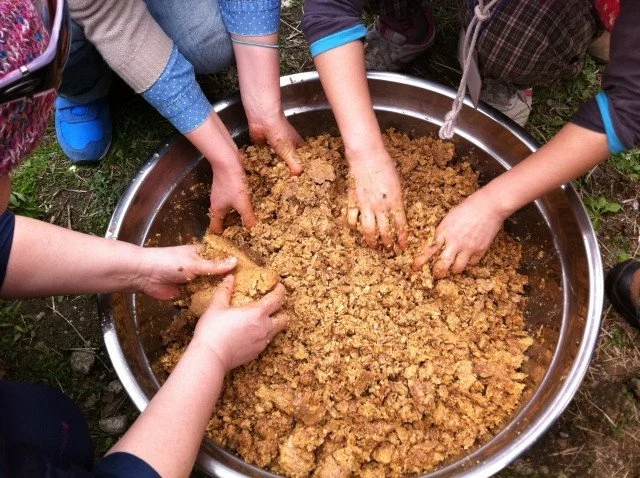
The Community Aspect of Jang Damgeugi. Kukmin Ilbo
Modern Changes, Media, and Heritage
The introduction of high-rise apartments and city growth in the late 20th century made it hard to continue the traditional jang mandeulgi process at home. Modern apartment balconies did not have room for big stone terraces or heavy clay jars. At the same time, factories made soy sauce and store-bought paste produced with fast chemical methods, which replaced the slow, year-long aging process in earthenware pots.
Even with factory food taking over, traditional jang has found new life in modern culture and media. This cultural pride shows up clearly on the Netflix cooking show Culinary Class Wars, where the classic jang trio of doenjang, ganjang, and gochujang appeared in one of the main ingredient rounds. The judges made it clear that fancy modern plating and Western cooking tricks didn’t matter if the chef hid the deep flavors of the fermented base. The episode shows how Koreans still view jang today, not just as a staple ingredient, but as a true testament to whether a chef understands Korean flavor and culinary roots.
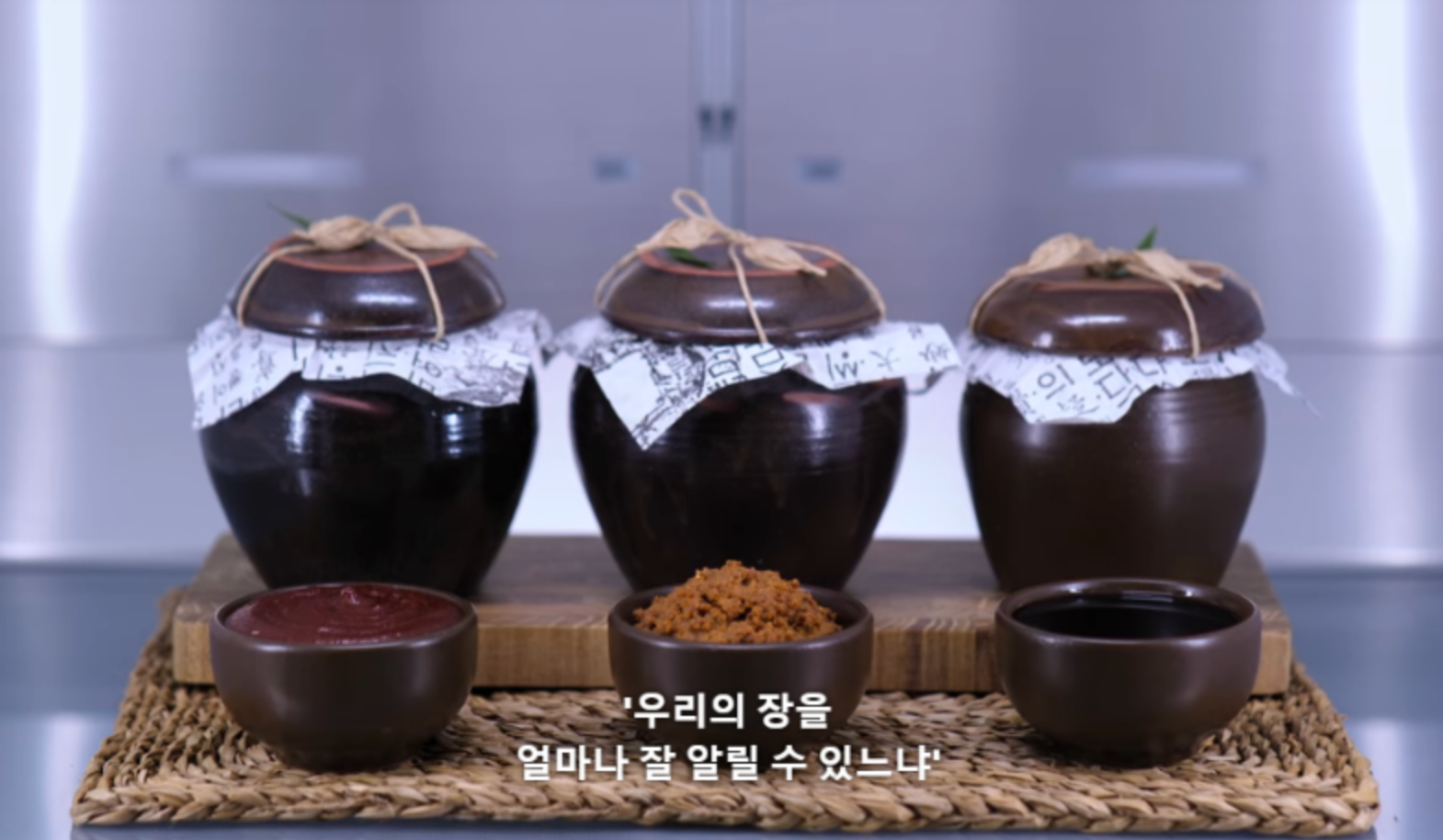
Jang Trio. Culinary Class Wars, Netflix
This portrayal in the media matches the official efforts to save the craft. The South Korean government recognized jang making as a National Intangible Cultural Heritage, and UNESCO placed it on its list of Intangible Cultural Heritage of Humanity (UNESCO, n.d.). Traditional artisans, Buddhist temple cooks, and local community groups continue to make jang the traditional way by hand. What originated as a basic household necessity has evolved into a proud symbol of patience, community work, and living Korean tradition.
The craft of jang damgeugi proves that premodern technology was tied to household survival and social life. It required artisans to understand living organisms, raw earth materials, and seasonal weather patterns without the help of modern scientific instruments. Jang damgeugi turned simple beans into a shared cultural language that continues to define Korean culinary heritage.
Bibliography
Culinary class wars. (2024). Netflix. episode.
Jangdokdae: Preserving Korea’s art of Fermentation. BIROSO. (2024, July 15). https://shop.kpc.global/blogs/%EB%89%B4%EC%8A%A4/jangdokdae-preserving-korea-s-art-of-fermentation#:~:text=%EC%A0%84%EB%B6%81%EC%9D%BC%EB%B3%B4%20In%20common%20households%2C%20this%20area%20is,dates%20back%20thousands%20of%20years%20in%20Korea.
Kim, S., Ko, J., & Kwon, D. Y. (2023). Jang, Korean fermented soybean product, the result of endeavors of Ancients for the best taste of Korean diet. Journal of Ethnic Foods. https://doi.org/https://doi.org/10.1186/s42779-023-00183-6
Knowledge, Beliefs and Practices Related to Jang Making in the Republic of Korea. UNESCO. (n.d.). https://ich.unesco.org/en/RL/knowledge-beliefs-and-practices-related-to-jang-making-in-the-republic-of-korea-01975#:~:text=Knowledge%2C%20beliefs%20and%20practices%20related%20to%20jang,21.COM.%2017%2F06%2F2026%20%2D%2011.GA.%2008%2F12%2F2025%20%2D%2020.COM.
Korea Tourism Organization New Delhi Office. (2023). Facebook. Retrieved from https://www.facebook.com/ktoindia/posts/meju-is-a-type-of-fermented-soybean-block-used-in-korean-cuisine-meju-blocks-are/8939867276085033/.
Mazur, M. (2023, June 16). Ancestral pottery: The artistry of onggi. Onggi. https://onggi.com/blogs/stories/ancestral-pottery-the-artistry-of-onggi?srsltid=AU7gw4WJ-Kb2IUs3GZ8C0UuAk3bzxqqAmFyBJCCxAT3LNhvKjXuT5MPI
Pettid, M. J. (2008). Korean cuisine: An illustrated history (Vol. 46). https://doi.org/10.5860/CHOICE.46-1446
Reinschmidt, M. (2008, December). Review of Korean cuisine: an illustrated history by michael j. pettid (review). Acta Koreana, 11(3), 251–257. Retrieved from https://muse.jhu.edu/article/805046/pdf.
Ro, S. (2016). Cookbooks and female writers in late choså•n Korea. Seoul Journal of Korean Studies, 29(1), 133–157. https://doi.org/https://doi.org/10.1353/seo.2016.0000
Sallim Kyŏngje / [hong man-sŏn ch’an, Yu Chung-Nim Ch’an] (山林 經濟 / [洪 滿選 撰, 柳 重臨 撰]) v.1-3. (n.d.). https://babel.hathitrust.org/cgi/pt?id=wau.39352054763560
Son, S. (2025). Cookbooks and the making of women’s authorship in the 1933. Seoul Journal of Korean Studies, 38(2), 227–256. https://doi.org/https://doi.org/10.1353/seo.2025.a979865
增補山林經濟 | 증보산림경제 | chŭngbo sallim Kyŏngje · Korean rare books at the Claremont Colleges Library · Claremont Colleges Asian Library highlights. Claremont Colleges Asian Library Highlights. (n.d.). https://claremontasianlibrary.omeka.net/exhibits/show/korean-rare-books/revised-encyclopedia-of-agricu
국민일보. (2024, November 5). 장 담그기 문화, 유네스코 인류무형유산 된다. 국민일보. https://www.kmib.co.kr/article/view.asp?arcid=1730787528
문화체육관광부 한국문화원. 문화체육관광부 한국문화원 메인 화면으로 이동. (2025, June 4). https://www.korean-culture.org/kocc/view.do?seq=1051590&page=57&pageSize=10&photoPageSize=6&totalCount=0&searchType=menu0023&searchText=&searchCondition=1&ctrcode=
정양완 (한국정신문화연구원. (2023, December 21). 규합총서. Encyclopedia of Korean Culture. https://encykorea.aks.ac.kr/Article/E0007298
집에서 따라해 보는 흑백요리사 음식’홈메이드 흑백요리왕’: 컴투스온. 컴투스온 | 컴투스 그룹 브랜드 커뮤니케이션 허브. (2025, January 23). https://on.com2us.com/life/jangtrio/
취향의 예술: 장트리오 대결 (최현석,원투쓰리). 네이버 블로그 | 까르페디엠. (n.d.). https://m.blog.naver.com/urjj/223595280578