From Foreign Technology to Japanese Craft: The Manufacturing of Tanegashima Matchlock Firearms
Introduction
In 1543, a Portuguese-style matchlock firearm arrived on the small Japanese island of Tanegashima. At first, the firearm was simply a foreign object. It was unfamiliar, technologically impressive, and difficult to reproduce. Yet within a relatively short period, Japanese craftsmen were producing their own versions of the weapon. The history of the tanegashima is therefore not simply a story about Japan receiving a new weapon from Europe. It is a story about what happened after the object arrived. Japanese craftsmen had to examine the weapon, determine how its components worked, experiment with unfamiliar techniques, and develop the knowledge necessary to reproduce it. In the process, a foreign technology became embedded within Japanese systems of craft production, labor, warfare, and political power.
This transformation is important because receiving a technology and knowing how to make it are two different things. The first matchlocks gave Japanese craftsmen an example, but the example itself did not explain how to manufacture every component. Producing a functioning firearm required specialized knowledge of ironworking, barrel construction, woodworking, screws, and the firing mechanism. It also required knowledge that could not easily be written down: how materials behaved, how much force to apply, and how to recognize when something was wrong. This essay first considers how Japanese craftsmen encountered and learned from the foreign firearm, then examines the many crafts required to produce it, the growth of production communities in Sakai and Kunitomo, and the relationship between firearm manufacturing and political power. Ultimately, the tanegashima demonstrates that technological transfer was not simply the movement of an object from one society to another. It was a process of learning, experimentation, and adaptation through craft.
From Foreign Object to Japanese Technology
The first documented arrival of Portuguese matchlock firearms in Japan occurred in 1543, when a Chinese ship carrying Portuguese traders reached Tanegashima.1 The local lord, Tanegashima Tokitaka, obtained two firearms and had Japanese craftsmen examine them. The timing mattered. The arrival occurred during the Sengoku period, when political authority was divided among competing military leaders, and a new projectile weapon could give an advantage to rulers who were constantly fighting over territory.
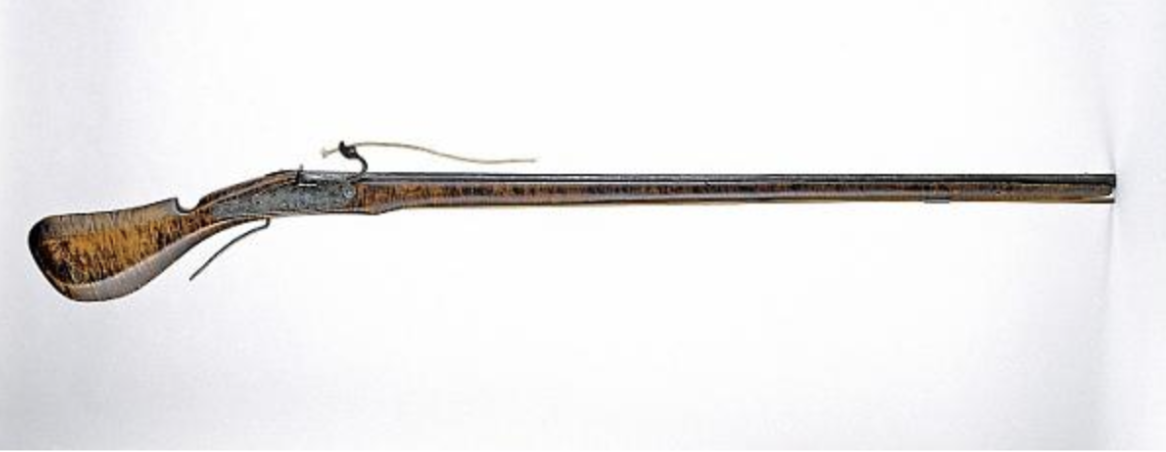
Figure 1. Matchlock Musket, Newtowne (Cambridge), Massachusetts, ca. 1630. Iron and wood, .75 caliber. National Museum of American History, Smithsonian Institution, AF.43435. Source: Smithsonian National Museum of American History.
Figure 1 is useful because it establishes the technological problem facing Japanese craftsmen. The firearm appears to be a single object, but it contains multiple components and manufacturing challenges. The long barrel, wooden stock, and serpentine firing mechanism had to work together as one functioning weapon. Although this example was made in colonial Massachusetts nearly a century after 1543, it preserves the basic matchlock configuration that helps visualize the type of European firearm introduced to Japan in the sixteenth century. The serpentine lock is especially important because it shows that the matchlock was not simply a tube for firing a projectile. It depended on a mechanical lever that lowered a burning match onto the flash pan.2 What appears to be one finished object was actually a collection of technical problems that Japanese craftsmen had to understand individually and then reproduce together.
This made the craftsmen who could reproduce the weapon just as important as the merchants who brought it. Two imported guns could only go so far. If Japanese warriors wanted firearms in significant numbers, they needed Japanese production. The movement of the firearm also shows that technology did not travel in a simple line from Europe to Japan. Kang describes the early modern musket as a global object that moved rapidly through Europe, the Ottoman world, India, Southeast Asia, China, and Japan.3 By the time it reached Tanegashima, the matchlock was already part of a much larger history of technology being changed as it moved. Its arrival therefore began a process rather than completing one.
Learning to Reproduce an Unfamiliar Object
The first Japanese craftsmen faced a difficult problem. They could see what the imported firearm looked like, but seeing an object does not reveal the knowledge required to make it. A craftsman could examine the barrel and lock but still need to determine what kind of metal was used, how it was shaped, how the parts were assembled, and how much variation the weapon could tolerate before it stopped functioning.
This is where the distinction between technical information and craft knowledge becomes important. Jacob Eyferth’s work emphasizes tacit, oral, and practical forms of knowledge. His study of Chinese papermakers shows that artisans learned by observing materials, experimenting, and repeatedly practicing a process rather than simply following a written formula.4 The same concept helps explain the Japanese matchlock. A written description could identify the parts of a firearm, but it could not replace the experience of working iron or fitting a complicated mechanism. In this sense, the imported firearm itself became a teaching object. Craftsmen could examine it, reproduce individual pieces, and compare their versions with the original.
Kang similarly emphasizes that craft knowledge was transmitted through people rather than simply through texts, and he describes this kind of process as “translation” rather than simple technological “transfer.” Transfer suggests that an object moves from one location to another while remaining essentially unchanged. Translation, by contrast, involves creating a new version of something in a different environment.5 The Japanese matchlock provides a useful example. Japanese craftsmen did not simply preserve the Portuguese firearm exactly as they found it. They learned from it and incorporated its principles into their own craft traditions. The speed of this process is particularly striking. Japan Tourism Agency materials explain that Japanese craftsmen reproduced the firearms using the European models and that production soon spread to other parts of Japan.6 This does not mean that they simply copied an object after looking at it. Rather, it shows how existing technical expertise could be redirected toward solving a new manufacturing problem.
A Firearm Required Many Crafts
One reason the tanegashima is useful for thinking about craft is that a single firearm depended on several different forms of specialized knowledge. Japan Tourism Agency materials describe matchlock production as involving different craftsmen: a blacksmith who forged the barrel, a woodworker who carved the stock, and a specialist who made and assembled the lock.7 The finished firearm therefore represented the combination of several crafts rather than the work of one person.
Figure 2. Matchlock Gun, inscribed by Kunitomo Katsumasa, eighteenth century. Japanese, Edo period. Iron, wood, silver, and brass. Metropolitan Museum of Art, object no. 14.100.100. Source: Metropolitan Museum of Art.
Figure 2 makes this combination of crafts visible. The Metropolitan Museum identifies the object as being made from iron, wood, silver, and brass.8 These materials correspond to different forms of specialized labor. The barrel required metalworking, the stock required woodworking, and the lock and fittings required mechanical and metalworking expertise. The use of silver and brass also shows that some firearms incorporated decorative craftsmanship in addition to purely functional construction. The inscription is important as well, because it connects this gun to Kunitomo, one of the major gunmaking centers discussed below. Rather than viewing the tanegashima as one invention, it can be viewed as the meeting point of multiple crafts. Its unity as an object conceals the diversity of knowledge required to make it.
The barrel presented a particularly difficult problem. Japanese blacksmiths already possessed sophisticated knowledge of ironworking through traditions such as swordmaking, but a firearm barrel had different requirements. It needed to be strong and consistent enough to contain the force produced when the gun fired, and it needed a secure breech. Sakai’s history of gunmaking describes the challenge of producing a cylindrical barrel and using screws in the breech, techniques that Japanese craftsmen had to master through repeated trial and error.9 The firing mechanism created another set of problems. Small components had to hold the burning match and lower it into position when the trigger was pulled, and a failure in one small component could make the entire firearm unusable.
From Individual Knowledge to a Production System
The most important transformation was not simply that one Japanese craftsman learned to copy one firearm. The larger change occurred when knowledge became reproducible within communities of craftsmen. Production expanded into places such as Sakai, which already had an established tradition of metalworking, and Kunitomo. The Japan Tourism Agency identifies Kunitomo and Sakai as two of the largest gunmaking centers in Japan and notes that more than 1,000 craftspeople worked at Kunitomo at its peak.10 The ability to make one firearm had become the ability of a community to produce firearms.
As production expanded, labor became increasingly organized. Sakai’s historical materials describe the introduction of a division of labor to make gun production more efficient.11 This is significant because it changes how we understand the word “craft.” Craft does not necessarily mean one artisan completing an object from beginning to end. A craft can also exist as a social network in which different specialists contribute different forms of knowledge. Sakai and Kunitomo were not simply locations where guns happened to be made. They became communities associated with particular forms of expertise, so a surviving Kunitomo or Sakai firearm represents not only an individual craftsman but also a broader culture of production.
The Craftsman, Warfare, and Political Power
Once matchlocks could be produced in large numbers, their consequences extended beyond the workshop. Firearms became increasingly important to Sengoku warfare, but their value was not determined by the technology alone. The ability to manufacture, purchase, distribute, and train soldiers to use firearms made them part of larger systems of military organization. The craftsmen in production centers such as Kunitomo, who supplied powerful military leaders, were therefore participating indirectly in struggles over political authority. Their specialized knowledge gave them an important economic and political position because military leaders depended on reliable access to firearms. At the same time, the growth of gunmaking centers created local economies built around specialized labor, materials, and trade. The tanegashima therefore connected the workshop to the battlefield: the people who made firearms helped shape the military capabilities of the political authorities who acquired them.
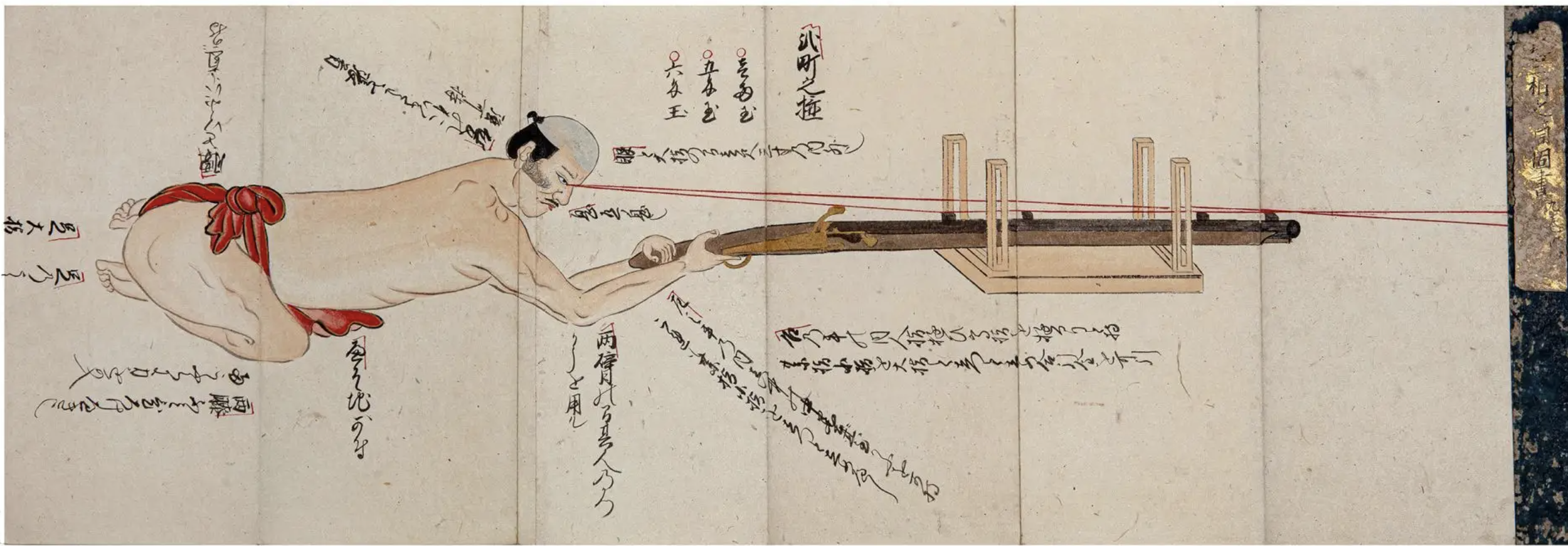
Figure 3. Manuscripts of the Inatomi School of Gunnery and Marksmanship, dated 1660, containing illustrated instructions on matchlock handling, shooting positions, accuracy, ammunition, and gunpowder. Source: Jonathan A. Hill, “Eleven Manuscript Orihon Volumes Relating to Matchlock Muskets & Marksmanship,” item 10734.
Figure 3 shows that the biography of the tanegashima continued beyond the workshop. The Inatomi manuscripts include instructions on how to hold a musket, methods for judging accuracy, different bullet sizes, gunpowder recipes, and techniques for shooting in different weather conditions.12 By 1660, firearm knowledge had become specialized enough to be organized and taught through a formal school of gunnery. This expands the definition of technical knowledge. Manufacturing a firearm required knowledge of materials and mechanisms, but using one effectively required another body of specialized knowledge. While Figures 1 and 2 focus on the physical firearm, Figure 3 shows the larger knowledge system around it, including maintenance, marksmanship, ammunition, and training. The technology was not complete when the firearm left the workshop. It became meaningful through the people who learned how to use and teach it.
This also changed the relationship between craftsmen and the state. During the Tokugawa period, firearm production became more closely regulated, and Galindo García shows that these restrictions shaped the size and organization of gunsmith communities.13 Craft knowledge was therefore not politically neutral. Once rulers recognized the military importance of firearms, the people who could make them became important as well. Craftsmen were valuable because they possessed knowledge that rulers needed, and rulers attempted to regulate that knowledge for the same reason.
Adapting Technology to Japanese Conditions
The tanegashima ultimately reveals that technological change is not simply about copying an invention. Swordsmiths and other metalworkers brought existing skills into firearm production, while new problems forced them to develop additional techniques. The resulting Japanese matchlock was therefore both foreign and local. Kang describes the Japanese teppō as a distinctive form of snap matchlock with a double-leaf spring, brass lock, and screwed breech plug.14 These characteristics show that the Japanese firearm became a specific technological form rather than remaining an unchanged Portuguese import.
The same process continued as production spread across Japan. Matchlocks made in different regions could vary in barrel design, caliber, stock shape, and firing mechanism, which shows that there was never just one Japanese matchlock. Local communities adapted the technology according to their own materials, expertise, customers, and military needs. This regional variation demonstrates that Japanese craftsmen were not merely preserving an imported design; they were making technological decisions based on the conditions of the communities in which they worked.
Conclusion
The history of the tanegashima demonstrates that technological change does not happen when an object simply arrives in a new place. The Portuguese matchlock entered Japan as a foreign technology, but its arrival was only the beginning. Japanese craftsmen had to learn how the firearm worked, experiment with unfamiliar techniques, combine existing skills with new knowledge, and transmit what they learned to other craftsmen. The figures in this essay trace that process, moving from the foreign model in Figure 1, to the combination of materials and crafts in the Kunitomo gun in Figure 2, and finally to the organized systems of training in Figure 3.
The production of the tanegashima also reveals how closely craft was connected to society. Making one firearm required knowledge of metalworking, woodworking, mechanical systems, and assembly. Producing firearms at a larger scale required something even more extensive: communities of specialists, systems of training, division of labor, and relationships with merchants and political authorities. As Kang’s framework suggests, technological movement is better understood as transformation than duplication.15 The firearm that arrived in Japan was not the same object that emerged from Japanese workshops. It was observed, experimented with, translated, adapted, and reproduced. The tanegashima began as a foreign object, but it became a Japanese craft. Its biography is ultimately the biography of the people who learned to make it.
Endnotes
Metropolitan Museum of Art, “Japan, 1400–1600 A.D.,” Heilbrunn Timeline of Art History.
National Museum of American History, Smithsonian Institution, “Matchlock Musket,” Newtowne (Cambridge), Massachusetts, ca. 1630, object no. AF.43435.
Hyeok Hweon Kang, “The Korean Snap Matchlock: A Global Microhistory,” American Society of Arms Collectors Bulletin (2022).
Jacob Eyferth, “Craft Knowledge at the Interface of Written and Oral Cultures,” East Asian Science, Technology and Society: An International Journal 4, no. 2 (2010): 185–205.
Hyeok Hweon Kang, Crafting Knowledge: Artisan, Officer, and the Culture of Making in Late Chosŏn Korea, 1592–1910 (PhD diss., Harvard University, 2020), 30–32.
Japan Tourism Agency, “Lock, Stock, and Barrel: Making a Matchlock Musket,” Ministry of Land, Infrastructure, Transport and Tourism, Japan.
Japan Tourism Agency, “Lock, Stock, and Barrel.”
Metropolitan Museum of Art, “Matchlock Gun,” inscribed by Kunitomo Katsumasa, eighteenth century, object no. 14.100.100.
Sakai Film Office, “Sakai – The City of Traditional Crafts,” Sakai City.
Japan Tourism Agency, “Gun Manufacturing Around Japan,” Ministry of Land, Infrastructure, Transport and Tourism, Japan.
Sakai Film Office, “Sakai – The City of Traditional Crafts.”
Jonathan A. Hill, “Eleven Manuscript Orihon Volumes Relating to Matchlock Muskets & Marksmanship,” Inatomi School of Gunnery and Marksmanship, item 10734.
Arturo Galindo García, “Tools and Regalia: A Short Survey of the Presence of Firearms in Edo Japan,” International Journal of Asian Studies (2026).
Hyeok Hweon Kang, “The Korean Snap Matchlock,” 5.
Hyeok Hweon Kang, Crafting Knowledge, 30–32.
Bibliography
Eyferth, Jacob. “Craft Knowledge at the Interface of Written and Oral Cultures.” East Asian Science, Technology and Society: An International Journal 4, no. 2 (2010): 185–205.
Galindo García, Arturo. “Tools and Regalia: A Short Survey of the Presence of Firearms in Edo Japan.” International Journal of Asian Studies (2026). DOI: 10.1017/S1479591426100667.
Hill, Jonathan A. “Eleven Manuscript Orihon Volumes Relating to Matchlock Muskets & Marksmanship.” Inatomi School of Gunnery and Marksmanship, item 10734.
Japan Tourism Agency. “Gun Manufacturing Around Japan.” Ministry of Land, Infrastructure, Transport and Tourism, Japan.
Japan Tourism Agency. “Lock, Stock, and Barrel: Making a Matchlock Musket.” Ministry of Land, Infrastructure, Transport and Tourism, Japan.
Kang, Hyeok Hweon. Crafting Knowledge: Artisan, Officer, and the Culture of Making in Late Chosŏn Korea, 1592–1910. PhD diss., Harvard University, 2020.
Kang, Hyeok Hweon. “The Korean Snap Matchlock: A Global Microhistory.” American Society of Arms Collectors Bulletin (2022).
Metropolitan Museum of Art. “Japan, 1400–1600 A.D.” Heilbrunn Timeline of Art History.
Metropolitan Museum of Art. “Matchlock Gun.” Inscribed by Kunitomo Katsumasa. Eighteenth century. Object no. 14.100.100.
National Museum of American History. “Matchlock Musket.” Newtowne (Cambridge), Massachusetts, ca. 1630. Smithsonian Institution. Object no. AF.43435.
Sakai Film Office. “Sakai – The City of Traditional Crafts.” Sakai City.
