Praised, Not Paid: Women’s Silk Labor in Song China
Introduction
On a spring afternoon, the story goes, Leizu, consort of the legendary Yellow Emperor (Huangdi), was drinking tea beneath a mulberry tree when a silkworm cocoon dropped into her cup. Enchanted, she watched as the heat unravelled the cocoon into soft silk threads. She persuaded her husband to give her a grove of mulberry trees, learned to rear silkworms, and invented the silk reel and the loom. This charming account is a modern story with little historical evidence behind it, but the figure of Leizu endures as a deity of sericulture, representing women’s productive labor as the origin of silk. By the Song Dynasty (960-1279), silk was central to society, clothing the elite and filling government storehouses. Women raised the worms, reeled the thread, and wove the cloth within the household, yet these duties were honored as virtue rather than recognized as work. Although Song sources such as the Confucian ideal “men till, women weave” (nan geng nu zhi) and Lou Shou’s Gengzhi tu (Pictures of Tilling and Weaving) celebrate women’s weaving, the terms of that praise recast economic labor as moral duty. This essay aims to examine the craft and its workplace, the ideology and imagery that celebrated it, and the fiscal reality beneath them.
Silk Production and Its Workplace
Silk production began with the mulberry tree. Households grew mulberry for its leaves, which were the only foods silkworms would eat. Mulberry leaves were picked (Figure 1) and placed on bamboo trays (Figure 2) where the silkworms would be raised. After gathering the leaves, silkworms were placed together with the mulberry leaves (Figure 3). Work usually began in the spring, when the silkworm eggs hatched. For roughly a month, the worms had to be fed leaves again and again, day and night, as they grew and molted before spinning their cocoons. Qin Guan’s Can shu (Treatise on Sericulture) shows how closely Song writers attended to this stage, describing in detail how to manage the worms' feeding, temperature, and cleanliness. Once the cocoons were ready, they were weighed and sorted, then killed with heat to keep the moth from breaking the thread (Figure 4). The cocoons were softened by the hot water and the continuous filament was drawn off and wound into a reel. Several filaments were combined to make a single strand. The thread was then spooled (Figure 5) and twisted to give it strength and finally, and woven on a loom into silk (Figure 6).
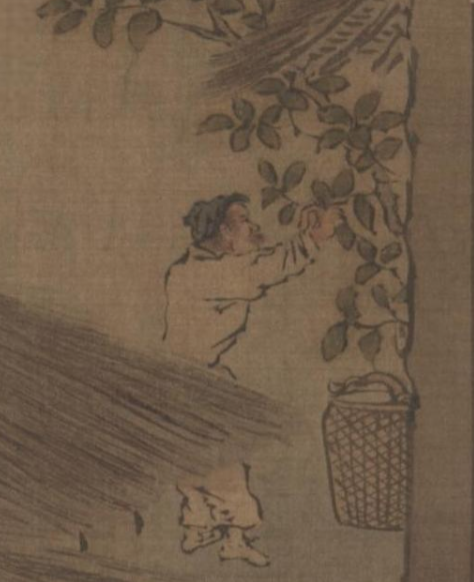
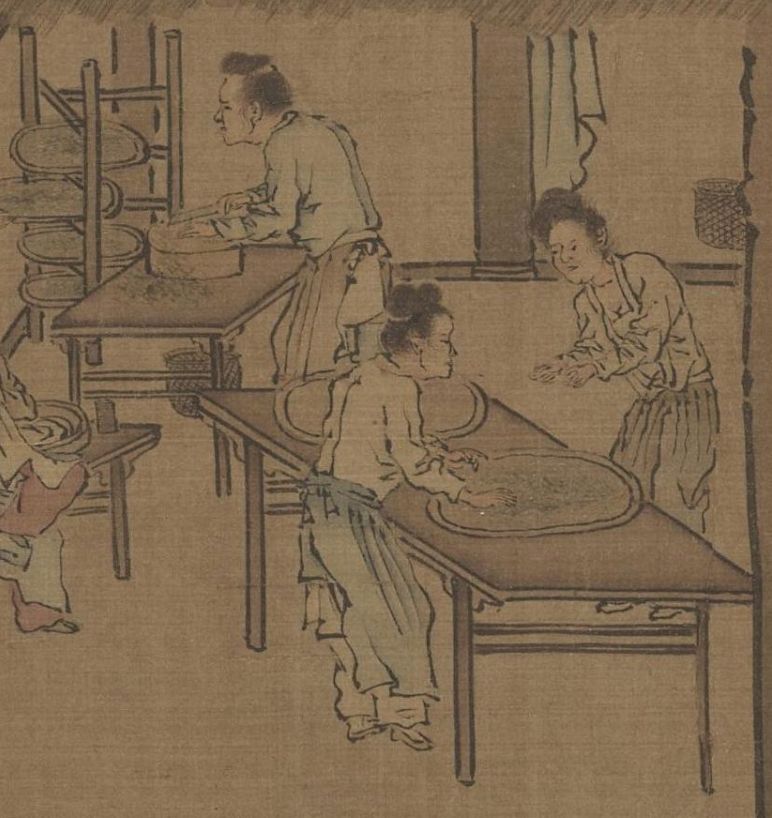
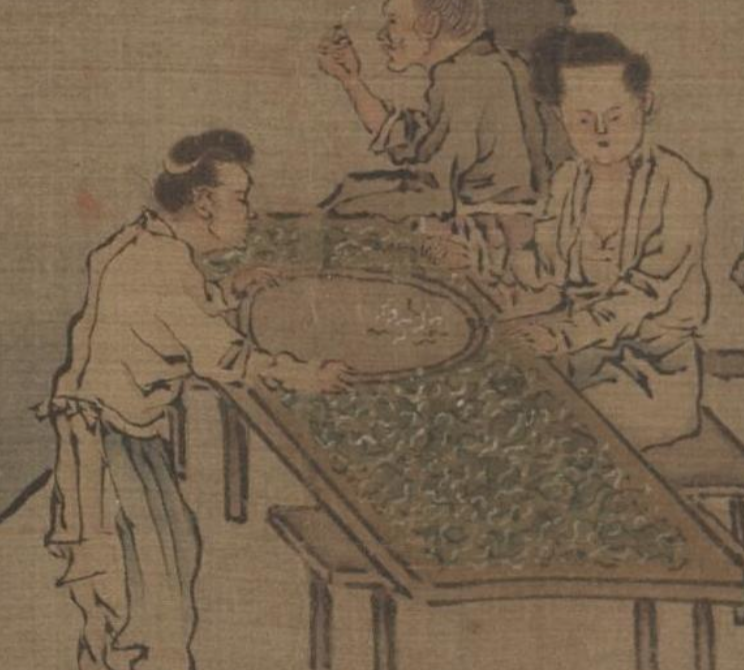
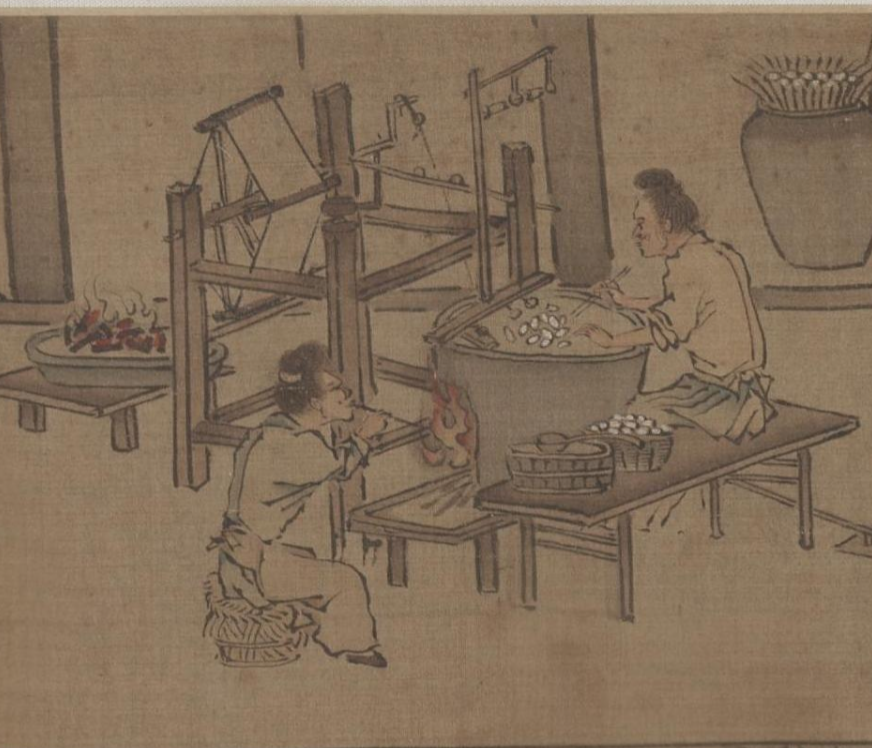
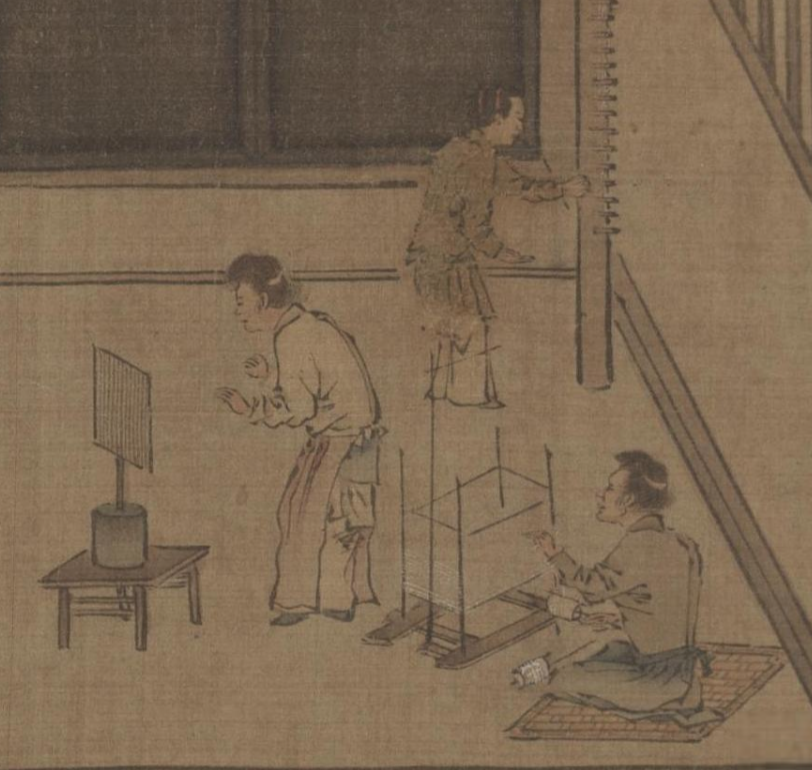
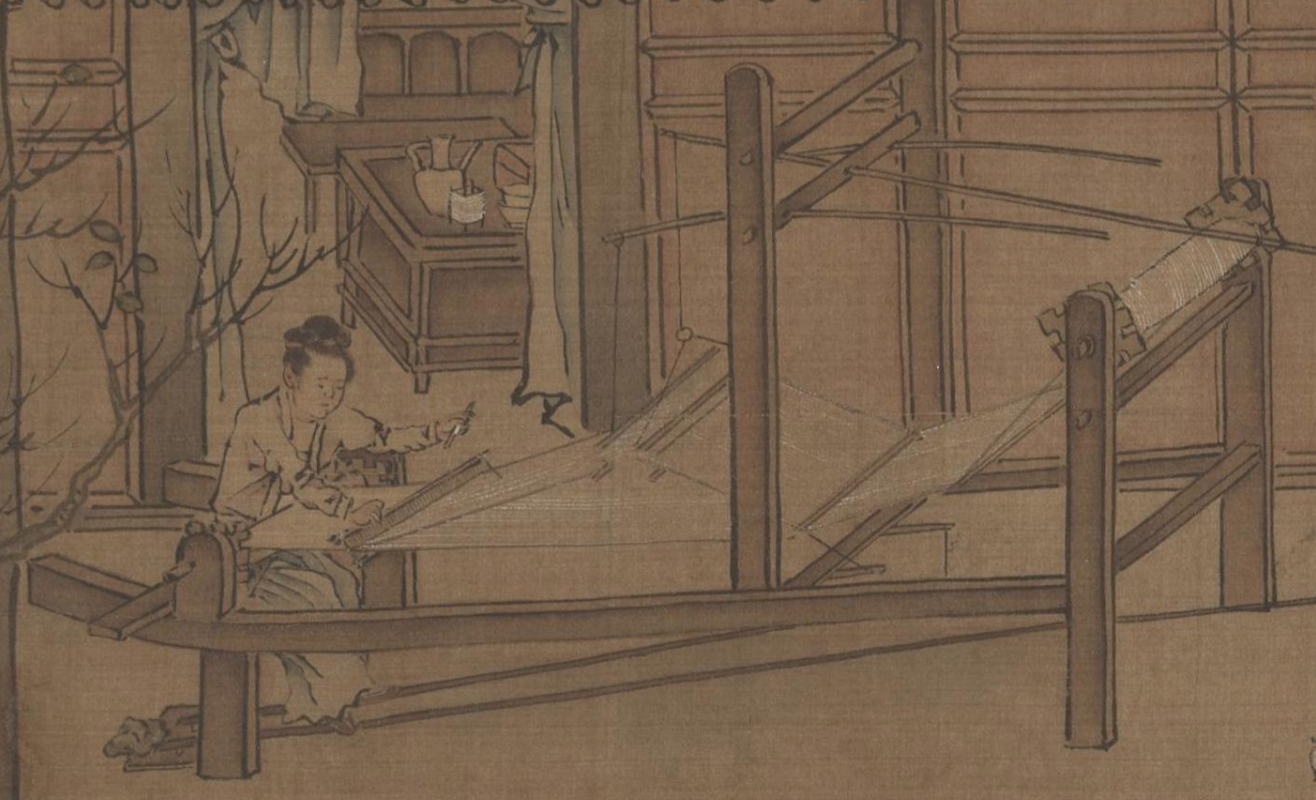
Most of this work took place inside the home. The Song taxation system required all peasants to produce grain, yarn, and textiles for tax. Because each step from raising the worms to weaving the silk required careful maintenance and skill, the season took over women’s time, and the household became the workshop. Mothers, wives, and daughters worked side by side, with older women passing on skill to younger ones, and the family itself functioned as the unit of production. In peasant families, there was no separate workplace or wage, only a household that organized its labor around the needs of the worm. Because the work was embedded in family life, it could easily be seen as an extension of a woman's domestic duties rather than as production with its own economic value.
Genzhi Tu (Pictures of Tilling and Weaving)
The images in the previous section come from a handscroll titled Sericulture (耕織圖), attributed to Liang Kai (Figure 7), which reimagines the Gengzhi tu (Pictures of Tilling and Weaving). Lou Shou, a scholar-official, originally produced the Gengzhi tu around 1145, pairing each scene of rice farming and silk production with a poem. Made by a male official for an imperial audience, it was less a record of rural life than a statement of what the state wished to see. Because Lou Shou's original is lost, the scroll reflects how later painters reimagined his design.

Figure 7: Sericulture (The Process of Making Silk) (耕織圖), early 1200s. Attributed to Liang Kai (Chinese, mid-1100s–early 1200s). Handscroll; ink and color on silk; first section: 26.7 x 98.6 cm (10 1/2 x 38 13/16 in.); second section: 27.6 x 92.3 cm (10 7/8 x 36 5/16 in.); third section: 27.6 x 92.3 cm (10 7/8 x 36 5/16 in.). The Cleveland Museum of Art, John L. Severance Collection, 1977.
This handscroll (Figure 7) follows the entire process of sericulture from picking the mulberry leaves to weaving silk, within a single household compound. In one scene (Figure 8), men and women work side by side. In one room, men prepare the twig frames on which the silkworms will spin their cocoons. These figures appear to be based on their prominent facial hair and lack of visible cleavage which can be seen in the female figures in the same position. Under the other roof, women are placing silkworms onto trays with mulberry leaves. The division of labor seems to echo "men till, women weave" (nan geng nü zhi): men handle heavy, standing tasks, while women do the seated, close work of feeding, reeling, and weaving. Every figure is absorbed in a task, the postures are calm, and the stages of craft flow smoothly from room to room. It also idealizes the workspace by leaving out worldly concerns like the fatigue, tax collectors, and debt. The spacious halls and gardens suggest a comfortable household, not the strained households of the peasants. The image presents women's silk work as a quiet virtue within a harmonious family, rather than as a burden on which the state depended.
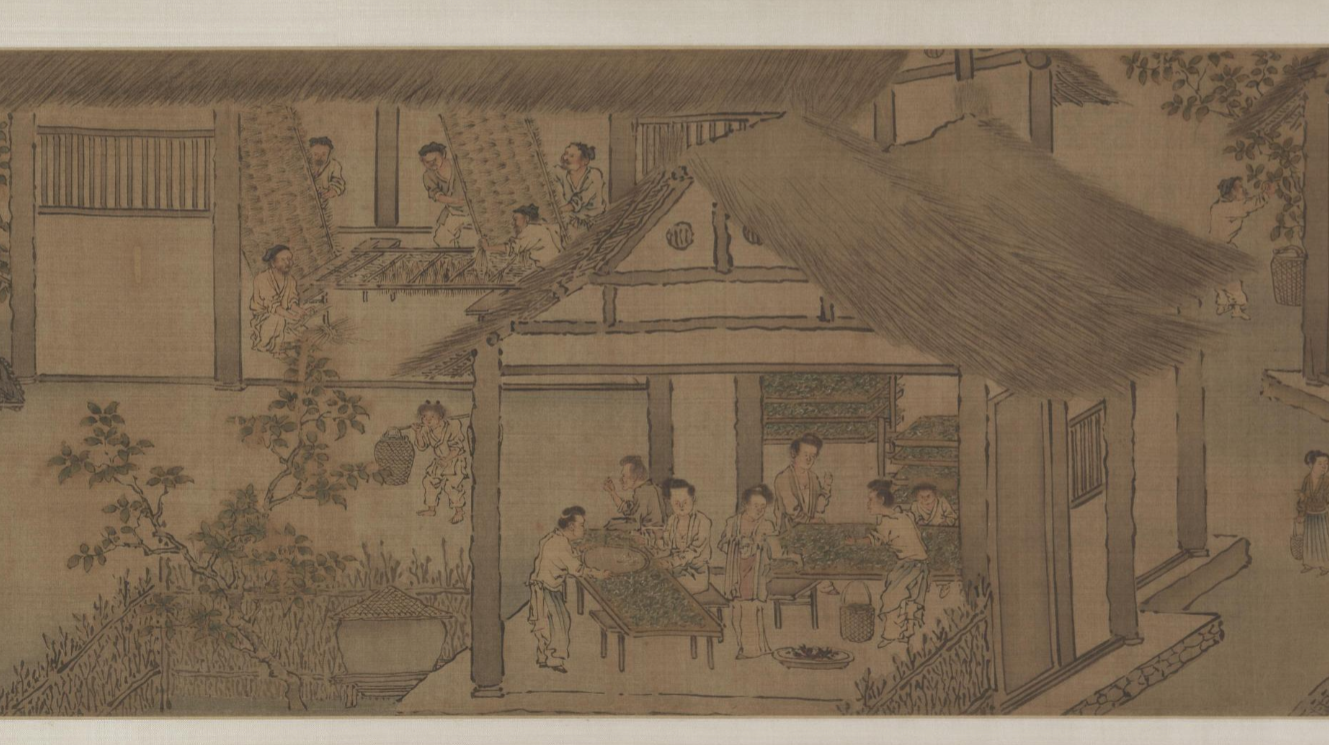
Figure 8: Scene from Sericulture (The Process of Making Silk) (耕織圖), early 1200s. Attributed to Liang Kai
Confucianism: Weaving as Virtue and Service
The ideal that "men till, women weave" (nan geng nü zhi) grew from the Confucian division of life into inner (nei) and outer (wai) spheres, domesticity for women and officialdom for men. The classics mark this division from birth. In the Book of Songs (Shijing) a newborn boy is dressed in robes and given scepters to play with, while a girl is wrapped in swaddling and given weaving tiles. In the Book of Rites (Liji), a bow is hung by the door for a boy and a handkerchief for a girl, signaling archery as a scholar's art and weaving and embroidery as women's work in the "four womanly virtues" (side). By age seven, children no longer sat or ate together, and by ten their education diverged: boys went out to seek teachers, while girls trained at home to become agreeable, compliant wives (Liji, "Neize").
Contrary to popular belief, Confucian thought did not treat this domestic role as lowly. In fact, the ideal ruler was called "the father and mother of the people" and the Liji marriage rite required the groom to serve as his bride's attendant, expressing the respect a husband owed his wife. Weaving belonged to this dignified moral world. Spinning and weaving produced "not only objects of value but also persons of virtue," teaching diligence, frugality, order, and self-discipline. Girls of gentle birth began around age eight or nine, when their brothers began to read and train in arms.
This respect is what makes the ideology effective. Weaving was honored, but as character rather than as production. Bray notes that long after elite households brought cloth on the open market, patriarchs still urged their daughters to spin and weave frugality and respect for the work of their inferiors. The moral value of weaving outlasted its economic necessity, and images like the Gengzhi tu pictured it as a harmonious household virtue. Praise of this kind made women's textile work a duty owed to family and social order.
The Reality of Labor and Taxes
Beneath this image of virtue lay a fiscal system that partly depended on household cloth. The Song state shifted from the Rent-Service-Tribute (Zu-Yong-Diao) system to the twice-taxation system (Liangshuifa) , levying a summer and autumn tax. collected much of its summer tax in silk and cloth, with grain coming in the autumn It also acquired silk through "harmonious purchase" (he mai), in which officials advanced payment for cloth that households later delivered. Because the work was embedded in the household, it counted as family duty rather than wage labor, so its value to the state was essential but largely uncounted. Women were not entirely without income: some worked in state workshops, and others sold surplus silk. These exceptions confirm the pattern, since the ideal still framed women's work as virtue.
Conclusion
Silk in Song China was made by women within the household, a seasonal rhythm of raising worms, reeling thread, and weaving cloth. Confucian thought honored this work as diligence, frugality, and virtue, and the Gengzhi tu pictured it as calm, harmonious family labor. Yet the state relied on that same labor for cloth and revenue, and the picture left out the pressure households faced. Praise did not erase women's work, but it changed how that work was understood. When labor is called virtue, its economic value becomes easy to overlook, and an essential burden can pass as natural duty.
Bibliography
Bray, Francesca. “Textile Production and Gender Roles in China, 1000-1700.” Chinese Science, no. 12, 1995, pp. 115–37. JSTOR, www.jstor.org/stable/43290487. Accessed 19 Oct. 2026.
Hammers, Roslyn Lee. Pictures of Tilling and Weaving: Art, Labor and Technology in Song and Yuan China. Hong Kong University Pres, 2011.
Kuhn, Dieter. “Tracing a Chinese Legend : In Search of the Identity of the ‘First Sericulturalist.’” T’oung Pao, vol. 70, no. 4, 1984, pp. 213–45, https://doi.org/10.1163/156853284x00099.
“Leizu.” Wikipedia, 3 Feb. 2022, en.wikipedia.org/wiki/Leizu. Accessed 19 Oct. 2026.
Mau Chuan-hui 毛傳慧. “A Preliminary Study of the Changes in Textile Production Under the Influence of Eurasian Exchanges During the Song-Yuan Period.” 2012, ostasien-verlag.de/zeitschriften/crossroads/cr/pdf/CR_06_2012_145-204_Mau.pdf. Accessed 19 Oct. 2026.
Rosenlee, Li-Hsiang. “Gender in Confucian Philosophy.” Stanford Encyclopedia of Philosophy, edited by Edward N. Zalta and Uri Nodelman, Metaphysics Research Lab, Stanford University, 27 Feb. 2023, plato.stanford.edu/entries/confucian-gender/. Accessed 19 Oct. 2026.
“Sericulture (the Process of Making Silk) | Cleveland Museum of Art.” Clevelandart.Org, 2025, www.clevelandart.org/art/1977.5. Accessed 20 Oct. 2026.
“The Song Dynasty in China | Asia for Educators.” Afe.Easia.Columbia.Edu, afe.easia.columbia.edu/songdynasty-module/econ-rev-silk.html. Accessed 19 Oct. 2026.
Theobald, Ulrich. “Liangshuifa 兩稅法 (Www.Chinaknowledge.De).” Www.Chinaknowledge.De, www.chinaknowledge.de/History/Terms/liangshuifa.html. Accessed 19 Oct. 2026.
