From Jiancha To Sencha: The Roots of Chinese (and Japanese) Loose-leaf Tea Making and Pottery
Introduction
“People no longer use powdered tea from Jiangxi. Now, loose-leaf tea is preferred everywhere” -Ye Ziqi, (“Ming Dynasty Yixing History”).
Ye Ziqi was a Chinese scholar that lived throughout the transition between the Yuan and Ming dynasty. This quote from Ming Dynasty Notes of Ye Ziqi encapsulates the radical change of Chinese tea craft during this transition of dynasties. Yet, why was this such a profound change and what were the everlasting impacts of this change? Rebounding from the period of Mongolian reign led by Kublai Khan, the first Ming emperor, the Hongwu emperor, seeks to disinfluence China from Mongol culture through a state-monopolized system (Rossabi 138). In this way, he de-influenced culture and crafts from Mongol culture while promoting Chinese-centered culture and crafts. This led to many rapid changes in all parts of life, e.g. the linkage between the waning influence of cheese in this era being linked to the change in ruling from Mongol to Chinese. One way Emperor Hongwu did this was through regulating the form in which tea was produced, crafted, and drunk. This decision brought about a new way of drinking, respecting, and crafting tea, forming the tea Sancha/Jiancha (煎茶), which in English is known as loose-leaf tea (or in Japanese, sencha 煎茶). This essay digs deeper into how Ming dynasty tea making and pottery played a significant role in developing both Chinese and Japanese tea culture we know today.
Historical Background of Tea in China
The Yuan Dynasty (1271–1368) led by the Mongols preceded the Ming dynasty (1368-1644). This dynasty marked the height of Mongol influence throughout not only China but almost all areas of Asia (excluding Japan). At this point in time, much of life in China was influenced by the Mongols. For example, drinking powdered tea and offering it as tribute tea (gong cha 贡茶) was the widespread way and culture of tea in the Yuan dynasty and before (Jiang, 2). While powder based teas were present in past dynasties before the Yuan dynasty, the Hongwu Emperor issued decrees that inhibited the trade of powdered tea while increasing the accessibility and demand for loose-leaf tea (Jiang, 2). One way he did this was banning the offering of powdered tea to him as tribute tea (“Tea Pu”). This decree, although taking over 100 years to see its full effect, shifted popularity and common tea culture from powdered tea to loose-leaf tea by the 15th century (Jiang, 2).
Ming Dynasty Chinese Tea Culture: the Yixing Teapot
From the efforts of the Hongwu emperor, a new tea culture was made that came with new crafts of both making tea and creating pottery designed for loose-leaf tea. One example of this can be seen through the clay teapot displayed below:
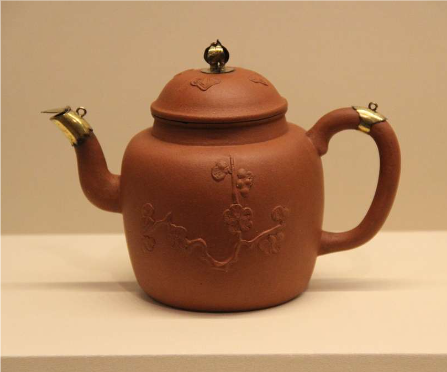
Yixing Teapot, zisha clay, 1627 (Priestley).
This teapot is an example of a Yixing teapot, which gets its name from the area in which its materials are found and then crafted. Yixing is a city in mid-eastern China that has an abundance of zisha clay, the high quality clay used to make this craft (Priestley). Three different types of zisha clay can be used (purple, red, and green clay). Purple clay was primarily used to make these pots due to its higher iron content (Priestley). Higher iron content was integral to the characteristics of zisha teapots, which were molded and fired without glaze– a profound difference from how porcelain pottery was created at this time. Because of this, the high iron content from the clay is able to also seep into the tea during the seeping process providing a unique flavor accent that changes over the amount of times the pot is used (Priestley).
Thinking of how loose-leaf tea tends to be lighter than powder tea, the incorporation of the flavor brought from the material of the pot highlights the clearly detailed thought process that must have come with creating this craft. This teapot was deliberately crafted for the steeping of light, loose-leaf teas, as strong, powdered teas would overpower the nuance that the pot itself incorporates into the flavor profile. Many trials and errors must have gone into finding this method of enhancing the flavor of loose-leaf teas through not only based on the tea leaf and quality.
From appearances, it is viable to assume that these pots would be put under fire for water to be warmed and thus tea to be put in. Yet, instead, the process of making loose-leaf tea first calls for warming the outside of the pot with warm water, then adding leaves and hot water inside the tea to steep (Priestley). Outside of providing a teapot that is crafted for loose-leaf tea making, this process itself may have been a new form of making loose-leaf tea that differentiated from similar tea processes prior to the Ming period. The teapot pictured above also features metal accents, which are not often found on other teapots coming from the same craft, indicating that this may have been a prototype containing these metal accents that did not receive traction in the craft. Instead, this inclusion could have been intended for decorative display in addition to the adding of a lovely flower branch and flowers molded onto the side and cap of the teapot. From its material, usage, and origin of its craft, the Jixing teapot encompasses a tea craft that China can fully claim its own.
Two Porcelain Tea Cups: Chinese Tea Making’s Influence in Japan
The following two tea cups piqued my interest in displaying how the Hongwu emperor’s changes to tea making China also had an influence on Japanese tea making culture. For context, the same description provided by the Metropolitan Museum of Art helps us understand the origin and intent of use for both of these cups:
“Cups like this one reflect the seventeenth-century Japanese taste for Chinese porcelain. They also reflect a change in Japanese tea culture brought about by Ōbaku monks from China, who arrived with a new form of tea that was popular on the continent. Unlike traditional powdered tea, whisked in deep bowls, the new tea (called sencha in Japan) was brewed by steeping whole, unfermented leaves in pots and served in small cups. In size, form, and aesthetic, this cup would have been perfectly suited to Japanese sencha practice (“Cup with Horses”) and ( “Cup With Characters for Longevity (shou)”).”
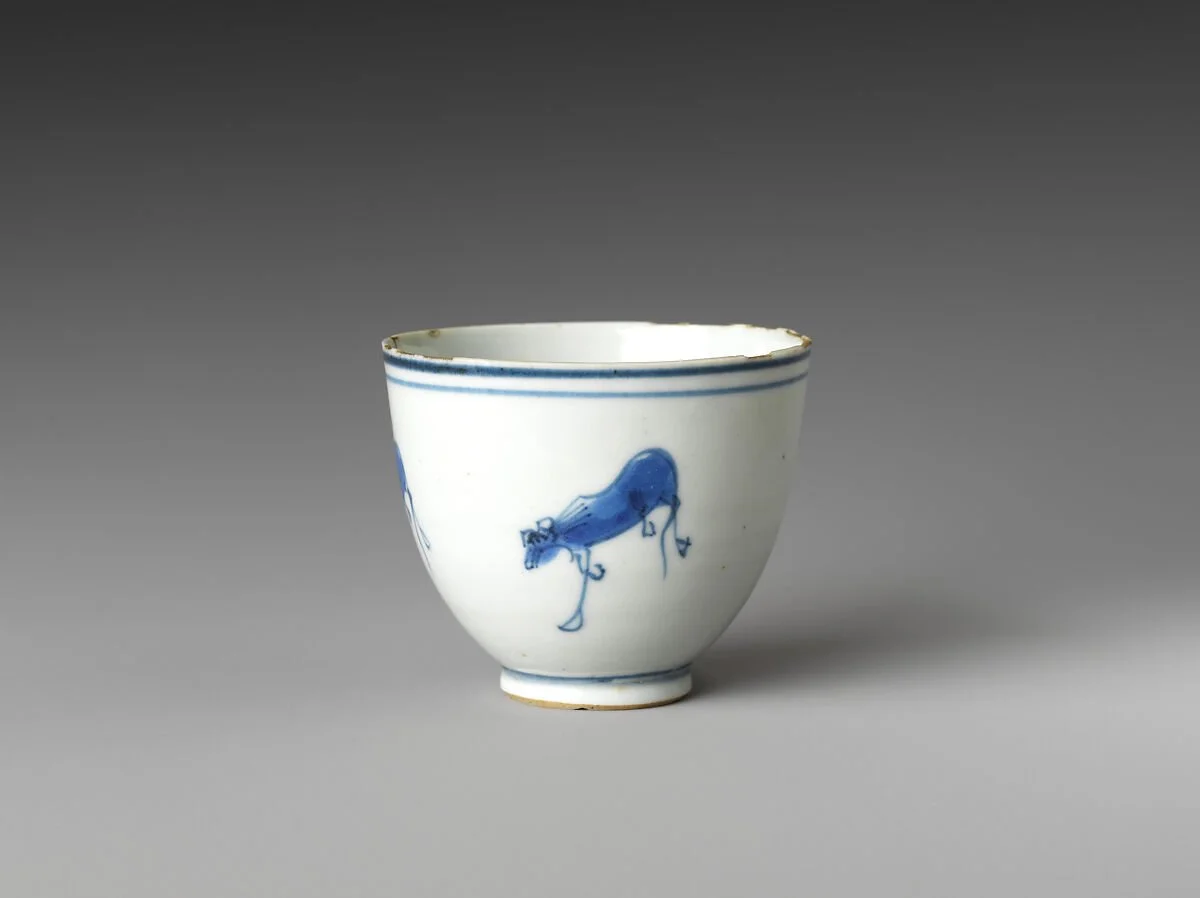
Cup with horses, porcelain painted in underglaze cobalt blue (Jingdezhen ware), circa early 17th century (“Cup with Horses”).
Cups like the two displayed were brought to Japan by Obaku monks in the 17th century, which was the first introduction of Chinese sancha to Japan. By this time, the prevalence of powdered tea craft had already become widespread in Japan. However, since its introduction, the practice of loose-leaf tea craft has also become widespread, as seen from the types of tea prevalent in Japan today. Ingen Ryuki (1592-1673), a Chinese monk, was the first to bring loose-leaf tea to Japan in 1654 (“Spiritual Roots of Japanese Tea”). This later develops into the Japanese style of tea “sencha (煎茶)” that is widely drank around the world and throughout Asia today. This sharing of knowledge resulted in the demand for loose-leaf teas in Japan. I assess that as this form of tea craft was popularized, pottery crafts such as porcelain that came with tea making also gained demand, and were thus also brought over with the tea.
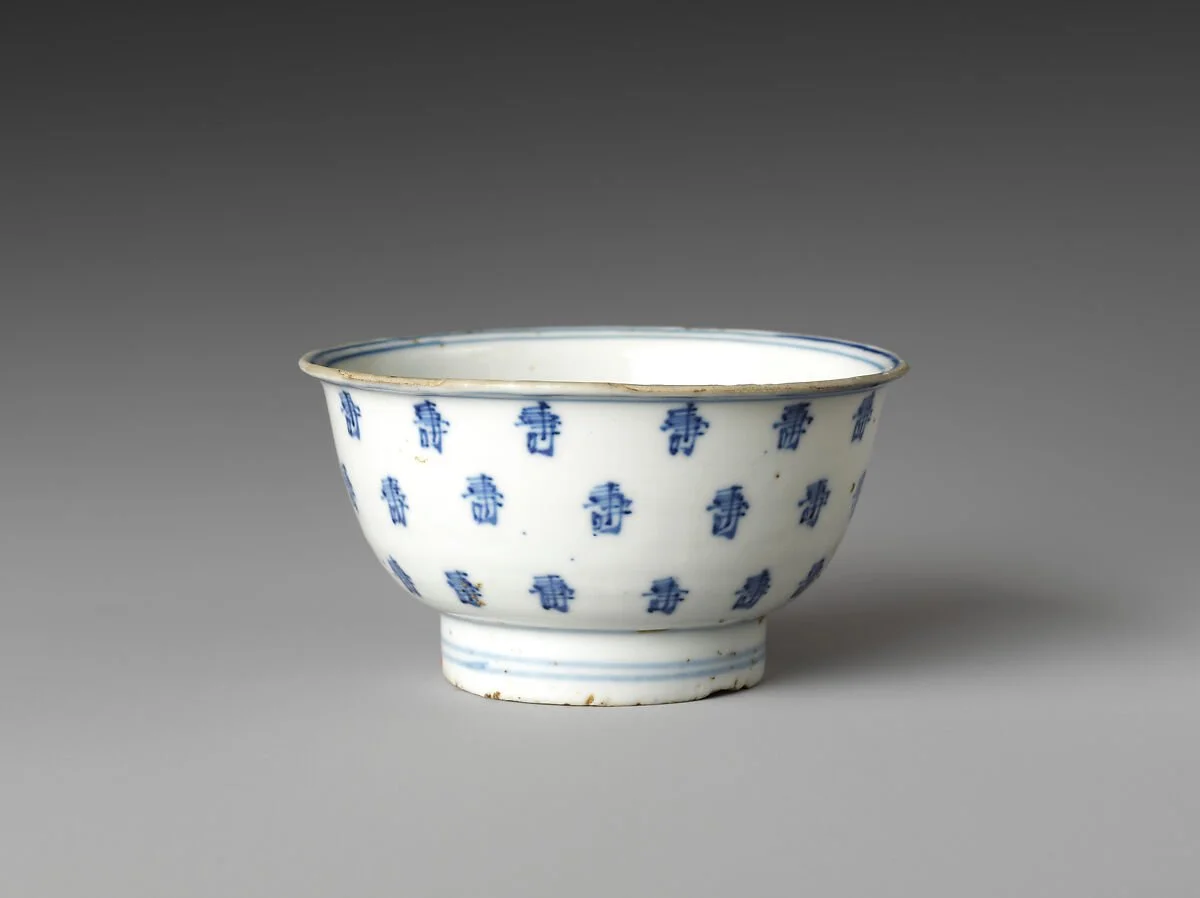
Cup with characters for longevity (shou), porcelain painted in underglaze cobalt blue (Jingdezhen ware), circa early 17th century (“Cup With Characters for Longevity (shou)”).
The first cup displays drawings of four horses spanning the circumference of the outer part of the cup. The use of horses for decorative purposes shows the intent behind the craftsmen in making a piece that resembles Chinese culture. While horses were an integral part of the Yuan dynasty, horses were one aspect that persisted into the Ming dynasty for their usefulness in transportation. They continued to be widely used in the Ming dynasty. The second cup displays the Chinese character for “shou” all around the sides of it. This decision coincides with the idea of tea as “nature,” widely seen from scholars who drank loose-leaf tea in China (Jiang 1).
The designs on both of the cups clearly display Chinese culture, including drawings of horses and the Chinese symbol “shou” for longevity. Both display use and wear over time, but have held well over the hundreds of years they have existed, both in shape and display of decorative features. This observation displays the high level of quality brought into creating these porcelain pieces, suggesting that these cups may have been used seldomly, more for specialized tea ceremonies over daily use. Through the description paired with both of these cups, it is suggested that they were crafted under the “Japanese taste for Chinese porcelain.” The display of horses and a Chinese character suggests that porcelain imported from China was meant to be discernible for traditional pottery practices that were found in Japan.
Conclusion
If the Mongols never invaded China, would the world have ever gotten this unique form of loose-leaf tea? The changes brought to tea in the Ming dynasty have had widespread impact on how tea was created and drunk throughout Asia. This story of tea shows how the methods and customs of tea culture are fluid: they change with the preferences and aestheticism of the people in power. The Ming dynasty was able to develop a unique culture by separating practices from Mongol influence. The birth of the Yixing teapot and popularization of porcelain practices to make pottery meant for loose-leaf tea became the common tea culture by the end of the Ming dynasty, bringing to the world another form of widespread tea that is commonly enjoyed by all today.
Works Cited
“Cup With Characters for Longevity (shou)” The Metropolitan Museum of Art, https://www.metmuseum.org/art/collection/search/48020.
Jiang, Hong. “Tea as Nature, Tea as Power in Early Modern China: Tea and the Literati in the Ming Dynasty.” Asian Culture and History, vol. 15, no. 1, 2023, pp. 1–10. https://doi.org/10.5539/ach.v15n1p1
“Ming Dynasty Yixing History.” Tea Technique, https://www.teatechnique.org/ming-dynasty-yixing-history/.
Priestley, Georgia. “Yixing Teapots.” Asian Art, Connecticut College, https://diluo.digital.conncoll.edu/Asianart/uncategorized/yixing-teapots/.
“Spiritual Roots of Japanese Tea.” Obubu Tea, https://obubutea.com/spiritual-roots-of-japanese-tea/.
“Tea Pu (茶譜).” Silkqin, https://www.silkqin.com/01mywk/themes/teapu.htm.
“The Cup with Horses.” The Metropolitan Museum of Art, https://www.metmuseum.org/art/collection/search/48028.