Hats Off: Craftsmanship and Social Hierarchy in Joseon Korea
Introduction
In any modern Korean historical or period drama, it is difficult not to notice the prevalence and diversity of headwear. Hats and headwear during the Joseon Period (1392-1910) served as significant social signifiers, indicating status, occupation, and even ceremonial circumstances among its wearers, contributing to Korea’s reputation among foreign observers as the “Nation of Hats.”[1] Among the most recognizable of these was the gat, a traditional Korean hat emblematic of the yangban elite and scholar-officials (sadaebu), which became an essential part of formal Korean men's attire and was culturally required for aristocratic men. Although the term gat serves as an umbrella term for various traditional brimmed hats, it is most commonly associated with the heukrip, an outdoor hat distinguished by its lacquered black color, wide brim, and cylindrical crown. Its delicate, translucent design, achieved through weaving fine horsehair and bamboo threads, reveals an exceptionally complex crafting process. Other examples of gat included baengnip, worn during times of national or personal mourning, and jurip, a red gat worn by military officers.[2]
Origins and Historical Development
Early precursors of the gat can be found in Korean historical records, including references to bamboo headwear in the Samguk yusa and hats found depicted in Goguryeo dynasty tomb murals (37 B.C.–668 A.D.).[3] However, the gat known to us today developed from paeraengi, a variant of the gat made from coarse, split bamboo worn by commoners during the Goryeo dynasty (918–1392) and developed into a more stylized craft during the Joseon dynasty.[4] Even though the gat appeared in historical records as early as 1367, the familiar heukrip developed its characteristic form during the Joseon Dynasty and underwent significant stylistic transformations as upper-class fashion trends shifted and the frequent government regulations and sumptuary decrees were enacted to curb their increasing extravagance and frivolity.[5] Looking beyond the surface, the gat was the combination of various regional goods, production centers, and specialized artisans. As such, the history of the gat reveals a juxtaposition between the dispersed artisans responsible for its production and the exclusive social identity exemplified by the finished product.
Materials and Craftsmanship
The traditional Korean craft of making gat is called gannil, which involves three distinct processes: chongmojail, making the cylindrical crown, woven primarily from horsehair; yangtaeil, making the circular brim, constructed from finely split bamboo; and ipjail, which included combining the crown and brim and lacquering and shaping the gat. Each process was traditionally performed by an individual specialized master craftsman (jang).[6] The selection of materials for gannil was essential to the gat's distinctive appearance. Horsehair, in particular, was valued for its smooth texture, natural luster, strength, and flexibility, allowing artisans to produce fine, semi-transparent gats that were lightweight and breathable.[7]
The remarkable delicacy of gat craftsmanship was recognized by Joseon scholars such as Park Ji-won, Yi Deok-mu, and Yu Deuk-gong, who, in a poem, lauded gats produced in Jeju, comparing them to the wings of a cicada, emphasizing their exceptional thinness and lightness and suggesting that the quality of craftsmanship contributed to their prestige.[8] The three specialized stages of gannil are illustrated in a photograph from the National Folk Museum of Korea's 2024 Craftswomen in Jeju exhibition (Figure 1), which displays a completed gat alongside a separately woven horsehair crown (chongmoja), bamboo brim (yangtae), as well as a skull cap (tanggeon) and headband (manggeon).[9] By presenting the unfinished components alongside the final product, Figure 1 reveals how the gat's seemingly unified appearance resulted from the combination of independently manufactured parts, reflecting the division of labor. Additionally, it’s important to note that the objects themselves were produced by different craftspeople over several decades. The bamboo brim, for example, was made by Go Jeong-saeng and Jang Sun-ja in the 1980s, whereas the horsehair crown was made by Kang Sun-ja in 2010.[10]
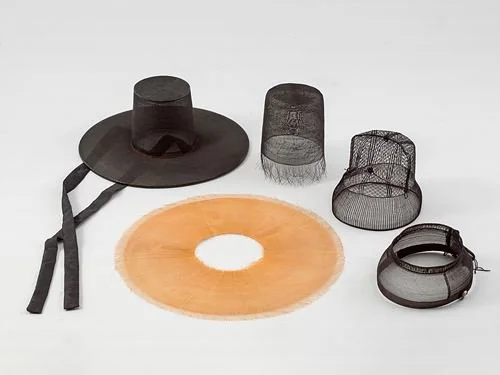
Fig. 1. Traditional Korean gat and its components, including the chongmoja (horsehair crown, upper center) and yangtae (bamboo brim, center), alongside a tanggeon (upper right) and manggeon (lower right). Various artisans, 1980s–2010. Photograph courtesy of the National Folk Museum of Korea.
Artisans and Culture of Production
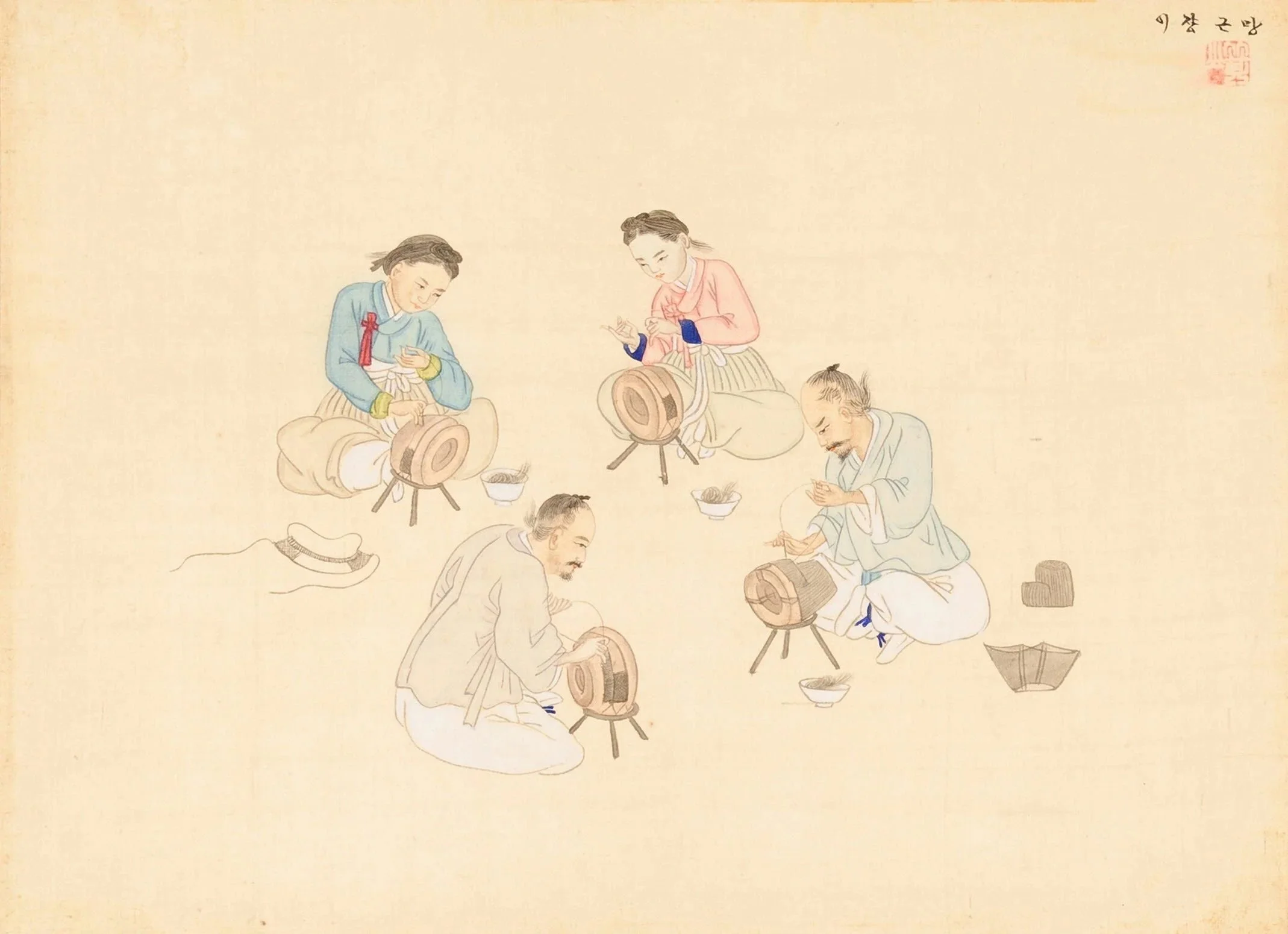
Fig. 3. Kim Jun-geun (Gisan), Manggeon Makers (망건쟝이), late nineteenth century. Depicts four artisans weaving manggeon, traditional horsehair headbands worn beneath the gat. National Folk Museum of Korea. Reproduced in the National Institute of Korean History's Korean History Image Collection.
According to the Gyeongguk Daejeon, the supreme foundational law code of the Joseon Dynasty, the Ministry of Works and Office of Royal Attire maintained thirty-four hat-related artisans in the capital's official craft organizations across six headwear-related specialties, including two positions specializing in bamboo brims. This indicates that hat-making was not solely a private enterprise, but also formed part of the government’s organized system of specialized artisanal labor.[11] Outside the capital, Jeju Island's extensive economy and history of raising ponies supplied horses as tribute to the mainland, and provided an abundant supply of horsehair for local artisans and craftsmen.1[2]
Jeju's role in Joseon gat production extended beyond supplying raw materials. Instead, artisans on Jeju specialized in producing the horsehair crowns and bamboo brims, which were then shipped to mainland centers in the south such as Tongyeong and Geoje, where other craftsmen assembled the finished hats. As Lee Min-joo explains, “A black gat was not made from beginning to end by one person.”[13] As such, although the division of labor was highly dispersed, because crowns and brims were manufactured separately, their dimensions and quality had to correspond for mainland craftsmen to assemble them into finished hats.
Evidence of this interconnected regional trade can be found in Jo Geuk-seon's Injae Ilrok, which records that goods obtained from Jeju in 1615 included a horsehair gat, a horsehair cap, and a manggeon.14
On Jeju Island, gat making was organized around specialized villages and communal workshops known as ilcheong. It is reasonable to conclude that at some point during the Joseon period, women played a significant role in gat-making, as evidenced by a traditional Jeju folk song associating Sinchon with female brim weavers and Dodu with female crown weavers. This account shows that although the finished product was heavily associated with elite men, women also acted as skilled producers of the components of those products.15
The Gat in Joseon Society
Beyond its elaborate craftsmanship, the gat also served as an important indicator of social hierarchy in Joseon society. Rooted in rigid Neo-Confucian social hierarchies, the Joseon government heavily regulated attire, including headwear, to reflect a man’s social status, rank, and occupation. For example, a clothing prohibition issued in 1775 restricted the wearing of horsehair hats, danggeon, changui, and silk hats to the yangban and scholarly class. Likewise, the heukrip similarly functioned as a symbol of aristocratic identity. It was not simply a matter of displaying status, but also of behaving in accordance with the societal expectation of that status, embodying Confucian propriety. Kim discusses the eighteenth-century scholar Yi Deok-mu, who warned against tying the gat’s strings improperly, or wearing it tilted too far forward or back. Such behavior from a yangban could suggest that the wearer lacked the moral code expected of a Confucian gentleman and “abandoned the duties of his social position.”[16]
However, it’s important to note that although the heukrip very clearly belonged to the aristocracy, not every gat conveyed the same level of status. Distinctions in official rank could be communicated through the materials used for decorative hat strings (gatkkeun) as well as ornaments attached to the top of the crown (jeongja). For example, only royalty was allowed to adorn their gats with gold, and only high-ranking officials (1st to 3rd rank) were permitted to use silver and jade.[17] The 1543 law code Daejeon Husoknok states that “hat strings of agate, amber, transparent amber, coral, and lapis lazuli are entirely forbidden to anyone below the senior court officials (dangsanggwan).”18 As such, the gat not only distinguished the yangban from commoners but could also communicate differences in status within the upper classes themselves.
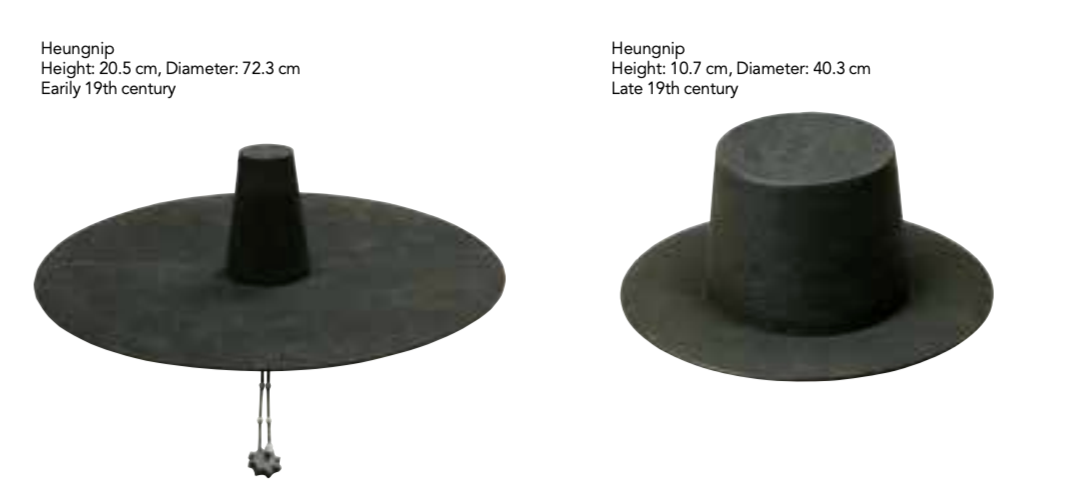
Fig. 2. Comparison of two nineteenth-century Korean gat. National Folk Museum of Korea, Encyclopedia of Traditional Korean Clothing (2021), p. 37.
Perhaps most interestingly, the physical dimensions of the heukrip itself were able to communicate social privilege in Joseon society. Figure 2 compares two surviving heukrip from the early and late nineteenth centuries, documented in the National Folk Museum of Korea's Encyclopedia of Traditional Korean Clothing. The earlier example measures 72.3 centimeters in diameter and 20.5 centimeters in height, while the later example measures only 40.3 centimeters in diameter and 10.7 centimeters in height.[19]
During the early 19th century, it was common for the brims of heukrip to be so “broad as to extend beyond the width of the shoulders,”[20] making them impractical for almost any kind of physical labor. This very appearance of impracticality helped communicate the wearer's privilege, as the yangban were not required to perform manual labor, unlike commoners. Thus, the exaggerated brim size conveyed status distinction through its impracticality rather than its usefulness. Ironically, the same elaborate craftsmanship that required considerable manual labor produced an object that symbolized the wearer’s exemption from such labor.
The reduction in gat dimensions also coincided with broader, tumultuous transformations in Joseon society throughout the latter half of the nineteenth century. Kim suggests that this may have reflected the government’s reformist drive against unnecessary extravagance, as the government pursued reforms aimed at simplifying traditional dress.[21] More significantly, in 1894, in an attempt to modernize and westernize Korea, the Gabo reforms were launched, abolishing the hereditary status distinctions and privileges associated with the yangban class, allowing anyone, from commoners to untouchables (cheonmin) to wear gats that had previously been associated with the yangban elite.[22] The traditional significance of the gat was further challenged by the Short Hair Edict of 1895, which mandated all Korean men to cut their topknots. As the gat was traditionally worn over the topknot, this edict threatened Joseon’s existing hat-wearing custom. For former yangban and conservative Koreans, this represented a direct attack on Confucian values and established social identity.[23] Therefore, although the gat had served as a visible marker of elite status for centuries, the political reforms of the late nineteenth century heavily undermined its social exclusivity.
Conclusion
The history of the gat reveals how a seemingly simple article of clothing can reflect the social and economic landscape of Joseon Dynasty Korea. Its distinctive appearance was the result of specialized craftsmen working across the country, from Jeju Island to the mainland. However, the finished hat became closely associated with the prestige and privilege of the yangban elite. As Joseon’s traditional status system weakened at the turn of the twentieth century, the gat’s appearance and social significance also underwent substantial change. Although the gat has since all but disappeared from everyday attire, the craft remains an important part of Korea's cultural heritage through popular media and the modern preservation of traditional gat-making techniques by successive generations of artisans.[24]
Sources
[1] Kim, Soon-Young. “A Study on the Perception of Korean Top Hat, the Gat, from the Late 19th to the Early 20th Century.” Journal of the Korean Society of Costume, vol. 64, no. 6, 2014, p. 184, https://doi.org/10.7233/jksc.2014.64.6.176; “Gat, Traditional Headgear in Korea [2].” Korea.net, 5 Feb. 2014, https://www.korea.net/NewsFocus/Culture/view?articleId=117428.
[2] Encyclopedia of Traditional Korean Clothing. Translated by MINT & Co., Ltd., National Folk Museum of Korea, 2021, pp. 36–41; “Gat, Traditional Headgear in Korea [2].”
[3] Encyclopedia of Traditional Korean Clothing, pp. 36, 40.
[4] Encyclopedia of Traditional Korean Clothing, pp. 40–41; “Gat, Traditional Headgear in Korea [2].”
[5] Encyclopedia of Traditional Korean Clothing, pp. 40–41; Kim, pp. 180, 182.
[6] “Gat, Traditional Headgear in Korea [3].” Korea.net, 11 Feb. 2014, https://www.korea.net/NewsFocus/Culture/view?articleId=117541; Lee, Min-joo. “The Effect of the Difference in Jeju Costume on the ‘Gat’ Culture of Joseon.” Korean Studies Quarterly, vol. 43, no. 3, 2020, pp. 137–38, https://doi.org/10.25024/ksq.43.3.202009.117.
[7] Lee, pp. 133–35.
[8] Lee, pp. 135–36.
[9] National Folk Museum of Korea. “졸앙졸앙 모자 졸아사: 제주의 모자 장인들.” 2024, https://www.nfm.go.kr/user/museumbbs/home/3/1274/selectMuseumBbsView.do?museumBbsIdx=13760&page=1&row=12.
[10] National Folk Museum of Korea, “졸앙졸앙 모자 졸아사: 제주의 모자 장인들.”
[11] Lee, p. 137.
[12] Lee, p. 133.
[13] Lee, p. 137.
[14] Lee, pp. 132–33, 135–36.
[15] Lee, pp. 140–41.
[16] Kim, pp. 179–81.
[17] Encyclopedia of Traditional Korean Clothing, p. 40; Kim, p. 180.
[18] Kim, p. 180.
[19] Encyclopedia of Traditional Korean Clothing, p. 37.
[20] Kim, p. 180.
[21] Kim, p. 182.
[22] Kim, p. 182.
[23] Kim, pp. 182–83.
[24] National Folk Museum of Korea, “졸앙졸앙 모자 졸아사: 제주의 모자 장인들”; Lee, pp. 137–39.