A Coat of Plates: The Craft and Role of the Joseon Dujeonggap
As the Hallyu wave of Korean culture washes over the world, once-niche products from the peninsula have become iconic and established a sense of Korea beyond the war and the jingoist tirades of the Democratic People’s Republic. Much of this cultural export (K-pop, K-food, K-beauty, K-dramas) is modern, and Korea’s traditions and historical milieu have, by comparison, fallen by the wayside. Even less known is the traditional armor of Korea. While samurai films have cemented the image of the Japanese yoroi in popular culture, Korean armor remains obscure despite its historical and cultural importance. The second verse of the Aegukga, South Korea’s national anthem, evokes a prominent image of armor: the pine atop Namsan, its bark wrapped around it as if iron armor, cheolgap (鐵甲). In a twist of irony, the armor most Koreans would picture, the dujeonggap 頭釘甲, would not have had any exposed iron. Its plates were hidden beneath cloth, with only the heads of the rivets holding them in place visible. Yet the anthem’s word was the Joseon court’s word too. The name dujeonggap belongs to a ritual code of 1474; later records named such coats by their materials, and by the eighteenth century cheolgap was what Joseon officials often called one when its plates were iron. In 1742, the gap between that coat and one without plates was enough to draw the ire of the king.
In the eighth month of 1742, at a review of his troops, King Yeongjo found a peculiar sight: his soldiers stood clad in iron armor (鐵甲) whilst his generals stood in silk (緞甲). Two days later he set his displeasure to paper. A general’s armor, he wrote, ought to be the same as his men’s; instead, the men wore “armor of leather and iron” (皮鐵之甲) while their commanders wore “silk armor adorned on the outside” (飾外之段甲), and he asked whether this could truly be called sharing the sweet and the bitter alike. On royal outings in the summer heat, he added, the generals’ armor was light and the soldiers’ heavy, and “though outwardly the same,” the burden was not. Henceforth any general caught in such armor would answer to military law.
The king does not say what made the generals’ armor light. His word for it, “decorated armor” (飾樣甲), the records define as armor faced with patterned silk. Kim Byeongryun reads this as a dujeonggap without plates. Thus, it was essentially a studded silk suit without any leather or iron that would make it actual armor. The men’s armor of leather and iron was most likely the plated version, which the Military Training Agency (Hullyeon Dogam 訓鍊都監) had issued to its infantry and cavalry since the 1650s. Like the brigandine of Europe, the dujeonggap was a coat of plates. Many plates of leather, copper, or iron were riveted to a fabric backing. This meant the same kind of studded coat could carry a full set of plates or none at all. Historians, Kim among them, have usually explained the emptied coats as casualties of the musket: firearms, the story goes, stripped armor of its purpose, so that by the seventeenth and eighteenth centuries Joseon armor survived chiefly as costume. Yet in 1742 it was the generals, not the rank and file, who had traded iron for silk.
Every one of those hidden plates had to be cut, lacquered, punched, and riveted by someone, and whether a coat carried them at all was decided when it was made, not when it was worn. By examining the armorers of the Government Arsenal (Gungisi 軍器寺), the costed production of the seventeenth-century military divisions, and surviving coats in museum collections, this essay hopes to shed light on the dujeonggap as both an object of beauty and a tool of war. It existed at the crossroads of cultural exchange, material science, and artistry and was not simply slain by the arrival of firearms.
A Coat of Plates
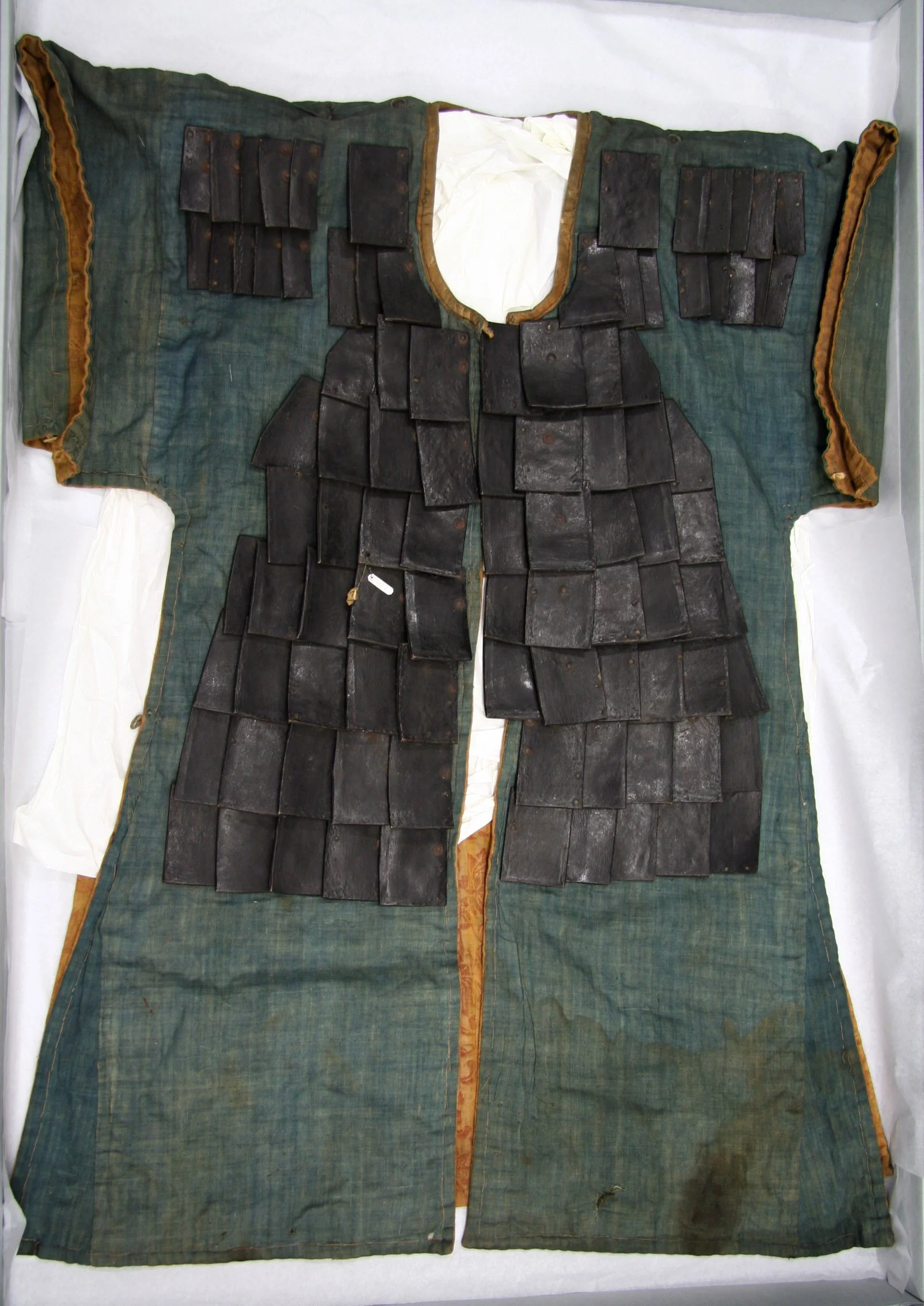
Figure 1. Dujeonggap 頭釘甲, catalogued by the museum as “Scale Armor,” interior view. Korea, 16th–19th century. Textile and hide; H. 107 cm, 7.7 kg. The Metropolitan Museum of Art, New York, 36.25.352, Bequest of George C. Stone, 1935. Source: The Met Collection, Open Access.
Seen from the outside, a dujeonggap is a robe strewn with studs; seen from the inside, it is a field of overlapping plates. Figure 1 shows a Korean coat in the Metropolitan Museum of Art that the museum catalogues as “Scale Armor.” About a hundred lacquered leather scales are visible on its front interior alone, riveted in overlapping blocks onto a blue-green lining across the torso and shoulders, while the sleeves and skirt are left unarmored. No plate is laced to its neighbor; each hangs from the lining by its own rivets and overlaps the one beneath it. Not every surviving coat is built this way. Of the forty entries in Kim’s survey, four have iron or copper plates, seventeen have leather plates, and nineteen have none at all. Of the coats with plates, the materials and amounts vary widely: shells of three to six layers of cloth; plates of lacquered leather or iron, about a millimeter thick in General Yi Wan’s coat, one to three rivets per plate; and three to fifteen kilograms in weight.
This style of armor was, however, most likely not a native invention. Riveted armor with plates concealed beneath cloth was in use under the Yuan, and Goryeo probably first met it in joint campaigns with Yuan forces, such as the invasions of Japan in 1274 and 1281. By 1474, the Gukjo oryeui seorye (國朝五禮儀序例), the illustrated preface to the state ritual code, had given the coat an official definition: blue cotton with iron plates riveted across it, in Kim renders as, “spread like stars,” alongside a red silk version lined with smoked deerskin and riveted with brass. The code distinguished its versions by cloth and rivet metal, a grading by material that later practice would map onto rank. The drawings in Figure 2 omit the underlying plates when depicting the dujeonggap. The dudumigap (labeled 頭頭味甲), a similar studded coat whose text calls for rivets of silver-white and brass set alternately, is drawn with no rivets at all.

Figure 2. Drawings of plated mail (gyeongbeongap 鏡幡甲) and the brigandine (dujeonggap 頭釘甲) (right page), and of the brass-riveted brigandine (hwangdong dujeonggap 黃銅頭釘甲) and the dudumigap (labeled 頭頭味甲) (left page). From Gukjo oryeui seorye 國朝五禮儀序例, 1474, gwon 4, “Byeonggi doseol” 兵器圖說. Woodblock-printed book, later impression; ink on paper. National Library of Korea, Seoul. Source: Wikimedia Commons (public domain).
Who Hit the Nail on the Head?
Given the variety of materials and number of parts, making a dujeonggap was no doubt a labor-intensive task. So who undertook this daunting task? For the first two centuries of Joseon, when, as Kim notes, lamellar armor still dominated, the answer was largely the Government Arsenal, an institution Hyeok Hweon Kang calls a preindustrial factory. Its armorers laced more lamellar than they riveted dujeonggap, but the habits of their workshop would outlast the lamellar coat. Armor was among its oldest trades. Its Goryeo forerunner already counted leather armorers (皮甲匠), helmet makers (牟匠), and makers of white armor (白甲匠) among its artisans in 1076, and by 1434 the arsenal’s 594 artisans, spread across thirty crafts, included forty-three armorers (造甲匠) and forty-three mail (chainmail) makers (鎖子匠). Nor did they work as lone masters. Around 1434, most artisans rotated through the workshops in three groups on five-day shifts, and beneath them labored an unfree workforce: in 1406, some four thousand slave assistants in ten shifts of four hundred. The compound itself was divided into specialized spaces for forging, casting, bow and arrow making, gunpowder, and armor, which had its own workshop (造甲所). Labor was divided even between institutions: in 1450 the court proposed that arsenal artisans make the plates for a Tang-style armor and pass them to the Office of Royal Attire (Sang-uiwon 尙衣院) for assembly.
The armorer’s work was also subject to rigor and circulation, and as part of this, they worked from models. Kang shows that early Joseon production ran on gyeonyang (見樣), the making and circulation of prototypes. In 1414, the king halted the arsenal’s monthly quota of eight dudumigap and three special iron armors (別鐵甲) and ordered mail coats in their place, having already commissioned a prototype of Chinese-style plated mail (鏡幡甲) for the provinces to copy. Firearms specialist Choe Haesan and three other officials were dismissed for failing to supervise that work in person, which exposes how much of the making had been left to the artisans themselves. In 1425, the arsenal tested its guns and bows against armor, dressing three hundred straw dummies in armor and helmets, setting them 150 paces from the royal tent, and having its powder smiths fire cannon at them before six officers shot arrows, to measure how deeply each pierced the armor. Production managers could also be sent to provincial workshops to supervise the making of armors according to examples sent from the arsenal. In one case from 1451, a scale armor sent up from Hamgyeong was so poorly made that the arsenal sent a prototype for the province to copy. Prototypes could also be worn to test their comfort and shot at to test their strength. A new design was tried on in 1462 before it went to the provinces, and in 1463 prototypes of a new leather-and-iron armor went out to the provincial commanders in three sizes, large, medium, and small (大中小葉兒), to be copied. In 1477, a model was proved before it was copied: the king had an iron armor with plates as large as two palms set up at fifty paces, and when an arrow failed to pierce it, he ordered the arsenal to make armor on its pattern. Plates that large suit a riveted coat better than lamellar, and Kim suspects it was a dujeonggap. This level of rigor and experimentation shows that Joseon armorers drew from examples both foreign and domestic and tested their works to a set standard.
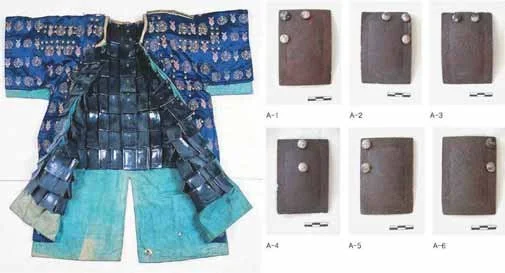
Figure 3. Left: inside a leather-plated dujeonggap in the Peter the Great Museum of Anthropology and Ethnography (Kunstkamera), St. Petersburg; each plate is riveted to the lining, and none is joined to its neighbors. Right: iron plates from General Yi Wan’s (1602–1674) dujeonggap, Gyeonggi Provincial Museum, each pierced with one to three rivet holes. Joseon dynasty. Reproduced from Kim, “Joseon sidae dujeonggap,” 88, pl. 17; Kim credits the plate photographs to Yu Seonhye’s 2006 MA thesis (Yongin University), 25 (88n121).
During the outset of the Imjin War (1592–98), the arsenal was burned, and production shifted to new military divisions of the capital, beginning with the Military Training Agency. Each built workshops of its own, and by the early 1680s there were five. In the eleven production runs listed in Kang’s table of managers (1679–1712), muskets and bows dominate, and armor appears only once, as fifty sets of leather armor and helmets made by the Royal Division (Eoyeongcheong 御營廳) in 1707. When mass-produced, the dujeonggap held an edge over lamellar. While lamellar needed between three and fifteen holes per lamella and lacing in two directions, the dujeonggap needed only one to three rivets per plate, and fewer, larger plates covered the same body. Making and joining the plates grew simpler, though the cloth body was extra work, while protection against arrows held roughly steady. When the Military Training Agency planned five thousand sets of leather armor and helmets in 1652, it made a single prototype first, measured what went into it, and multiplied. Even a thousand sets, it reported, would need two thousand cowhides, a thousand bolts of cotton for shells and linings, and thirty du of lacquer. Sometimes the bottleneck lay in the cloth rather than the metal. In 1636 the Special Arms Manufactory (Gungi Byeoljocheong 軍器別造廳) reported that the iron plates for several hundred iron armors were already forged; what was hard to come by was the blue cloth for their shells, which it proposed to buy.
At the other end of the scale sits a formula for a single gilded leather armor, preserved in the Royal Division’s old precedents and translated by Kang; Kim reads the armor as a two-piece dujeonggap. Its bill of materials runs to some 470 body scales and 90 more for the neck, 128 round-headed brass nails and 1,031 gilded ones, gold and mercury for gilding, and velvet and silks. Its bill of labor names seven kinds of workers paid in cloth and rice, from leather workers and armorers to a silversmith’s assistant, a polisher of shoulder and sleeve pieces, and a needleworker. As the labor involved included not just the practical construction, but also aesthetic decoration, many more hands were needed.

Figure 4a. Dujeonggap with a stamped cotton shell with helmet. Joseon dynasty. Cotton shell, plates inside, metal rivets. Lender not recorded (probably one of the National Museum of Korea’s Bon-gwan 53 coats). Exhibited in Military Rituals: Symbol of the Joseon Dynasty’s Military Power (조선 왕실 군사력의 상징, 군사의례), National Palace Museum of Korea, Seoul, 2021. Photograph by Brian Lee, January 31, 2021.

Figure 4b. Dujeonggap with a velvet shell, gilt or brass studs, dragon appliqués, and fur trim; helmet with gilt fittings. Joseon dynasty. Lender not recorded. Exhibited in Military Rituals, National Palace Museum of Korea, Seoul, 2021. Photograph by Brian Lee, January 31, 2021.

Figure 4c. Detail of the coat in Figure 3b, wearer’s left front panel: the worn velvet pile shows the outlines of the plates beneath. Photograph by Brian Lee, January 31, 2021.
The dujeonggap of the soldier was on the other end of that spectrum. Two in the National Museum of Korea are yellow cotton stamped in black, front and back, with the fourteen designs, characters, and pomegranates among them, whose placement Hwang Jinyoung takes as evidence of fixed rules. Their plates are held by two rivets apiece, and one, examined during conservation, carries 216 lacquered leather plates and weighs about ten kilograms. Names are inked inside: 黃殷哲 inside a sleeve of one of the stamped pair, and on a third coat, stamped all over with lotuses, 金致衡 inside a sleeve and 朴宗後 and 權命賢 together on a single plate. Hwang takes them for the wearers’ names; the later conservation report allows that they may be the makers’. The coat in Figure 4a wears stamped roundels of the same kind, and its rivets pass straight through the printed designs. The cloth was stamped before it was riveted, showing an established order of operations and making this particular example more a mass-produced, functional piece of equipment than a custom work of art.

Figure 5. Names inked inside two leather-plated dujeonggap in the National Museum of Korea, as read by Hwang Jinyoung: (a) 黃殷哲, inside a sleeve of a stamped cotton coat (Bon-gwan 53); (b) 金致衡, inside a sleeve; and (c) 朴宗後 and 權命賢, on a single plate from the upper back, both from a second coat (Jeung 3570). Joseon dynasty. Reproduced from Hwang, “Joseon sidae pigap,” 73, fig. 13.
Armor In the Age of Firearms
If firearms had simply made armor obsolete, one would expect the state to stop issuing it to the men who carried them. As discussed, their construction was no small undertaking in cost, time, and material. In 1653, the Military Training Agency reported five hundred sets of leather armor already made and distributed among its squad leaders and best musketeers, to be worn on royal processions and at drill, while six hundred iron armors for the cavalry were old, damaged, and in need of repair. A century and a half later, the Man-gi yoram 萬機要覽 (1808) listed the same agency’s stores as 839 sets of iron armor, most of them for cavalry, and 2,892 sets of leather armor for its musketeers and swordsmen, alongside ninety-nine sets of silk. Silk and felt belonged to officers from the rank of company commander (chogwan 哨官) upward.
Contemporaries did not treat armor as helpless before new weapons. In 1667, King Hyeonjong observed that arrows went straight through iron armor but not through leather, prompting the general Yu Hyeokyeon to boast that Korean cowhide was twice as good as any other country’s. In 1711, by contrast, Yi Hwi reported that a musket ball fired at fifty paces pierced leather armor but not iron. The objections, when they came, were practical rather than fatalistic. In the debate over the 1652 order, one minister asked how a musketeer burdened with armor could move when he met the enemy, and dismissed the coats as useless and a waste of resources. Yeongjo himself conceded that iron had given way to leather “for the ease of the body,” but he insisted that drill was rehearsal for battle (習操者習儀也). A general who drilled in light, decorated armor would not be able to move in real armor when war came.
The move to plateless dujeonggap might be more a result of peacetime and less due to the musket. On Lee Joo-Young’s reading, two of the earliest extant dujeonggap, those of the Imjin War officers Jeong Gongcheong and Jeong Chungsin, carry quilted cotton rather than plates, much like the padded cotton armor (棉甲) of the Ming; she reads them as armor thinned into show by the long peace after the 1474 code, and presumes the plates returned after the war. Kim, who ties the later plateless coats to the musket, still wonders whether some were made from the start to rely on cloth.
Figures 4b and 4c show the officer’s side of the ledger. The coat in Figure 4b follows the same plate logic as the soldier’s coat in 4a, but its every surface called on another trade: velvet, studs, dragon appliqués, and fur trim, much as the Royal Division’s formula itemizes velvet and gilding. On its front panel (Fig. 4c) the velvet pile has worn thin, and beneath it the outlines of the plates show through as a grid of rectangles, each row crowned by a line of studs. This decorated officer’s coat was still plated, though whether with leather, iron, or thin copper the photograph cannot say. Lower on the skirt, however, the studs leave the grid for staggered rows, lines, and rosettes around a dragon, with no plate outline beneath them: rivets that appear to have become ornament, as on at least one other commander’s coat. Figure 4c is a reminder that a coat decorated without could still carry plates within.
Conclusion
Despite its relative absence in modern Korean popular culture, the dujeonggap carries the cultural, economic, and scientific weight of its time. It draws from influences beyond its borders, and the production of even a single coat could run through the hands of many. Its usage and efficacy were thoroughly scrutinized, and its role was adapted to the development of new weapons, not curtailed by it. Taken together, the coats and the records describe a craft that the story of obsolescence flattens. Joseon armor was made in a factory before factories, and the dujeonggap inherited its standard operating procedures: prototypes, proof-testing, and a division of labor that ran from cloth buyers to gilders and needleworkers. Whether produced en masse as munitions armor or tailor-made for a wealthy commander, the dujeonggap represented a confluence of socio-economic and political factors. While not prevalent in the current zeitgeist, by its very nature, it was an imprint of the contemporary milieu.
Bibliography
Primary Sources
Eoyeongcheong gusingnye 御營廳舊式例 [Old precedents at the Royal Division]. Transcribed 1707. Jangseogak Collection, K2-3346. Cited in Kang, “Crafting Knowledge,” 181–83, table 13.
Gukjo oryeui seorye 國朝五禮儀序例 [Preface to the illustrated rubrics for the Five Rites]. 1474. Woodblock edition, later impression. National Library of Korea, Seoul. Also catalogued as Gukjo orye seorye 國朝五禮序例. Digitized as “CNTS-00047984873 2 國朝五禮序例.pdf,” Wikimedia Commons. https://commons.wikimedia.org/wiki/File:CNTS-00047984873_2_國朝五禮序例.pdf.
Man-gi yoram 萬機要覽 [Essentials of the myriad affairs of state]. 1808. “Gunjeong pyeon” 軍政編, Hullyeon Dogam. Quoted in Hwang, “Joseon sidae pigap,” 65. Cited in Kim, “Joseon sidae dujeonggap,” 100n155.
The Metropolitan Museum of Art. “Scale Armor.” Korean, 16th–19th century. Accession no. 36.25.352. Bequest of George C. Stone, 1935. Accessed October 18, 2026. https://www.metmuseum.org/art/collection/search/31993.
Munjong sillok 文宗實錄 [Veritable records of Munjong’s reign]. Entries for 1450/11/15, 1450/12/23, 1450/12/24 and 1451/6/26. Quoted in Kang, “Crafting Knowledge,” 31–32n81, and cited at 136, table 11.
Sejong sillok 世宗實錄 [Veritable records of Sejong’s reign]. Entry for 1425/11/27. Quoted in Kang, “Crafting Knowledge,” 140–41n284.
Seongjong sillok 成宗實錄 [Veritable records of Seongjong’s reign]. Entry for 1477/10/29. Cited in Kang, “Crafting Knowledge,” 136, table 11. Quoted in Kim, “Joseon sidae dujeonggap,” 92n131.
Seungjeongwon ilgi 承政院日記 [Daily records of the Royal Secretariat]. Entries for 1636/7/17, 1652/10/18, 1652/10/21, 1653/8/4, 1667/11/13, 1711/9/4 and 1742/8/18. Quoted in Kim, “Joseon sidae dujeonggap,” 89n124, 91 and n129, 95nn136–37, 99nn152–53, and 101n160.
Taejong sillok 太宗實錄 [Veritable records of Taejong’s reign]. Entries for 1406/4/1 and 1414/11/4. Quoted in Kang, “Crafting Knowledge,” 42n98 and 134n279.
Yeongjo sillok 英祖實錄 [Veritable records of Yeongjo’s reign]. Entry for 1742/8/16. Quoted in Hwang, “Joseon sidae pigap,” 76 (ref. 5), and in Kim, “Joseon sidae dujeonggap,” 101 and n159.
Secondary Sources
Hwang Jinyoung 황진영. “Gungnip Jungang Bangmulgwan sojang Joseon sidae pigap-ui teukjing-e gwanhan gochal 국립중앙박물관 소장 조선시대 피갑(皮甲)의 특징에 관한 고찰” [Main features of leather armor from the Joseon dynasty in the National Museum of Korea]. Bangmulgwan bojon gwahak 박물관 보존과학 20 (2018): 61–76. https://doi.org/10.22790/conservation.2018.20.0061.
Jeong Misuk and Nam Gyeongmi 정미숙·남경미. “Gyeonggi-do Bangmulgwan sojang Heonjong garye jinha gyebyeong-ui gunbongnyu-e gwanhan yeongu 경기도박물관 소장 憲宗嘉禮陳賀契屛의 군복류에 관한 연구” [A study of the military dress on the Gyeonggi Provincial Museum’s screen of King Heonjong’s wedding]. Hagyeji 學藝誌 16 (2009): 104–42.
Kang, Hyeok Hweon. “Crafting Knowledge: Artisan, Officer, and the Culture of Making in Chosŏn Korea, 1392–1910.” PhD diss., Harvard University, 2020.
Kim Byeongryun 김병륜. “Joseon sidae dujeonggap-e daehan gunsasajeok geomto 朝鮮時代 頭釘甲에 대한 軍事史的 검토” [A military-historical review of the Joseon dujeonggap]. Hagyeji 學藝誌 16 (2009): 50–103.
Lee Joo-Young 이주영. “Imjin waeran-gi (1592–1598) sanggeup sugun gabot-ui yuhyeongbyeol teukseong-gwa illeoseuteuhwa 임진왜란기(1592~1598) 상급 수군 갑옷[甲]의 유형별 특성과 일러스트화” [The style characteristics and illustration of armors worn by high navy officers during the period of Japanese invasion of Korea (1592–1598)]. Boksik 服飾 63, no. 7 (2013): 94–108. https://doi.org/10.7233/jksc.2013.63.7.094.
National Palace Museum of Korea. Joseon wangsil gunsaryeok-ui sangjing, gunsa uirye 조선 왕실 군사력의 상징, 군사의례 [Military Rituals: Symbol of the Joseon Dynasty’s Military Power]. Special exhibition, Seoul, January 19–March 28, 2021.
Park Ga-Young 박가영. “Joseon sidae gapju yumul-ui gamjeong-eul wihan hyeonhwang paak-gwa sidae gubun 조선시대 갑주 유물의 감정을 위한 현황파악과 시대구분” [Present situations of the remaining Korean armors and helmets of the Joseon dynasty and their periodization for a better appraisal]. Boksik 服飾 58, no. 5 (2008): 166–77.
Park Jinho, Park Jihye, and Hwang Jinyoung 박진호·박지혜·황진영. “Gungnip Jungang Bangmulgwan sojang gapju-ui bojon cheori-wa gujojeok teukjing: Joseon sidae jung-hugi gapju-reul jungsim-euro 국립중앙박물관 소장 갑주(甲冑)의 보존처리와 구조적 특징: 조선시대 중·후기 갑주를 중심으로” [Conservation treatment and structural characteristics of armor and helmets housed in the National Museum of Korea: Armor and helmets from the mid- and late Joseon dynasty]. Bangmulgwan bojon gwahak 박물관 보존과학 26 (2021): 35–66. https://doi.org/10.22790/conservation.2021.26.0035.
Song Yangseop 宋亮燮. “Joseon sidae-ui gunboksik 朝鮮時代의 軍服飾” [Military dress of the Joseon period]. In Hanguk-ui gunboksik baldalsa I: Godae–dongnip undonggi 韓國의 軍服飾發達史 I: 古代~獨立運動期 [The development of Korean military dress, vol. 1: From antiquity to the independence movement], 255–364. Seoul: Gukbang Gunsa Yeonguso 國防軍史硏究所, 1997