The Color of the Commoners: Japanese Indigo
During the 11th month of 1857, Utagawa Hiroshige published a woodblock print of an ordinary Edo neighborhood seen from above (Figure 1) [1]. Strips of freshly dyed cotton fabric can be seen hanging from drying towers over the shops of Kanda. Although this scene depicts nothing grander than laundry, these blue fabrics carry an extensive history of law, money and status. When Hiroshige first published this print, indigo (ai) had become one of the few bright colors Japanese commoners were allowed to wear. Sumptuary laws created by the Tokugawa shogunate enacted many restrictive policies that emphasized frugality over luxury, which restricted many choices including what people were allowed to wear [2, 3]. This biography follows indigo dyeing from the fermentation sheds of Awa Province to the streets of Edo. It shows how a craft shaped by sumptuary law became one of early modern Japan’s most profitable industries and collapsed during global competition, later returning in the 20th century as a national symbol: “Japan Blue” [4].
A Living Dye
Japanese indigo depended on a material that had to be grown, composted and kept alive. Instead of using the tropical Indigofera of India, Japanese dyers used tade-ai (Persicaria tinctoria), a plant from the knotweed family whose green leaves contain no blue, but a colorless precursor called indican. In Awa Province, these leaves are harvested during the summer and dried in piles often measuring several tons in a fermentation house called a nedoko, or “bed” [5]. Workers then sprinkle the pile with water and turn it for roughly 100 days, at a near-constant 60°C where microbes break down the plant tissue while the indican is converted into indigo [6]. The product of this fermentation reaction is a dark compost called sukumo. This process is facilitated by trained masters (aishi), who assess the progress of the reaction by sight and smell, as the fading of the sharp odor is a sign that it has finished [7]. The knowledge of these masters comes from vast experience and teachings from their predecessors, not from a written science [7]. It has long been believed that a god resides within the nedoko, and when the work is finished, it is dedicated to the god [8]. This suggests that this work was viewed by the artisans as a spiritual process as well as a chemical one. Even today, the process is still not fully resolved scientifically, and the craft is shrinking from a lack of successors [7].
The finished sukumo is then sold to dyers who mix it in with lime, wood-ash lye, and additives like wheat bran [5, 7]. This strongly alkaline bath invites a separate community of bacteria that convert the insoluble indigo into a soluble form that can soak into the fiber. Once dipped and lifted into the air, the cloth oxidizes and turns a light indigo before the dyer’s eyes [6, 7]. Each dip into the dye adds a layer of indigo to the cloth and a deep indigo is obtainable after more than 40 rounds of dyeing [9]. Additionally, if repeated about 70 times, the fabric can take on a nearly blackish-purple tone [9]. In short, Japanese indigo was a craft that required the management of microbes. This management requires a collaboration between harvesters and dyers, with most of their knowledge held in their hands and noses rather than in texts [7].
Law and Status
Tokugawa society was divided into status groups and the shogunate utilized clothing as a way of preventing competition between samurai and commoners over appearance [2]. Additional sumptuary laws prevented commoners from wearing colorful clothes or expensive materials like silk, apart from the coarse pongee (tsumugi) [2, 3]. A famous text from 1649, the Keian Proclamation, told peasants to live frugally and to wear nothing but cotton [2]. These regulations applied to groups of commoners in different ways. For peasants, economic motives by officials set out to make farmers live more frugally, hoping that more of what they produced would be left for others [2]. For wealthy townspeople, the laws required them to dress more plainly so as not to compete with the appearance of the samurai. In response, many of the wealthy townspeople would hide silk clothing under their rougher outer garments [2]. In effect, cotton became the most common fabric for commoners, and indigo was a dye that was well suited for it, as it is one of the most colorfast of natural dyes and one of the few bright colors that were permissible under sumptuary laws [3].
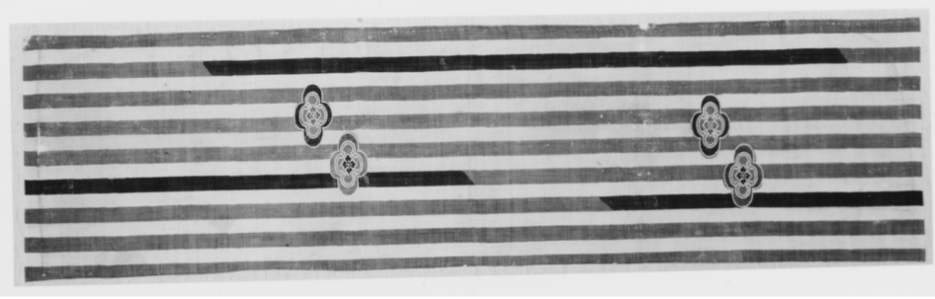
Fig. 2. Piece, late 17th–early 18th century, stencil resist-dyed bast fiber (asa) with indigo. The Metropolitan Museum of Art, New York, 2001.428.34.
These restrictions did not end fashion. Wealthy townspeople began to commission Edo komon, which are stencil-dyed patterns that were so fine that they looked plain from a distance. This allowed individuals to wear expensive and highly skilled work, while still appearing to obey the law [10]. A fragment from the Metropolitan Museum of Art shows the stencil technique used for such cloth (Figure 2). The museum’s description states that resist paste was likely applied through a stencil onto bast fiber (asa). The cloth was then dipped into indigo, and the protected pieces stayed pale. Finally, areas of darker indigo were added by hand [11]. A matching piece of the same cloth, associated with a woman, has an inscription dated 1710, making it a rare trace of the ordinary individuals who wore such cloth [11]. The color of the commoner was a way of negotiating with the state.
Reading the Print
It’s worth returning to Hiroshige’s print for a closer look. The cloth seen drying above Kanda was on its way to becoming tenugui, as cotton towels and headbands were common gifts in Edo [1]. The strips that can be seen in the foreground bear a fish-shaped mark of the series’ publisher, Uoei, while the ones behind carry Hiroshige’s mark, which is the only time it appears in the series [1]. The marks turn the cloth into a kind of advertisement, as businesses could print their brand name on it. The print also records how large the trade had grown. Kanda Kon’ya-chō, “dyers’ town,” directly took its name from the craft, but by 1854 only 47 of Edo’s 522 dye shops remained there as dyeing had spread across the entire city [1]. This depiction of a seemingly quiet neighborhood scene is actually a picture of a mass market.
Blue Gold: Tokushima’s Indigo Economy
Much of the demand for indigo was met by a single region. Tokushima, which was ruled by the Hachisuka family, lay along the Yoshino River. The land that met the river was too often flooded for rice, but the rich wet soil was suited for indigo [12]. The Hachisuka family actively supported the production of indigo and by the 1700s Awa indigo dominated national trade [13]. Tokushima has been described as an unusually commercialized region that specialized in producing and exporting indigo [14]. By the late Tokugawa period, indigo made up roughly a fifth of its agricultural output [14]. The wealth that came with Awa indigo’s popularity helped support festivals, which eventually grew into the Awa Odori dance [15].
This trade also created much conflict. In the mid-eighteenth century, Osaka merchants formed buying cartels to lower the price of Awa indigo. Tokushima opposed these advances with the establishment of an indigo office, export controls, providing cheaper credit for its own merchants and the use of favored merchant groups, only to see the shogunate side with the Osaka merchants on multiple occasions [16].
Collapse and Rebranding
Japan’s ports opened in 1858, which in turn exposed Awa indigo to global competition. Imports of natural Indian indigo stayed modest in the early Meiji period but surged in the 1890s to nearly 1.2 million kilograms a year by the end of the decade, while synthetic indigo from Europe followed suit [17]. Most of the imports entered through Yokohama, which cost the Awa indigo industry its largest market in the Kantō region [18]. To give a glimpse of this financial impact, Masatoshi Amano, an economic historian, documents the financial loss of the Takahashi family. Their indigo revenues stalled in the mid-1890s, while the costs of fertilizer and labor rose. In 1900 the family was forced to close its business [18]. Tokushima’s cultivation reached its peak in 1903 and then fell. By 1966, only four hectares of indigo were planted [19].
The color, however, did not leave Japan’s self-image. In the 1870s, the British chemist Robert William Atkinson was struck by the deep integration of indigo in Japanese life and called it “Japan Blue” [4, 20]. Nearly 150 years later, indigo was chosen for the emblems of the Tokyo 2020 Olympic and Paralympic Games, even though only five masters still make sukumo through traditional methods [4, 20]. Indigo, the color that was once tied to commoners, became a symbol that represented the nation.
Conclusion
Returning once again to Hiroshige’s print, the strips of cotton that blow above Kanda appear much different. The biography of Japanese indigo is as much of a story about status and power as it is about technique. The blue is a product of months of carefully facilitated fermentation, of laws that restricted the stylistic choices of commoners, of a domain that grew rich from that demand and of merchants who fought over the profits. Within 50 years of the print, imports and synthetic dyes had hollowed out the Japanese indigo market. Since then, Japanese indigo has survived primarily through cultural heritage by rebranding its commoner roots into a national symbol: “Japan Blue.”
Utagawa Hiroshige. Dyers’ Quarter, Kanda, No. 75 from One Hundred Famous Views of Edo. 1857, woodblock print, Brooklyn Museum, New York. Brooklyn Museum, https://www.brooklynmuseum.org/objects/121689.Accessed 14 Oct. 2026.
“Sumptuary Regulations.” SamuraiWiki, Samurai Archives, https://samurai-archives.com/wiki/Sumptuary_law. Accessed 14 Oct. 2026.
Kennedy, Alan. “Yukata.” Encyclopedia of Clothing and Fashion. Encyclopedia.com, https://www.encyclopedia.com/fashion/encyclopedias-almanacs-transcripts-and-maps/yukata. Accessed 14 Oct. 2026; “Aizome (Indigo Dyeing).” JTA Sightseeing Database, Japan Tourism Agency, 2020, https://www.mlit.go.jp/tagengo-db/en/R2-01794.html. Accessed 14 Oct. 2026.
“Aizome (Indigo Dyeing).” JTA Sightseeing Database, Japan Tourism Agency, 2020, https://www.mlit.go.jp/tagengo-db/en/R2-01794.html. Accessed 14 Oct. 2026.
“Awa Indigo.” Tokushima Prefecture, https://www.pref.tokushima.lg.jp/en/japanese/natural_culture/traditional_culture/awa-ai. Accessed 14 Oct. 2026.
Tu, Zhihao, et al. “The Mechanism Underlying of Long-Term Stable Indigo Reduction State in Indigo Fermentation Using Sukumo (Composted Polygonum tinctorium Leaves).” Frontiers in Microbiology, vol. 12, 2021, article 698674, https://doi.org/10.3389/fmicb.2021.698674.
Ueno, Yoshiyuki. “Indigo Dyeing and Fermentation: Sukumo, Essential for Traditional Japanese Aizome.” Arts et sciences, vol. 7, no. 3, 2023, pp. 1–7, https://doi.org/10.21494/ISTE.OP.2023.0996.
“Indigo Work to the Future: Watanabe’s Indigo Color Continues to Evolve.” ORIGAMI Online Store,https://origami-kai.com/en/blogs/special-feature/watanabes_interview. Accessed 14 Oct. 2026.
Todate, Kazuko. “Indigo, Illuminated: The Matsueda Family.” Translated by Ginza Motoji, Ginza Motoji, 2025, https://www.motoji.co.jp/blogs/en-articles/light-within-indigo-the-matsuda-family. Accessed 14 Oct. 2026.
“A Length of Double-Sided Edo Komon Katazome: Hemp.” Sri, https://www.srithreads.com/products/a-length-of-double-sided-edo-komon-katazome-hemp. Accessed 14 Oct. 2026.
Piece. Late 17th–early 18th century, bast fiber (asa), The Metropolitan Museum of Art, New York. The Met Collection, https://www.metmuseum.org/art/collection/search/61829. Accessed 14 Oct. 2026.
“Aizome (Indigo Dyeing).” JTA Sightseeing Database, Japan Tourism Agency, 2020, https://www.mlit.go.jp/tagengo-db/en/R2-01794.html. Accessed 14 Oct. 2026.
“Awa Indigo.” Tokushima Prefecture, https://www.pref.tokushima.lg.jp/en/japanese/natural_culture/traditional_culture/awa-ai. Accessed 14 Oct. 2026; “The Other ‘Japan Blue’ – ‘Nii-Seiaisho’ Has Supported ‘Ai-zome’ Indigo Dyeing in Japan.” NIHONMONO, 27 Jan. 2010, https://nihonmono.jp/en/article/14179/. Accessed 14 Oct. 2026.
“Tokushima han.” SamuraiWiki, Samurai Archives, https://samurai-archives.com/wiki/Tokushima_han. Accessed 14 Oct. 2026.
“Development of Awa Odori through the Indigo Industry.” JTA Sightseeing Database, Japan Tourism Agency, https://www.mlit.go.jp/tagengo-db/common/001565339.pdf. Accessed 14 Oct. 2026.
“Tokushima han.” SamuraiWiki, Samurai Archives, https://samurai-archives.com/wiki/Tokushima_han. Accessed 14 Oct. 2026.
Amano, Masatoshi. “A Study of the Awa Indigo Industry in the Middle of the Meiji Period: With Special References to the Indigo Business of the Takahashi Family in Tokushima Prefecture.” Kobe University Economic Review, vol. 42, 1996, pp. 25–26, https://doi.org/10.24546/81000904; “Awa Indigo.” Tokushima Prefecture, https://www.pref.tokushima.lg.jp/en/japanese/natural_culture/traditional_culture/awa-ai. Accessed 14 Oct. 2026.
Amano, Masatoshi. “A Study of the Awa Indigo Industry in the Middle of the Meiji Period: With Special References to the Indigo Business of the Takahashi Family in Tokushima Prefecture.” Kobe University Economic Review, vol. 42, 1996, pp. 26–34, https://doi.org/10.24546/81000904.
“Aizome (Indigo Dyeing).” JTA Sightseeing Database, Japan Tourism Agency, 2020, https://www.mlit.go.jp/tagengo-db/en/R2-01794.html. Accessed 14 Oct. 2026; “The Other ‘Japan Blue’ – ‘Nii-Seiaisho’ Has Supported ‘Ai-zome’ Indigo Dyeing in Japan.” NIHONMONO, 27 Jan. 2010, https://nihonmono.jp/en/article/14179/. Accessed 14 Oct. 2026.
“The Other ‘Japan Blue’ – ‘Nii-Seiaisho’ Has Supported ‘Ai-zome’ Indigo Dyeing in Japan.” NIHONMONO, 27 Jan. 2010, https://nihonmono.jp/en/article/14179/. Accessed 14 Oct. 2026.
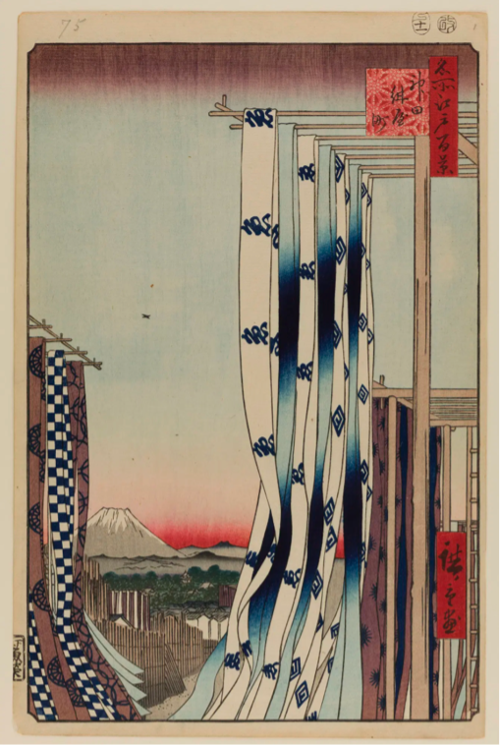
Fig. 1. Utagawa Hiroshige, Dyers’ Quarter, Kanda, No. 75 from One Hundred Famous Views of Edo, 1857, woodblock print. Brooklyn Museum, New York, 30.1478.75.