Imported Technique to Korean Craft: Soju Distillation and the Sojugori
Introduction: Soju Distillation and Its Artifact
Soju’s past is less familiar than the drink itself. Making soju required distillation—a technique brought to Korea through technological exchange during the Mongol-led Yuan dynasty (1271–1368). Distilling transformed a fermented mash of organic materials like grain into a stronger distilled liquor, known as a spirit, by heating it, capturing the vapor, and cooling it back into liquid. To prevent vapor from escaping, people sealed gaps with flour dough. This method, new to Korea at the time, required equipment beyond what was used for fermentation. Essential to this process was the sojugori (소줏고리), a traditional Korean still. Although distillation first came from outside Korea, local artisans adapted it: potters and metalworkers crafted the equipment, households learned to use it, and government authorities sometimes restricted production when grain was scarce. The sojugori embodies this intersection of imported knowledge and local adaptation.
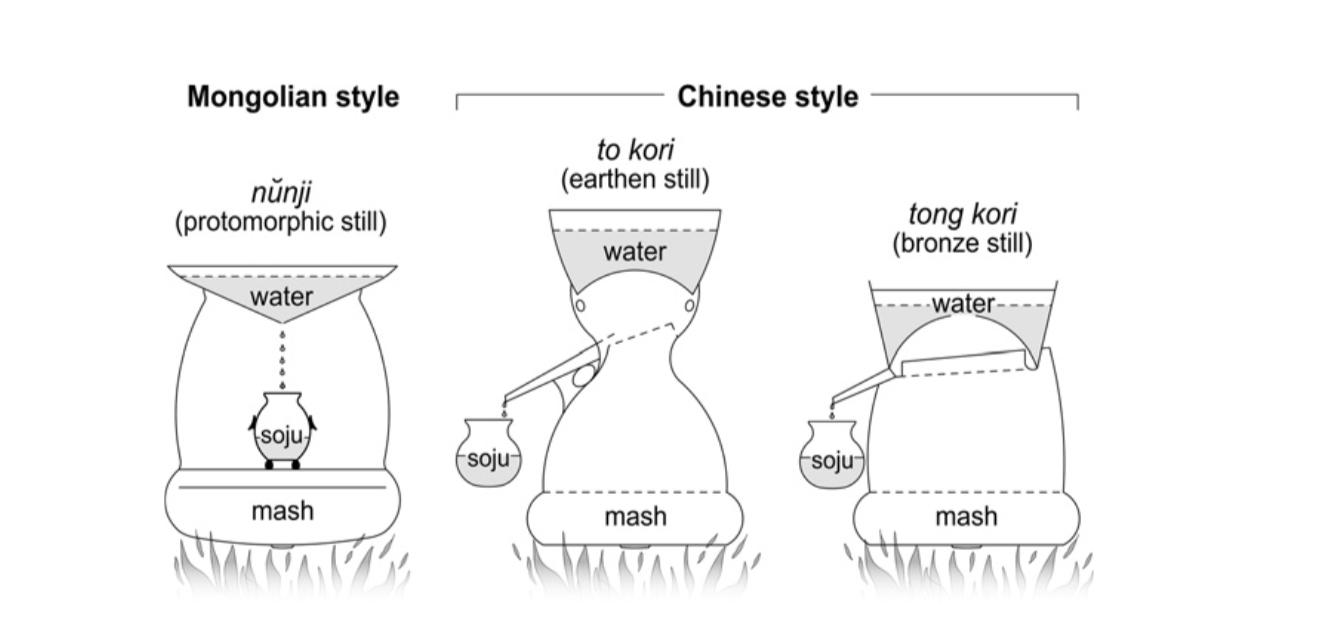
Fig. 1. Types of traditional Korean stills. Drawing by Matilde Grimaldi, after Chōsen shuzō kyōkai, Chōsen shuzōshi, 1935, p. 159. Mongolian- and Chinese-style labels follow Joseph Needham’s categorization. Park, Soju, Cambridge University Press, 2021, fig. 4.1, p. 135.
Figure 1 compares three types of stills, and the key difference is where the distilled liquid is collected. In the Mongolian-style nŭnji, a basin of cooling water sits on top and a small vessel above the mash catches the condensate inside the still. In the Chinese-style earthen (to kori) and bronze (tong kori) stills, the condensate instead runs down a spout into a vessel outside. An outside spout allowed distillation to continue without taking the still apart. The nŭnji resembles the large pot, inverted lid, and small cup that Hyunhee Park describes for early Choson, which supports her suggestion that Mongolian portable-still technology could have reached Korea near the end of the Koryŏ period. The spouted sojugori, however, falls into the Chinese-style category, a reminder that the history of distillation technology and the history of the still’s form are not identical.
Origins: The Transmission of Distillation Technology
Before distillation reached Korea, alcohol was produced only through fermentation and produced milder drinks. Distilling these into stronger liquor required new equipment, since an ordinary fermenting jar could not capture and condense vapor. The sojugori filled this need and gradually became part of Korean craft practice. Park places the rise of Korean soju within the wider movement of technologies, people, and goods across Eurasia during the Mongol period. Distillation had developed in China and spread through networks connecting different regions. Merchants and Mongol military personnel may have contributed to its transmission, but the precise route and timing are uncertain. This uncertainty matters because the history of distillation technology is not identical to the history of the sojugori design. Evidence supports the spread of distilled alcohol into Korea during the late Koryŏ period, but it does not establish that the Mongols introduced the apparatus seen in Figure 1. The Academy of Korean Studies identifies the late Koryŏ period as the likely time the sojugori appeared, possibly extending into early Choson. The Korean still also drew on more than one tradition. Korean distillers adopted the outside-receiving spout of the Chinese still, but they used it to distill liquid grain wine, retaining the liquid-distillation approach of the Mongol tradition. This combination is what makes Korean distillation an adaptation and not a simple copy. Korean distillers reshaped a foreign technique to fit local grain-based brewing, and the sojugori was at the center of this adaptation.
Materials and Construction: Adapting the Technology
The sojugori was made from earthenware, copper, and brass. Earthenware versions were constructed as one connected piece, while copper and brass versions could have detachable upper and lower sections. The apparatus typically measured approximately 40 to 60 centimeters in height, and larger examples sometimes included handles near the base. These differences indicate the skills needed to convert raw materials into useful distillation equipment. Potters shaped and fired clay vessels so that they could withstand the stresses of heating, and metalworkers on the other hand created different designs by using particular construction techniques and removable parts. Although the available sources do not name any particular makers or workshops, the fact that both clay and metal equipment exist indicates that various forms of specialized craftsmanship were involved in the development of distillation technology.
The apparatus also required careful assembly. Practitioners had to position the still above the pot, secure the lid or cooling basin, and seal gaps so that vapor traveled through the intended route. The cooling surface had to remain effective for condensation to occur, while the spout needed to direct the liquid into a separate container. The sojugori demanded precision in its construction because vapor had to travel a specific route. A poor seal between sections or a badly shaped spout would undermine its function. Unlike an ordinary fermenting jar, which only had to hold liquid, the still also had to direct vapor, cool it, and channel the result into a separate container. The making of the sojugori, like its use, therefore required specialized skill.
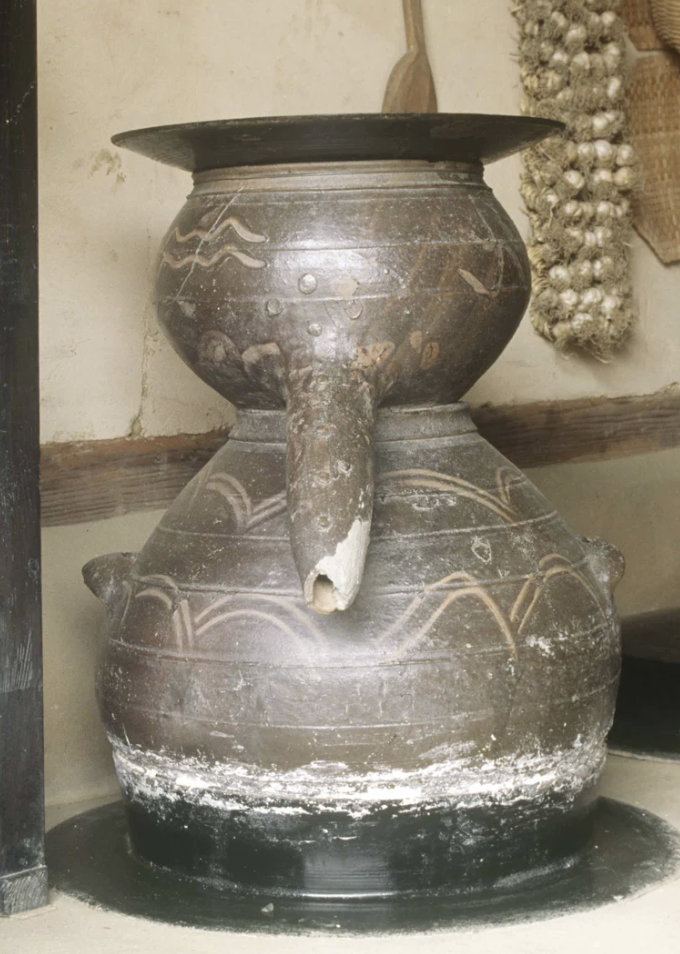
Fig. 2. Traditional Korean sojugori (소줏고리), an earthenware distillation apparatus. Handok Pharmaceutical Museum. "소주고리 [Sojugori]." 한국민족문화대백과사전 [Encyclopedia of Korean Culture], 2026, encykorea.aks.ac.kr/Article/E0030278. Accessed 12 Oct. 2026.
Figure 2 shows an earthenware sojugori assembled for use. Two rounded vessels are stacked and joined at a narrow waist, and a wide, shallow lid sits on top, consistent with the cooling surface described by the Academy of Korean Studies. A long spout projects from the upper vessel, carrying condensed liquid out of the apparatus, which matches the to kori in Figure 1. Small lugs on the lower vessel served as handles, and incised wavy lines and studs decorate the surface, so the object reflects both function and care in making.
Practitioners and the Culture of Production
Soju distillation involved practitioners from different social positions. In the royal court, the Royal Medical Office distilled red soju (hongsoju) from clear rice wine in silver vessels normally used for preparing medicine. By contrast, some ordinary households distilled liquor for family use and rituals, though, according to the National Folk Museum, not all owned a still, and some borrowed or rented one. Potters and metalsmiths supported all of these practitioners by making the stills themselves.
Women played a central role in household alcohol-making and in passing on the knowledge it required. The clearest evidence is Ŭmsik timibang (also titled Gyugon siuibang), a cookbook written around 1670 by Lady Jang of Andong, also known as Lady Chang Kyehyang, for her daughters and daughters-in-law. Of its 132 items, 51 concern alcohol, which the encyclopedia entry reads as a sign that brewing was an important task for housewives.The author also asked her daughters to copy the book and keep it safe, so the knowledge was meant to travel from one generation of women to the next. Figure 3 shows an open spread of the manuscript, written out by hand in Hangul with a Chinese poem on the facing page, a reminder that this knowledge was recorded to be copied and passed on. A written recipe can only partly capture skills such as judging heat or sealing a still, so the book likely worked alongside hands-on instruction within the household.
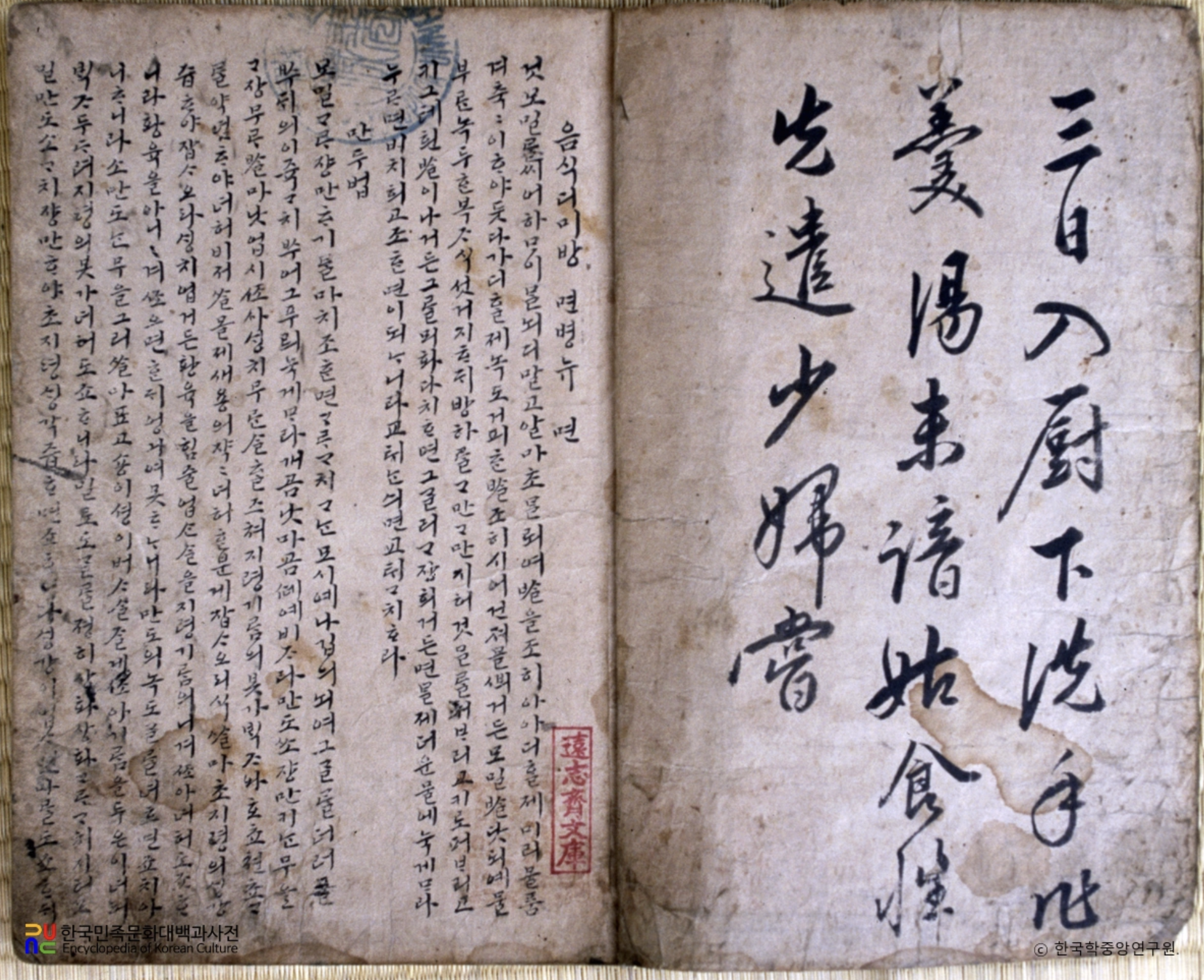
Fig. 3. Open pages of Lady Jang of Andong, Ŭmsik timibang (also titled Gyugon siuibang), ca. 1670. Hwang Hye-seong, "규곤시의방 [Gyugon Siuibang]." 한국민족문화대백과사전 [Encyclopedia of Korean Culture], 2025, encykorea.aks.ac.kr/Article/E0007249. Accessed 12 Oct. 2026.
Social Context: Household Production and Specialized Labor
In the Choson era, distillation was incorporated into household routines and social customs, since families needed alcohol for ancestral rites, hospitality, and family events. Distilling was more demanding than fermentation because it required using special equipment and carefully managing both heat and cooling Not every household owned a sojugori. The National Folk Museum of Korea notes that making soju required more skill and effort than brewing fermented drinks, so only some families had their own stills. Others would borrow or rent one when needed. This suggests that access to distillation depended on both equipment and expertise, including the ability to regulate heat, maintain cooling, and seal the apparatus so that vapor followed the intended route. This use of experience-based knowledge rather than step-by-step instructions corresponds to the concept of tacit knowledge: regulating heat, vapor flow, and seals was an embodied skill that could not be fully mastered through written text alone.
Economic and political elements also influenced soju distillation. Making distilled liquor used a lot of grain for a small yield, so it was expensive. Production likely picked up after harvests and demand spiked around holidays like Lunar New Year Because grain was essential to the food supply, authorities restricted alcohol production during periods of drought and famine. These restrictions created a tension between social demand for distilled spirits and the government’s responsibility to protect food resources. As a result, soju distillation depended not only on access to equipment and technical knowledge, but also on agricultural conditions and government policy. These conditions explain how an imported technique became a local craft: the materials of the stills point to potters and metalsmiths as their makers, households supplied the skill to operate them, and the state’s control of grain set the limits within which both worked.
Conclusion: Soju Distillation and the Sojugori
Soju distillation in premodern Korea was shaped by technology, materials, family life, and government policy—and the sojugori makes this history visible. The sojugori likely appeared during the late Koryŏ or early Choson period, as distillation technology arrived from the Mongol-Yuan era. Its spouted, Chinese-style design was adapted for local grain-based alcohol, showing innovation rather than simple copying. Versions in earthenware, copper, and brass highlight the skill of craftspeople, while successful operation depended on precise heating, cooling, and sealing. Potters and metalworkers created the equipment; households preserved and shared the know-how, as seen in Lady Jang’s cookbook; and the state set boundaries based on grain supply. The sojugori tells a story not just of making liquor, but of how foreign technology was transformed by Korean expertise and woven into everyday life, shaped by skill, resources, and society’s needs.
End notes:
Hyunhee Park, Soju (Cambridge University Press, 2021), p. 21.
Park, p. 144
Park, pp. 132-144
Park, pp. 135-136
Park, pp. 96-99
"소주고리 [Sojugori]," 한국민족문화대백과사전 [Encyclopedia of Korean Culture], 2026, encykorea.aks.ac.kr/Article/E0030278.
Park, pp. 143-144
“Distiller,” Google Arts & Culture, National Folk Museum of Korea, artsandculture.google.com/asset/distiller-unknown/ZAG9XQrW1mKZgQ. Accessed 11 Oct. 2026.
Korean Culture and Information Service, “Alcohol in Korean Life [7],” Korea.Net, 21 Jan. 2014, www.korea.net/NewsFocus/Culture/view?articleId=117176.
Yu-sang Baek, "약이 술술 붉은빛 소주 [Red Soju That Goes Down Smoothly]," 한국한의약진흥원 웹진, Mar. 2024, nikom.or.kr/webzine/vol07/sub2_3.html.
National Folk Museum of Korea, “'술꾼 조상들'이 설날 술을 마신 까닭 [Why Our Ancestors Drank Alcohol on Lunar New Year],” 국립민속박물관 웹진, 2 Feb. 2022, webzine.nfm.go.kr/2022/02/02/%ec%88%a0%ea%be%bc%ec%a1%b0%ec%83%81%eb%93%a4%ec%9d%b4-%ec%84%a4%eb%82%a0-%ec%88%a0%ec%9d%84-%eb%a7%88%ec%8b%a0-%ea%b9%8c%eb%8b%ad/.
Korean Culture and Information Service, “Alcohol in Korean Life [7],” Korea.Net, 21 Jan. 2014, www.korea.net/NewsFocus/Culture/view?articleId=117176.
National Folk Museum of Korea, “'술꾼 조상들'이 설날 술을 마신 까닭
National Folk Museum of Korea, “'술꾼 조상들'이 설날 술을 마신 까닭
Works Cited
Baek, Yu-sang. "약이 술술 붉은빛 소주 [Red Soju That Goes Down Smoothly]." 한국한의약진흥원 웹진 [Korea Institute of Oriental Medicine Webzine], Mar. 2024, nikom.or.kr/webzine/vol07/sub2_3.html. Accessed 11 Oct. 2026.
“Distiller.” Google Arts & Culture, National Folk Museum of Korea, artsandculture.google.com/asset/distiller-unknown/ZAG9XQrW1mKZgQ. Accessed 11 Oct. 2026.
Hwang, Hye-seong. "규곤시의방 [Gyugon Siuibang]." 한국민족문화대백과사전 [Encyclopedia of Korean Culture], 2025, encykorea.aks.ac.kr/Article/E0007249. Accessed 12 Oct. 2026.
Korean Culture and Information Service. “Alcohol in Korean Life [7].” Korea.Net, 21 Jan. 2014, www.korea.net/NewsFocus/Culture/view?articleId=117176. Accessed 11 Oct. 2026.
National Folk Museum of Korea. “'술꾼 조상들'이 설날 술을 마신 까닭 [Why Our Ancestors Drank Alcohol on Lunar New Year].” 국립민속박물관 웹진, 2 Feb. 2022, webzine.nfm.go.kr/2022/02/02/%ec%88%a0%ea%be%bc%ec%a1%b0%ec%83%81%eb%93%a4%ec%9d%b4-%ec%84%a4%eb%82%a0-%ec%88%a0%ec%9d%84-%eb%a7%88%ec%8b%a0-%ea%b9%8c%eb%8b%ad/. Accessed 11 Oct. 2026.
Park, Hyunhee. Soju. Cambridge University Press, 2021.
"소주고리 [Sojugori]." 한국민족문화대백과사전 [Encyclopedia of Korean Culture], 2026, encykorea.aks.ac.kr/Article/E0030278. Accessed 12 Oct. 2026.
Works Consulted
Bawden, Charles R. “Kublai Khan.” Encyclopædia Britannica, 1 Jan. 2019, www.britannica.com/biography/Kublai-Khan. Accessed 11 Oct. 2026.
Teekah, Ethan. “Pax Mongolica.” Encyclopedia Britannica, 13 Aug. 2026, www.britannica.com/event/Pax-Mongolica. Accessed 11 Oct. 2026.
