The True Colors of Choson Women: Analyzing the Craft of Color in Saekdong Through Women’s Garment Making
Behind every great artist is an infinite number of decisions, and the women behind saekdong are no different.
Saekdong is the craft of dying, weaving, sewing vibrant strips of silk to create an array of visually pleasing colors that are incorporated into wrapping cloths, garments, and other fabric goods. This craft is deeply traditional, having been said to have roots dating back to 500 B.C.E.1 However, the incorporation of saekdong into celebratory garments and children’s garments was a notable trend that started in the Choson period and has continues on into modern Korea.1,2
With the Neo-Confucian revolution that followed Goryeo Dyansty’s fall, women’s role in the public sphere decreased dramatically over the following centuries.3 From the loss of the uxorilocal system to the widespread distribution of oppressive books outlining the virtues of women, or even the architectural segregation of men and women in the house, the Choson Dynasty came with a notable loss of autonomy for women.3,4 Textile crafts was one of the ways women worked within the oppressive patriarchal framework to established themselves as worthy of respect to the men who valued Neo-Confucian ideologies while simultaneously expressing themselves. In other words, the crafting of garments was a medium through women could choose to conform to the expectations of the time to manipulate the views husbands, fathers, officials, and sons had of them to optimize their social standing and the treatment they received. Within this practice, it’s not surprising that there are means through which women’s aspirations were expressed subtly in their crafts as well. Women who wove children’s garments as well as celebratory garments began involving saekdong more frequently as a technique in their textile work during the Choson era to imbue their hopes for the future of the society on the work. This was both a display of their expected practice of “womanly” Neo-Confucian virtues as well as a reflection of their hopes for the future of Choson society.
Before examining the crafts themselves, it’s important to understand the crafts people. As Neo-Confucian values flooded every corner of Choson life, women in particular were the targets of —what scholars like Martina Deuchler have called— indoctrination or “a major propaganda campaign.”4 Despite being allowed to become literate in vernacular Korean, women were prescribed books like Four Books for Women, Illustrated Guide to the Three Bonds, and Elementary Learning (among a swath of other titles) that exemplified virtuous women who put their lives at risk, or even committing suicide, to remain pious.4 One notable feature of these texts was that they defined the so-called “female virtues”; women were to spend their time in private, cooking, children rearing, and doing textile work. Deuchler states in a different paper how after the age of seven, girls were kept away from boys and men and kept in the house more and more in order to be trained on the cultivation of silkworms, among other training for filling their filial role after marriage.3 Beyond just an outline of “virtuous labor,” Confucian ideals pushed the notion that it was not proper for a woman to express her feelings.4 With innumerous limitations on interactions beyond the walls of the household on top of private conduct, women had very few avenues for expressing themselves or sharing their own thoughts. Even in textual petition records, it is hard to distinguish if the written word was true to how women felt because the rhetorical strategies for ensuring safety while communicating discontent was indistinguishable from the rhetorical voice of a woman who devotedly followed the Confucian law.5 In reality, due to the deep reach of female indoctrination into private space, and the ever persistent framework of patriarchy in preservation, no matter how much the rhetoric is debated or teasing out, Korean historian may never answer the question about how the women of Choson Korea authentically felt or experienced life from their own perspective. Despite this impossible question, it is still possible to collect and analyze artifacts produced by women in hopes of getting closer to understanding the lives, desires, and pride of women in Choson Korea. To do this, a new medium must be analyzed.
One such craft was the textile technique of saekdong seen on celebratory garments. Saekdong is recognizable for its characteristic repeated use of 5 to 7 vibrantly colored, even width stripes of silk. With its rise in popularity in the Choson era, it was frequently seen on shaman’s robes, celebratory garb, and children’s wear.2 Saekdong originated from the adjacent craft of geum —the practice of double or triple weaving silk fabric into patterns with multi-color warps.2 Unlike the bulky product of geum, Saekdong drew inspiration from the five-colored geum and continued the motif of colorful stripes.2 Many of these crafts women began the process by cultivating silk worms, harvesting the fiber, dying the threads, weaving the silk, and then using the fabric to produce the saekdong design which could be incorporated into the celebratory garb. The silk was woven on looms and the sewing done meticulously by hand.
As any good artist would know, color is never a surface level choice; The same was true for saekdongs. In Korea, color is imbued with broad spiritual and philosophical significance. As stated by Ok Hyun Kim, red was associated with sky, man, and Yin, blue was associated with earth, women, and Yang, and yellow took on the meaning of humankind.6 Often in celebratory wear, five colors were chosen to represent wood, earth, water, fire, and metal.6 Despite the Neo-Confucian revolution, the order of saekdong was important in correspondence to Daoist philosophy that remained. The harmony of colors was thus part of the craft itself. It was noted that if only two colors were to ever be picked for patchwork designs it must be red and blue, if three then red, blue, and yellow, and if five then red, blue, yellow, white, and black as per the philosophy of Taeguk, Dae-samjak norigae, and Obang Confucian cosmology color philosophy respectively.6 According to the National Folk Museum in Korea, the colors of Korean culture have even broader symbolism than Kim states. White represented purity, innocence, rectitude, and temperance. Black represented darkness, death, formality, dignity, and rules. Red took on the meaning of authority, exorcism to ward off evil spirits or bad luck, pursuits of happiness, cohesion, and solidarity. Blue embodied spring, youth, hope, and uptopia. Finally, yellow was holiness, wealth, authority, fertility, and warning.7 Other colors such as green represent youth and vitality, pink represents innocence and femininity, and purple symbolizes wealth and elegance.8 The Folk Museum agrees with Kim that the pursuit of Yin and Yang in color harmony was one that continued as part of cosmology that spread with Neo-Confucianism. Without modern day synthetic dyes, Choson women obtained textile dyes from plants and roots such as safflower and redwood for red, indigo for blue, and gardenia, turmeric, or gold thread for yellow.6 In these ways, women wove intricate designs with colors that could speak far more words than they were supposed to for themselves. Color became a language in itself, largely untouched by the Confucian oppression of expression.
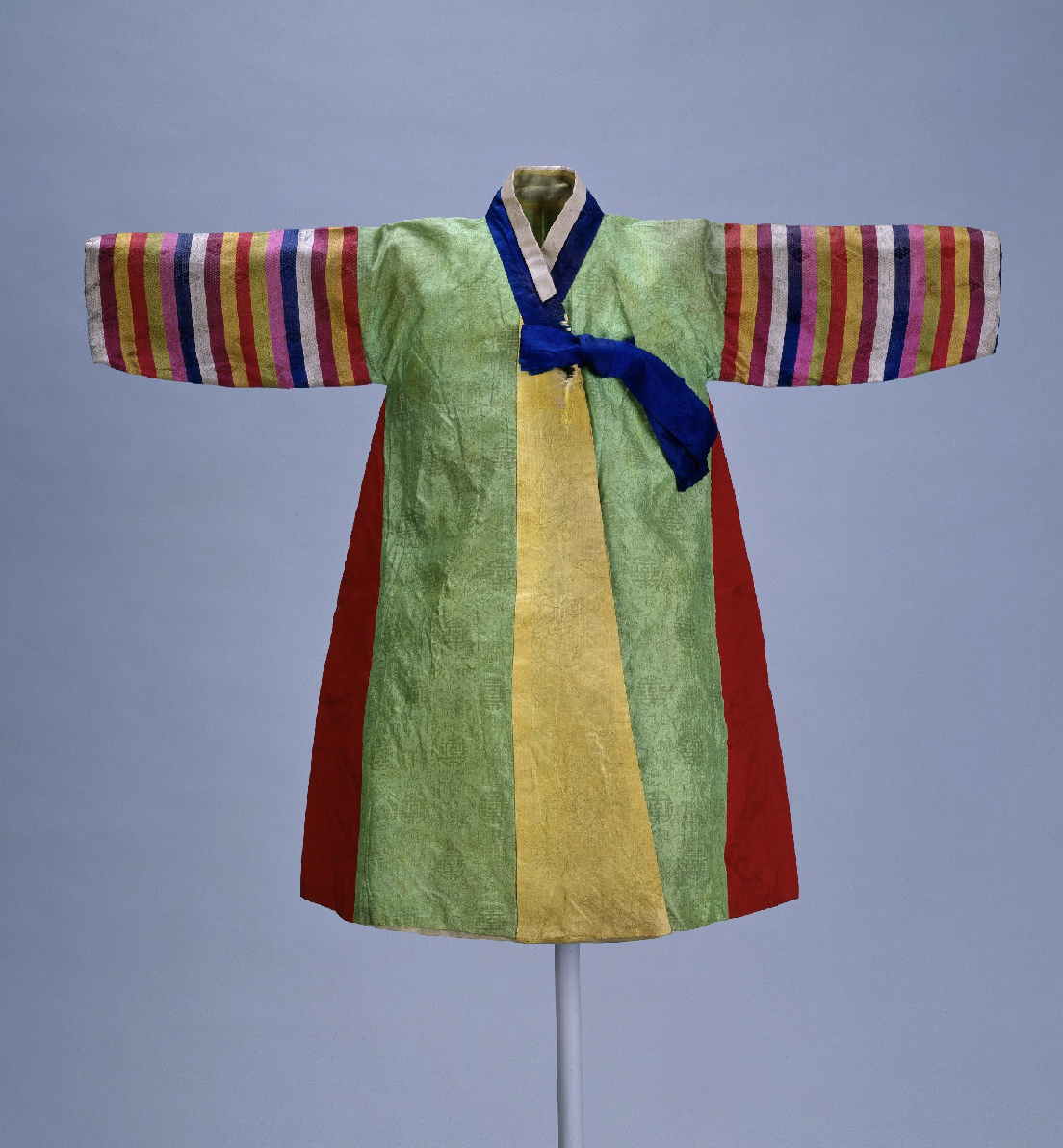
Figure 1:
Boy’s Festival Robe.10
Now with an understanding behind the significance and language of colors, the use of colors can be observed here in this boy’s festival robe on display in the Peabody Essex Museum in Salem, Massachusetts in the United States of America. The sleeves of this artifact are seen are seen to incorporate red, yellow, purple, white, blue, pink, and green stripes. The symmetrical sleeves and evenly spaced design is a key feature of saekdong. Often in children’s wear, black was omitted for its negative connotations.1 It is clear in this garment that the mother was crafting not only a garment for her son but a character which she saw in her son; A character of innocence, youth, wealth, prosperity, purity, and vitality. One can image that of all the colors available to the mother, she was able to choose a series and frequency that to her embodied her desires for her child who would grow up to be part of the future of Choson. Unlike the mother, the male child wearing the festival robes would be seen by the public eye as a child of hers and either be celebrated or part of a larger celebration. In this way she was able to enact agency within the narrow and rigid range of her “virtuous duties” to create an image of what her hopes were for the direction of growth for her son and make a subtle but clear statement about what she aspired for both in him but also in his prospective future in the Choson bureaucracy.
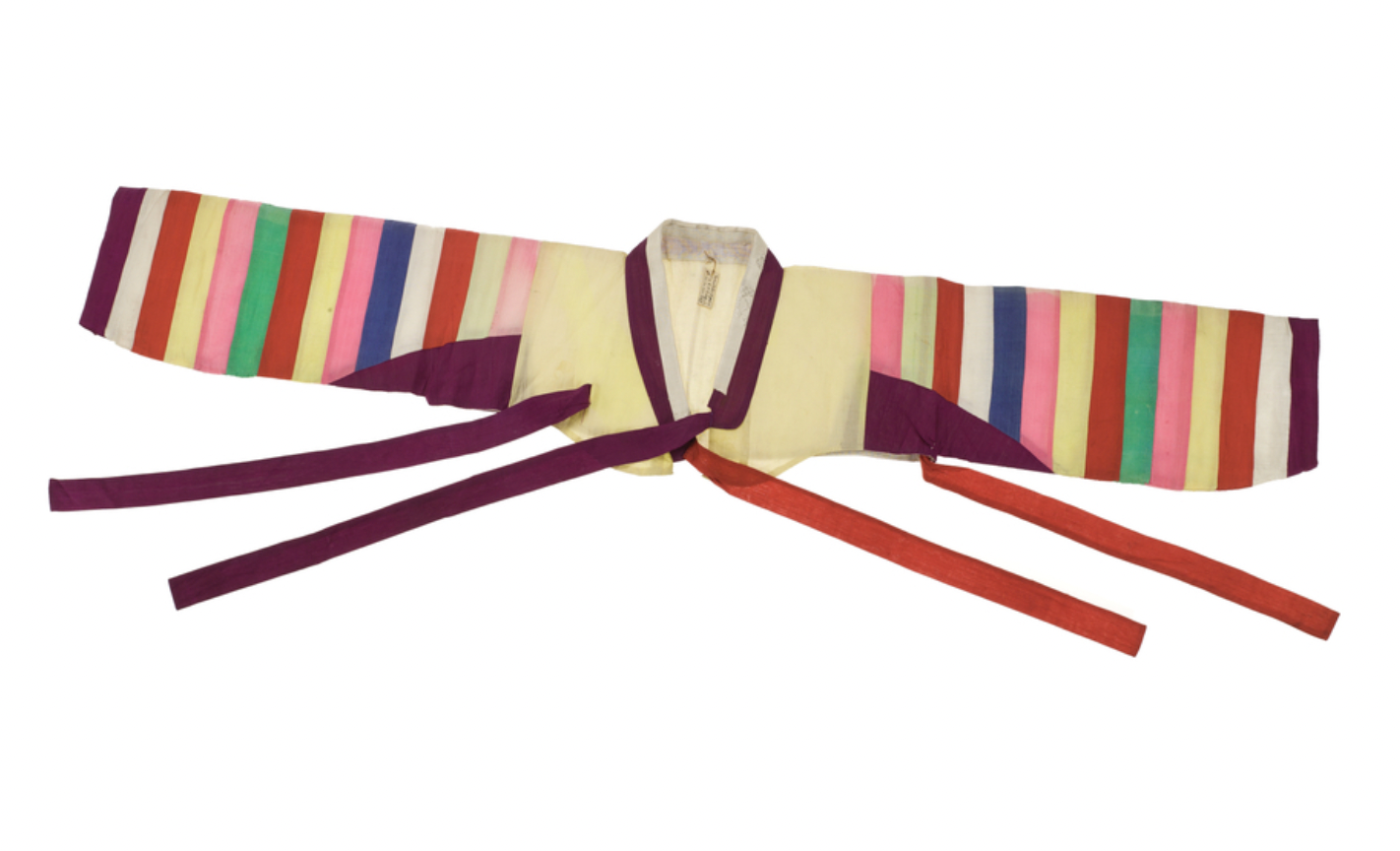
Figure 2:
Girl’s Jacket.11
Another instance of a mother producing a garment for her child can be seen in a girl’s jacket from the collection of the National Museums Scotland. In comparison to the boy’s robe which had two stripes, it may be notable that the girl’s jacket has three pink stripes with the first one being closes to the body of the garment, unlike the boy’s robe. Further, far fewer stripes of blue and green are seen on this jacket when compared to the colors of red, pink, and yellow. With red being a color for sky and men, yellow being a color of wealth, and pink being innocence and femineity. Perhaps the mother had hopes of her daughter preserving her femineity, and marrying a well-off man to ensure that she is well cared for emotionally and financially. Knowing that girls and women had far less control over securing their autonomy and preserving their social status, this may have been the mother bestowing her wisdom and reflecting her worries upon her daughter through this series of unevenly repeating colors.
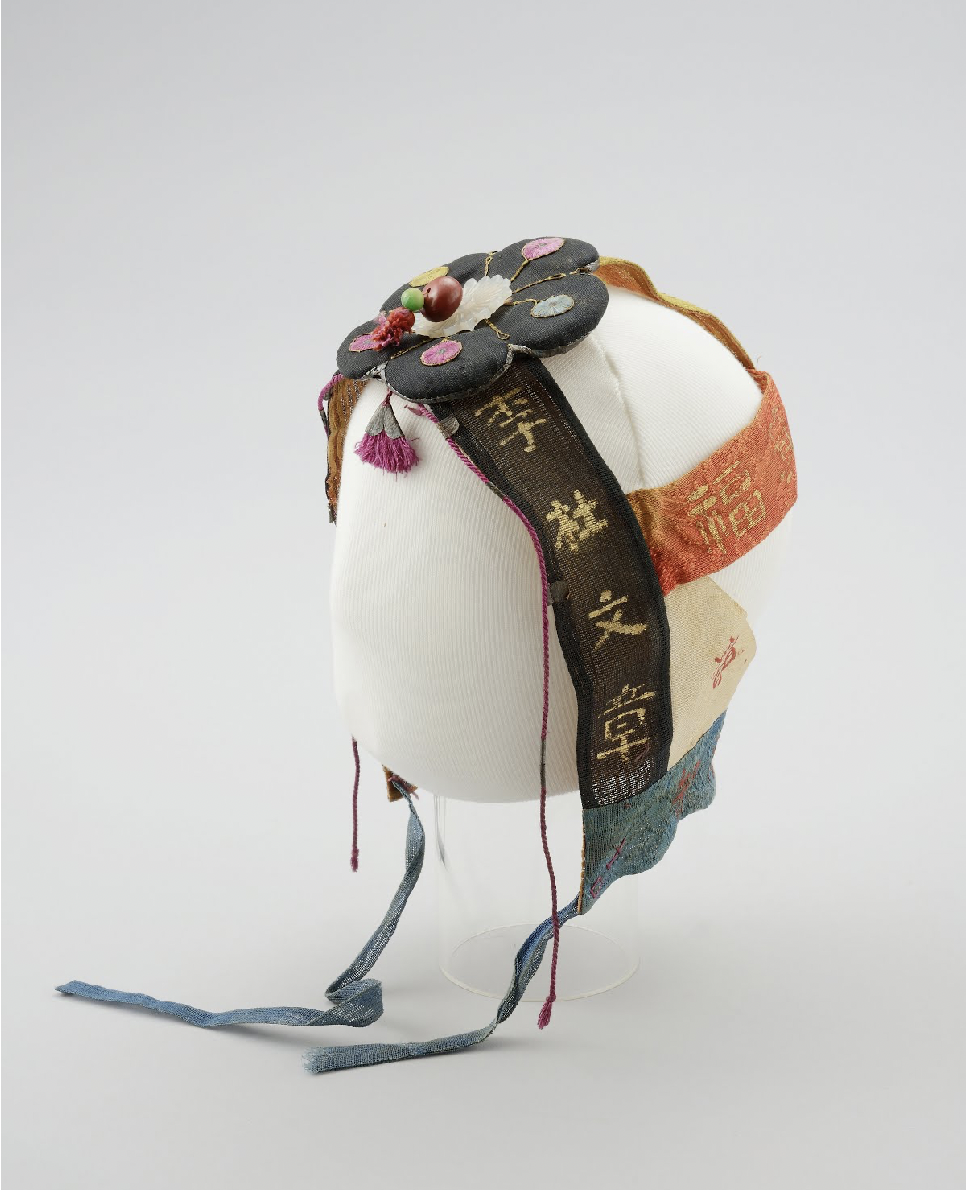
Figure 3:
Girl’s Headpiece.12
Beyond just saekdong and coats, women crafted colorful headpieces with a similarly deliberate notion of color to reflect wishes and dreams for their children. In the head piece, the colors are notably blue for earth and girls along with yellow orange for prosperity. The writing, as translated by Dr. Hyeok Hweon H.H. Kang, states, “The literary accomplishments of Li Bai and Du Fu.” Dr. Kang explains that Li Bai and Du Fu were two famed poet-literi, thus he interprets the statement as a wish to the daughter, “May you write as brilliantly as Li Bai and Du Fu.” Given that the writing is in classical Chinese, it was possible that the woman herself did not write the characters, however, with textiles being considered “feminine work,” it can be assumed that it was her desire to have these words inscribed. In this way, the woman was able to present a worn textile craft to her child as a physical expression of her feelings and opinions about what kind of person she wants her child to grow up into.
In the 20th century, saekdong was still seen in bridal robe sleeves, in bedding, and festival wear. However, in the 21stcentury, only one saekdong factory with one remaining producer remains.9 Despite the practice seeming to have fallen out of fashion, saekdong still remains a colorful part of Korean history that interwove women’s lives, traditional craftsmanship, and Confucian teachings and practices. The fiber crafting skills of weaving, sewing, and garment making that were wrapped in the mastery of saekdong, was in this way not only a way for mothers to appear virtuous and pious, but this was also a medium through which women made symbolic statements about their hopes for their children. This thought could be extrapolated to say that women were making subtle statements about the morals and traits they valued in the next generation of Choson people who would steer the society’s growth. Perhaps the lack of understanding surrounding female experience of Choson Korea has not hit a dead end due to lack of resources, rather we have yet to choose the right language to understand them through.
Sources:
1. Na, Jisu Kim and Youngjoo. “The Characteristics of Korean Traditional Fabric of Saekdong.” Lupine Publishers, Lupine Publishers, 2 May 2019, lupinepublishers.com/fashion-technology-textile-engineering/fulltext/the-characteristics-of-korean-traditional-fabric-of-saekdong.ID.000163.php.
2. Kim, J., Na, YJ. Triangulation proves Geum brocade with the horizontal loom of Gojoseon.Fash Text 9, 32 (2022). https://doi.org/10.1186/s40691-022-00309-5
3. Deuchler, Martina. The Confucian Transformation of Korea : A Study of Society and Ideology. Distributed by Harvard University Press, 1992, https://doi.org/10.2307/j.ctt1dnn8zj.
4. Deuchler, Martina, et al. “Propagating Female Virtues in Chosŏn Korea.” Women and Confucian Cultures in Premodern China, Korea, and Japan, University of California Press, 2019, pp. 142–69, https://doi.org/10.1525/9780520927827-010.
5. Kim, Jisoo M. “Women’s Legal Voice: Language, Power, and Gender Performativity in Late Chosŏn Korea.” The Journal of Asian Studies [New York, USA], vol. 74, no. 3, 2015, pp. 667–86, https://doi.org/10.1017/S002191181500056X.
6. Ok-Hyun Kim. “COLOR PHILOSOPHY IN KOREA.” AIC MEETING SEOUL, vol. 2000, no. 11, 2000, pp. 72–72. https://www.dbpia.co.kr/pdf/pdfView.do?nodeId=NODE06702800
7. National Folk Museum of Korea, Seoul, South Korea - Google Arts & Culture.” Google Arts and Culture, Google, artsandculture.google.com/partner/national-folk-museum-of-korea. Accessed 15 Oct. 2026.
8. “Hanbok Color Symbolism: Decoding Traditional Meanings: Simcorner Au.” SimCorner, 15 Feb. 2024, simcorner.com/blogs/travel-guides/hanbok-color-symbolism-decoding-traditional-meanings.
9. Se-jeong, Kim. “Korea’s Last ‘Saekdong’ Weaver Keeps Colorful Tradition Alive.” The Korea Times, The Korea Times, 4 Dec. 2025, www.koreatimes.co.kr/lifestyle/koreanheritage/20251202/koreas-last-saekdong-weaver-keeps-colorful-tradition-alive.
10. “Boy’s Festival Robe - Peabody Essex Museum - Google Arts & Culture.” Google Arts and Culture, Google, artsandculture.google.com/asset/MwF1WAN9kFcb4Q. Accessed 15 Oct. 2026.
11. “Jacket, Girl’s - National Museums Scotland.” National Museums Scotland, World Culture, www.nms.ac.uk/collections/search/object?entry=322676. Accessed 15 Oct. 2026.
12. Gulle, Bonnet for Girls - Seok Juseon Memorial Museum, Dankook University.” Google Arts and Culture, Google, artsandculture.google.com/asset/gulle-bonnet-for-girls/OQFus_5hTbITzA. Accessed 15 Oct. 2026.