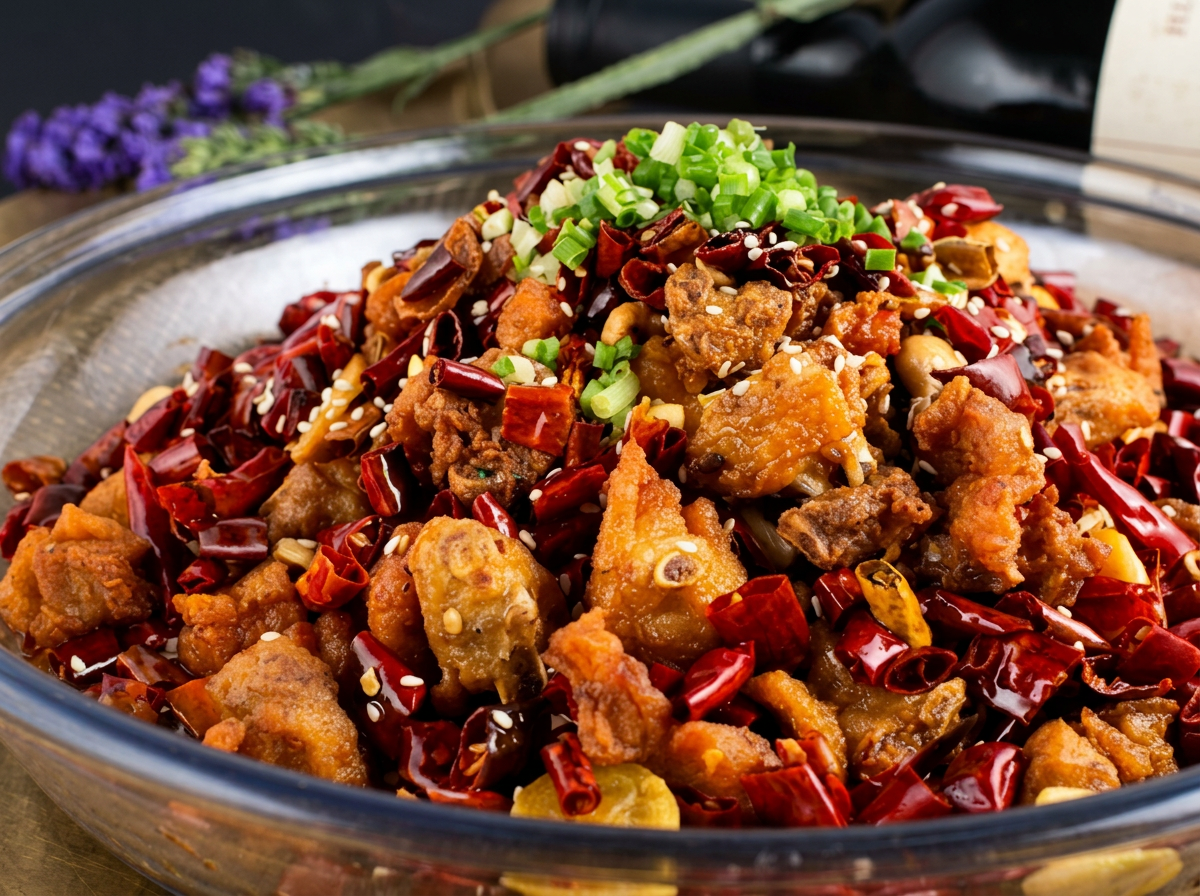
Chili Pepper Chicken (라조기)
Chili Chicken with a Shandong Accent:
The Rise and Slow Simmer of Rajogi
Seoul, in the giddy months after liberation. In a house still floored with Japanese tatami, Bang Sam-bok, a former farmhand and shoe-mender grown suddenly rich on the scraps of English he picked up in Shanghai, drinks beer with a resentful elder from his hometown. He boasts that he has drunk the waters of all three East Asian nations and gets by in Chinese, Japanese, and English alike; beer, he pronounces, is the only true drink, and even in drinking the Americans are more civilized than Koreans. Then the farmhand slips out from under the new suit. He wipes the foam from his lips with the back of his hand, picks up a piece of najogi with his fingers, and crunches it.¹
The scene, from Chae Man-sik's 1946 satire "Mister Bang," is a still life of shifting appetites: Japanese floors, American beer, the reflexes of a Korean field hand, and, crunching between an upstart's teeth, a Chinese dish. Or rather, a dish that claims to be Chinese. Najogi, now spelled 라조기 (rajogi), is chili chicken, fried and then dressed in a glossy, chili-slicked sauce, and it has held a place on the menus of Korea's Chinese restaurants for generations while remaining, in this form, all but unknown in China itself. It is, in other words, a China that exists chiefly in the Korean imagination. By tracing 라조기 from the woks of Shandong migrants to the menus and delivery apps of modern Korea, this essay argues that the dish has settled into a slow simmer: receding from the neighborhood menu, holding its place in the canon, and resurging, where it resurges at all, as a flavor rather than a plate.
This dish, while rare outside of Korea and increasingly unheard of even within, is near and dear to my heart and, more so, my stomach. My grandparents introduced it to me in my youth, and it has never been absent from the table if present on the menu. While the classic Sino-Korean culinary combo would be 짜장면 (jjajangmyeon) (or 짬뽕, jjamppong) with an order of 탕수육 (tangsuyuk), I was always partial to 라조기 at the cost of forgoing 짜장면. I have always been curious about the dish, and this is a bit of a love letter and an intellectual rabbit hole.
A Name with an Accent
Korea's standard dictionary defines 라조기 as: chicken cut into pieces, dredged in starch and deep-fried, then stir-fried with chilies, scallions, garlic, and ginger before a starch slurry binds it into a sauce.² Restaurant versions add bamboo shoots, mushrooms, and bok choy, and the result is salty, savory, and hot rather than sweet, which is what separates it from its sugar-glazed cousin 깐풍기 (kkanpunggi); its sibling 라조육 (rajoyuk) simply swaps in pork, since 肉, "meat," means pork on a Chinese menu unless told otherwise.³ The name, however, is where the dish keeps its passport. Written 辣椒鷄, "chili-pepper chicken," it should read nalchogye in Korean and làjiāojī in Mandarin, and 라조기 is neither. The linguist Han Seong-u observes that the chicken dishes of the Korean-Chinese menu, from 깐풍기 (乾烹鷄) to 유린기 (油淋鷄, yuringi) and 기스면 (鷄絲麵, giseumyeon), all end in gi rather than ji because their names hardened in the Shandong dialect of the migrants who cooked them.⁴ 라조기 belongs to the same family, and the food writer Yun Deok-no says so outright, calling it a name stitched together from Shandong dialect and Korean-style Chinese.⁵ Every Korean who orders it, then, speaks a century-old Shandong accent without knowing it.
Those migrants began opening restaurants in Seoul and Incheon in the 1880s and, after the Boxer Uprising, crossed the Yellow Sea in droves; by 1930, the peninsula counted 1,635 Chinese restaurants and 1,139 hotteok shops, staffed by some 2,349 Chinese cooks.⁶ The grandest houses, such as Seoul's Aseowon and Daegwanwon and Incheon's Gonghwachun, served Beijing and Cantonese banquet fare, and many of their owners came from Fushan county, near present-day Yantai, a cradle of Shandong cooking whose sons also ran the kitchens of Beijing. Aseowon, the historian Lee Jeong-hui records, reportedly admitted no one but Fushan natives to its kitchen.⁷ The Korean-Chinese menu still preserves the hierarchy those houses built. Cheap 식사 (siksa, meals) of noodles and rice sit on one side; costlier 요리 (yori, dishes) meant for sharing sit on the other, and 라조기 belongs firmly to the latter, priced, as Yun observes, near the top of the list.⁸ Even today, it is often one of the pricier, if not priciest, items on the dwindling number of restaurant menus that list it, and often I forgo any 식사 so that I may partake of the glorious 요리 of 라조기.
Korean-Sino-Korean Cuisine
A diner who carries the name to China is in for a surprise, though not the expected one. There, 辣子鸡 (làzijī) is common enough to have splintered into a family of regional versions, each with its own origin story. In Yun's telling, Sichuan's version was born in the mid-eighteenth century, when a Qing general fed chili-fried chicken to soldiers wilting in the damp of the Jinchuan campaigns; Shandong's descends from a retired imperial cook who opened a restaurant back home and dressed the dish up with rooster; and Guiyang's was invented after China's reform and opening, by a restaurant that sold it to visitors at revolutionary sites with tales of who had eaten it during the civil war. Yun files the first legend under "believe it or not" and admits that the second's provenance is murky.⁹ The dish's most famous modern form, meanwhile, is Chongqing's: small pieces of chicken fried dry and buried beneath heaps of dried chilies, with no glossy sauce and no vegetables, a dish that by one account was invented in the 1920s but became a national sensation only in the 1990s, half a century after Mister Bang crunched his najogi.¹⁰ China, in short, offers not one original but a quarrel of origins.
Southern Shandong's rustic 辣子鸡, as a local writer describes it today, is a stir-fry of whole local chicken and thin-skinned green chilies served to honored guests, fiery but not numbing. Yet even that writer calls it a Shandong-ized take on Sichuan cooking and concedes that written records of its history are scarce, and the dish itself hails from the opposite end of the province from the Fushan cooks who staffed Seoul's kitchens.¹¹ It is a cousin, not a proven ancestor, and it would be a mistake to read 라조기 as a garbled copy of any of these. The dish is better understood as a Korean-Chinese creation, built on the same fry-then-sauce chassis as its menu-mates 탕수육, 깐풍기, and 유린기, and tuned by cooks whose customers, as the decades passed, were increasingly Korean.¹²
For four decades, until 1992, South Korea had no diplomatic relations with the People's Republic of China, and the cooking of its Chinese residents evolved apart from the mainland it nominally represented. When newcomers arrived after normalization, they brought a different China: restaurants selling malatang and guobaorou under their Mandarin names, establishments that Koreans, tellingly, do not call 중국집 (junggukjip) at all.¹³ One Itaewon restaurant devoted to Chinese home cooking lists a dish it calls "Rajji," its rendering of làzijī, numbing heat and all, and explains it to customers as the Sichuan dish known in Korea as 라조기, a gloss that concedes the Korean name even as it corrects it.¹⁴ The modern Korean dish is thus akin to a species having undergone island syndrome, being sufficiently varied from its many potential origins, but not too different as to be unrecognizable.
Where Korean-Chinese food has traveled, it has traveled with Koreans. The regulatory squeeze and emigration of the 1970s thinned the ranks of Chinese restaurateurs in Korea, and those who left became, in Lee Jeong-hui's phrase, missionaries of Korean-style Chinese food in the United States and Taiwan; more recently, Korean-style Chinese restaurants have opened even in mainland China.¹⁵ By 2010, Korean-Chinese eateries were fixtures of most American Koreatowns.¹⁶ The missionaries, however, preached a narrow gospel. The telltale sign of a Korean-owned Chinese restaurant in America, the food writer Dennis Lee advises, is a menu bearing three dishes: 짜장면, 짬뽕, and 탕수육.¹⁷ In Tokyo, a 2022 guide to a new Korean-Chinese restaurant in Shin-Okubo led with its jet-black noodles, the ones Korean dramas made famous.¹⁸ While its more accomplished and iconic culinary compatriots embark on their world tour, expensive, niche, and bastardized 라조기 is relegated to the confines of the Korean mainland.
Decline, Plateau, or Revival?
In South Korea, 라조기 remains easy to find and easy to overlook. Yun puts the paradox neatly: the dish is familiar to Korean eyes and ears from the menu board, yet unlike 탕수육 it is not eaten often enough for the mouth to remember its taste.¹⁹ A search of DiningCode, a Korean restaurant-review aggregator, returns roughly 2,300 restaurants nationwide associated with 라조기, and a similar figure for 라조육, against some 4,500 for 유린기, 7,300 for 깐풍기, and 10,000, apparently the site's maximum, for 탕수육.²⁰ These are crude numbers, since such searches sweep up old reviews and loosely matching menus alike, but the pecking order is hard to miss: of the three fried-chicken 요리, 라조기 is the least common. A 2024 survey of the menus of Korea's Chinese restaurants likewise found the most common items to be the expected trinity of 짬뽕, 짜장면, and 탕수육.²¹ Korea's crowd-sourced encyclopedists go further, calling 라조기 a decidedly minor item that few restaurants make well and that turns up more often in school and office cafeterias than in Chinese restaurants proper.²²
The case for decline begins with the economics of the wok. 라조기 asks a cook to fry and then to build a separate sauce of vegetables, chili oil, and stock, all for a single shared plate, and Korea's Chinese restaurants are shedding precisely this kind of labor. When reporters checked the menus of 189 Chinese restaurants around Seoul's Gwanghwamun in 2024, a mere 28 still offered 짬짜면 (jjamjjamyeon), the half-and-half noodle combination, and the reporters suspected even that count was generous; one owner who dropped it in 2018 blamed rising labor and ingredient costs, since a single order took two cooks' work.²³ The kitchens themselves are closing, too. Korea lost a net 12,443 restaurants in 2025, and closures of eateries more than twenty years old reached a record 2,797, up 61 percent from 2021.²⁴ Not all of them were Chinese restaurants, but the figures describe exactly the kind of long-lived neighborhood kitchen that keeps a dish like 라조기 on the menu. Meanwhile, the Korean appetite for Chinese heat has found a new outlet. The mala craze multiplied mala-branded outlets on the delivery app Baemin tenfold between 2018 and 2019, and by 2026 the leading malatang franchise ran 589 stores.²⁵
Yet decline is not disappearance, and the case for stability is written on the menu itself. 라조기 still appears at a couple of thousand restaurants, holds its fixed seat among the 요리 beside 깐풍기 and 유린기, and has migrated into the cafeteria, a sure sign that a dish has become routine rather than rare.²⁶ Its menu-mates show the same stubbornness. Even 짬짜면, the casualty of Gwanghwamun, thrives where an owner makes it a signature; one franchise owner told reporters that it accounted for half of the restaurant's noodle sales.²⁷ A dish Koreans have been eating since at least 1946 does not vanish in a decade. It recedes, as old dishes do, into the category of things one orders when someone at the table insists. And I often do.
The case for a revival is real but oblique, because what is rising is less the dish than its flavor and the prestige of its craft. In 2020 the food giant Ottogi launched two versions of 라조장 (rajojang), a bottled chili oil, after 라조장 as a category had climbed the search rankings for Chinese sauces; the syllables that once named a banquet dish now sell a spoonful of heat for instant noodles.²⁸ The mala craze, for its part, has trained a generation of Korean palates on Sichuan heat, and by 2026 an industry insider was calling mala flavor a steady seller rather than a fad, a palate that a spicier 라조기 could court.²⁹ Television has burnished the cook's reputation as well. In the days after the September 2024 premiere of the Netflix competition Culinary Class Wars (흑백요리사, Heukbaek yorisa), searches on the reservation app CatchTable for the competing chefs' restaurants rose seventy-four-fold week on week, and bookings rose 148 percent on average, with veteran Chinese-cuisine chef Yeo Kyung-rae's Hongbogak among the beneficiaries.³⁰ Korean-Chinese menus are also trading up: one food columnist points to black-pork 짬뽕 and truffle 짜장면 as signs of a premium turn that an old 요리 could ride.³¹ Abroad, the strongest tailwind is the plainest. In a 2023 government survey of consumers in eighteen foreign cities, Korean fried chicken was both the most frequently eaten and the most preferred Korean food.³² 라조기 is fried chicken in chili sauce; if Korean-Chinese menus abroad ever widen beyond their trinity, it provides an ideal, proven platform.
Weighed together, the evidence points to neither collapse nor revival but a slow simmer. As a neighborhood restaurant dish, 라조기 is in gentle decline, squeezed by labor costs, closures, and a newer, Mandarin-speaking Chinese food scene. As a member of the Korean-Chinese canon, it holds steady, kept on the menu by habit, by cafeterias, and by the lingering prestige of the 요리. Its resurgence, such as it is, belongs to its flavor and its craft rather than its plate: the 라조 in a jar of chili oil, the celebrity of Chinese master chefs, the global appetite for Korean fried chicken. Whether those currents ever carry the dish itself abroad remains an open question, one the cooks will answer before the critics do.
The Accent Lingers
라조기 was never quite Chinese and never merely Korean. It was born of Shandong migrants who cooked banquet fare in Korea, first for their compatriots and then for their hosts, named in their accent, and preserved by a Cold War that kept the mainland at arm's length. It appears in Korean literature as a prop in a parvenu's fantasy, and in Korean life as the dish one orders when baiju is present or when a rare but devoted fan of the dish insists. Today it is outnumbered on menus, outflanked by mala, and upstaged abroad by its more iconic companions, yet its name thrives in a jar of chili oil and its craft basks in the glow of televised competition. Mister Bang crunched his najogi to show how far he had come; the dish has since traveled further still, from his beer table to the cafeteria tray, though it has seldom strayed far from the peninsula. Its flavor may one day be forgotten, but the accent will linger on the tongue.
Notes
Chae Man-sik 채만식, "Miseuteo Bang" 미스터 방 [Mister Bang], Daejo 대조 2, no. 7 (July 1946), excerpted in Kim Gyeong-jin 김경진, "[Myeongjak myeongjangmyeon] Chae Man-sik soseol 'Miseuteo Bang'" [명작 명장면] 채만식 소설 《미스터 방》 [Great works, great scenes: Chae Man-sik's story "Mister Bang"], Munhagin sinmun 문학인신문, May 1, 2024, http://www.munhakin.kr/news/articleView.html?idxno=3431. The paraphrase rests on a provisional AI translation; see the AI acknowledgment.
Wikipedia (Korean), s.v. "라조기" [Rajogi], citing the National Institute of Korean Language's Pyojun gugeo daesajeon [Standard Korean language dictionary], accessed October 16, 2026, https://ko.wikipedia.org/wiki/라조기.
Namuwiki, s.v. "라조기" [Rajogi], last modified October 13, 2026, https://namu.wiki/w/라조기.
Han Seong-u 한성우, "Kkanpunggi, maratang, gyeongjangyukseul… almyeon alsurok 'jjamppong'-in junggukjip menyupan" 깐풍기·마라탕·경장육슬…알면 알수록 '짬뽕'인 중국집 메뉴판 [Kkanpunggi, malatang, Beijing-sauce shredded pork: The more you know, the more the Chinese-restaurant menu is a mishmash], Kyunghyang Shinmun 경향신문, November 20, 2024, https://www.khan.co.kr/article/202411202054005.
Yun Deok-no 윤덕노, "[Yun Deok-no-ui siktak wi Jungguk] Jiyeokbyeol rajogi-e damgin Jungguk eumsik cheontaemansang" [윤덕노의 식탁 위 중국] 지역별 라조기에 담긴 중국음식 천태만상 [Yun Deok-no's China on the Table: The kaleidoscope of Chinese food in regional rajogi], JoongAng Ilbo 중앙일보, April 10, 2024, https://www.joongang.co.kr/article/25241792.
Lee Jeong-hui 이정희, "[Hanguk hwagyo 130-nyeonsa 6] Junghwa yorieop-ui sijak-gwa jinhwa" [한국 화교 130년사⑥] 중화요리업의 시작과 진화 [130 years of the Chinese in Korea, part 6: The beginnings and evolution of the Chinese restaurant trade], Aju gyeongje 아주경제, October 14, 2017, https://www.ajunews.com/view/20171011144537734; Han, "Kkanpunggi."
Lee, "Junghwa yorieop."
Han, "Kkanpunggi"; Yun, "Jiyeokbyeol rajogi."
Yun, "Jiyeokbyeol rajogi."
Lu Zhao, "Home-Style Spicy Chicken in the Best Way Possible," The China Project, October 29, 2020, https://thechinaproject.com/2020/10/29/home-style-spicy-chicken-in-the-best-way-possible/.
Liu Peisheng 刘培省, "Shandong weidao | Laziji: Tiaodou weilei de yingcai dandang" 山东味道 | 辣子鸡:挑逗味蕾的硬菜担当 [Flavors of Shandong | Spicy chicken: The hearty guest dish that teases the taste buds], Pengpai xinwen 澎湃新闻 [The Paper], Pengpaihao user channel, July 3, 2019, https://www.thepaper.cn/newsDetail_forward_3810752; Lee, "Junghwa yorieop."
Lee, "Junghwa yorieop."
Han, "Kkanpunggi."
"Janggang Gwanghwa (중국가정식 장강중류)," restaurant listing, AutoReserve, accessed October 16, 2026, https://autoreserve.com/de/restaurants/istqqK17aV35V4VodvQH. The listing is user-submitted, and its English menu text is likely a translation.
Lee, "Junghwa yorieop."
Kai Ma and Lola Pak, "Know Your Noodle," Character Media, January 24, 2010, https://charactermedia.com/know-your-noodle-2/.
Dennis Lee, "A 60-Second Intro to Korean-Chinese Food," The Takeout, March 4, 2021, https://www.thetakeout.com/the-3-signature-dishes-of-korean-chinese-restaurant-men-1846357969/.
Kawai Hanako 河合華子, "Kankoku dorama de onajimi no makkuro na 'jajan men' o Shin-Ōkubo 'Chincharu' de tannō" 韓国ドラマでおなじみの真っ黒な「ジャジャン麺」を新大久保「チンチャル」で堪能 [Savoring the jet-black jajangmyeon of Korean dramas at Chinchal in Shin-Okubo], Rurubu & more., updated August 13, 2022, https://rurubu.jp/andmore/article/16799.
Yun, "Jiyeokbyeol rajogi."
DiningCode, search results for "라조기," "라조육," "유린기," "깐풍기," and "탕수육," accessed October 16, 2026, https://www.diningcode.com/list.dc?query=라조기.
Statista Research Department, "Most Common Menu Items Offered in Chinese Restaurants in South Korea as of November 2024," Statista, April 30, 2025, https://www.statista.com/statistics/1611481/south-korea-chinese-restaurant-common-menus/. Only the free summary was consulted.
Namuwiki, s.v. "라조기."
Kang Eun 강은, "Junggukjip menyupan-eseo 'ㅉㅉㅁ'-i sarajyeotda?" 중국집 메뉴판에서 'ㅉㅉㅁ'이 사라졌다? [Has jjamjjamyeon vanished from Chinese-restaurant menus?], Kyunghyang Shinmun 경향신문, August 17, 2024, https://www.khan.co.kr/article/202408171200011.
Jeong Jae-hong, "Business Growth Hits Slowest Pace in 20 Years in 2025," Korea JoongAng Daily, July 6, 2026, https://www.koreajoongangdaily.com/business/business-growth-hits-slowest-pace-in-20-years-in-2025/12756502.
Choi Sin-hye 최신혜, "Baedal aep-kkaji jeomnyeonghan 'mara yeolpung'… jeonnyeon-bi eumsikjeom su 10-bae 'kkeongchung'" 배달앱까지 점령한 '마라 열풍'…전년比 음식점 수 10배 '껑충' [The mala craze conquers the delivery apps: Restaurant count jumps tenfold year on year], Asia gyeongje 아시아경제, June 4, 2019, https://www.asiae.co.kr/article/2019053115403035543; Kang Seung-yeon 강승연, "Yuhaeng kkeunnatda haji mara… maratang-eun yeojeonhi 'hwalhwal'" 유행 끝났다 하지마라…마라탕은 여전히 '활활' [Don't call it a passing fad: Malatang is still red-hot], Herald gyeongje 헤럴드경제, U.S. edition, June 23, 2026, https://www.heraldk.com/article/2026062318500079558.
DiningCode, search results; Namuwiki, s.v. "라조기."
Kang, "Junggukjip menyupan."
Choi Saeng-hye, "Just One Big Spoonful Makes Chinese Cuisine Easy… Ottogi Launches Two Types of 'Lajojang,'" Asia Business Daily, English edition, May 18, 2020, https://www.asiae.co.kr/en/article/2020051809075487157.
Kang, "Yuhaeng kkeunnatda."
Ha Seung-yeon 하승연, "'Don isseodo motga'… 'Heukbaek yorisa' sikdangdeul yeyak 148% 'kkeongchung' daebak natda" "돈 있어도 못가"…'흑백요리사' 식당들 예약 148% '껑충' 대박 났다 ["Can't get in even with money": Reservations at Culinary Class Wars chefs' restaurants jump 148 percent], Seoul Shinmun 서울신문, October 7, 2024, https://m.seoul.co.kr/news/2024/10/07/20241007500173.
Kang, "Junggukjip menyupan."
Ministry of Agriculture, Food and Rural Affairs, "Oegugindeul-ege 'hansik'-hamyeon yeonsangdoeneun menyu-neun?" 외국인들에게 '한식'하면 연상되는 메뉴는? [What dishes do foreigners associate with Korean food?], press release, January 4, 2024, https://www.mafra.go.kr/bbs/home/792/569015/artclView.do.
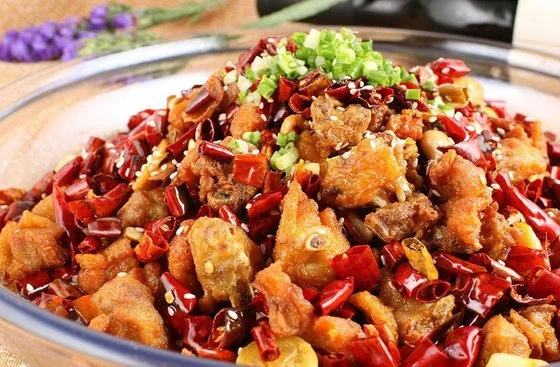
Figure 1. Sichuan-style làzijī (辣子鷄), the Chinese dish whose name Korea renders as 라조기. Image credited to Baidu (百度)
AI Acknowledgment
I used Claude Opus 5.5 (Anthropic) on October 16, 2026, to locate sources, read and translate Korean, Chinese, and Japanese material, format these Chicago citations, and generate an early draft of this essay; the prompts and responses are recorded in my AI engagement log.