Introduction: The Black Lips of Examination Candidates
During the Song dynasty civil service examinations, officials removed the tea and tents from the hall when candidates were tested on the Classics, to stop them from cheating. Shen Kuo records the result: "If examinees were thirsty, they could only drink the water in their inkslabs, which made their lips all black." [1] It is a joke about exam security, but it points to something ordinary. On the most important day of a scholar's life, an inkstone sat at his elbow, filled with ink he had to prepare himself.
Chinese sources say a great deal about ink: what it was made from, which makers were best, how connoisseurs judged it. They say almost nothing about the minutes spent turning a stick against a stone before a single word could be written. This essay asks what grinding ink by hand reveals about the labor, skill and material knowledge of writing that two texts written six centuries apart, Shen Kuo's Brush Talks from Dream Brook (c. 1090) and Song Yingxing's Tiangong kaiwu (1637), leave out.
Over three trials and about 85 minutes of grinding, I found that ink preparation was slow work that depended on technique and set the pace of writing itself. The texts leave it out not because it was unimportant, but because every literate reader already carried this knowledge in the hand.
Context: Ink, Inkstones and Their Users
The "four treasures of the study" (文房四寶) were the brush, ink stick, paper and inkstone. The inkstone (硯) is where solid ink becomes liquid, which makes it the one tool that demanded labor every time it was used. Its users included examination candidates, officials, clerks copying documents, painters and calligraphers. Shen Kuo named his own book after it: "As I could only chat with my writing brush and inkslab, I called it 'chatting with my writing brush.'" [2]
Ink was also a commodity people judged and paid for. Song Yingxing writes that "for fine ink, our dynasty esteems the people of Huizhou" (凡造貴墨者,國朝推重徽郡人). [3] Shen Kuo shows how this taste worked socially. One official tests a younger man by having a servant rub an ink ball on the steps and asking his opinion of it. [4] Another scholar refuses an inkslab priced at 30,000 cash that supposedly never runs dry, remarking that even if he blew on it all day, "the water gathered from it is only worth 3 dollars." [5] Dorothy Ko notes that an inkstone was also "a father's gift to his school-bound son, a token of exchange among friends." [6] In both periods, then, ink tools were judged by people who used them. Their judgment came from use, which is exactly the part no one wrote down.
Sources: A User and a Recorder, Six Centuries Apart
Shen Kuo (1031–1095) was a Northern Song official and polymath who wrote Brush Talks after being dismissed from office. He says he wrote to "while away my lonely days" and asks readers not to "take the topics in this book too seriously." [7] The 609 entries are anecdotes, not instructions; the earliest surviving edition was printed in 1305. [8] Shen writes as a user and connoisseur of ink. He also writes as an experimenter: in Yanzhou he made ink from petroleum soot, judged it better than pine-soot ink, and warned that "pine trees will be exhausted one day," since whole mountain ranges were already "half-bare." [9]
Song Yingxing (1587–c. 1666) was a Jiangxi scholar who failed the metropolitan examination several times. His friend Tu Bozhu paid to print Tiangong kaiwu in 1637. [10] He wrote for gentlemen who "enjoy the taste and forget the source" (如其味而忘其源者眾矣), and he insisted the book "has nothing to do with seeking office and advancement." [11] Its reception shows how little that audience cared: the book circulated poorly in Qing China and survived largely through a Japanese reprint before returning to Chinese scholarship in the twentieth century [12].
Song's ink section is about manufacture. Ink is "made by burning [material] for soot and solidifying it" (凡墨,燒煙凝質而為之); nine tenths came from pine soot and one tenth from oil soot; one jin of oil yielded only "a little over one liang" of fine soot. [13] He is honest about his limits: "Alas, I am poor!" (傷哉貧也), too poor to buy objects to check or gather experts. [14] He ends by sending readers to older ink manuals, since his account "only roughly records materials and origins" (此不過粗記質料原因而已). [15]
The two texts pull against each other. Shen predicted that pine would run out and proposed petroleum. Six hundred years later, Song reports pine still supplying 90 percent of ink, while Huizhou's makers of fine ink solved the supply problem another way: they sent men to live in Jingxiang and Chenyuan to burn cheap tung oil there and carry the soot home (遣人僦居荊襄、辰沅,就其賤值桐油點煙而歸). [13] The consumer imagined a new material; the trade answered with long-distance labor.
Yet on one point the texts agree completely: neither describes grinding. Dorothy Ko names Song as a salient example of a scholar who investigated craft skills but "had to subsume the latter into his theoretical framework when he committed his findings to writing before it became legible." [16] Song's only remark about grinding in the whole chapter concerns vermilion, which shows on a stone inkstone but turns black on a tin one. [17] The producer explains making and the consumer explains judging, but neither explains using. I treat that silence as evidence, take my grinding technique from living calligraphy practice, and test the sources' claims against my own hands.
Reconstruction: Grinding by Hand
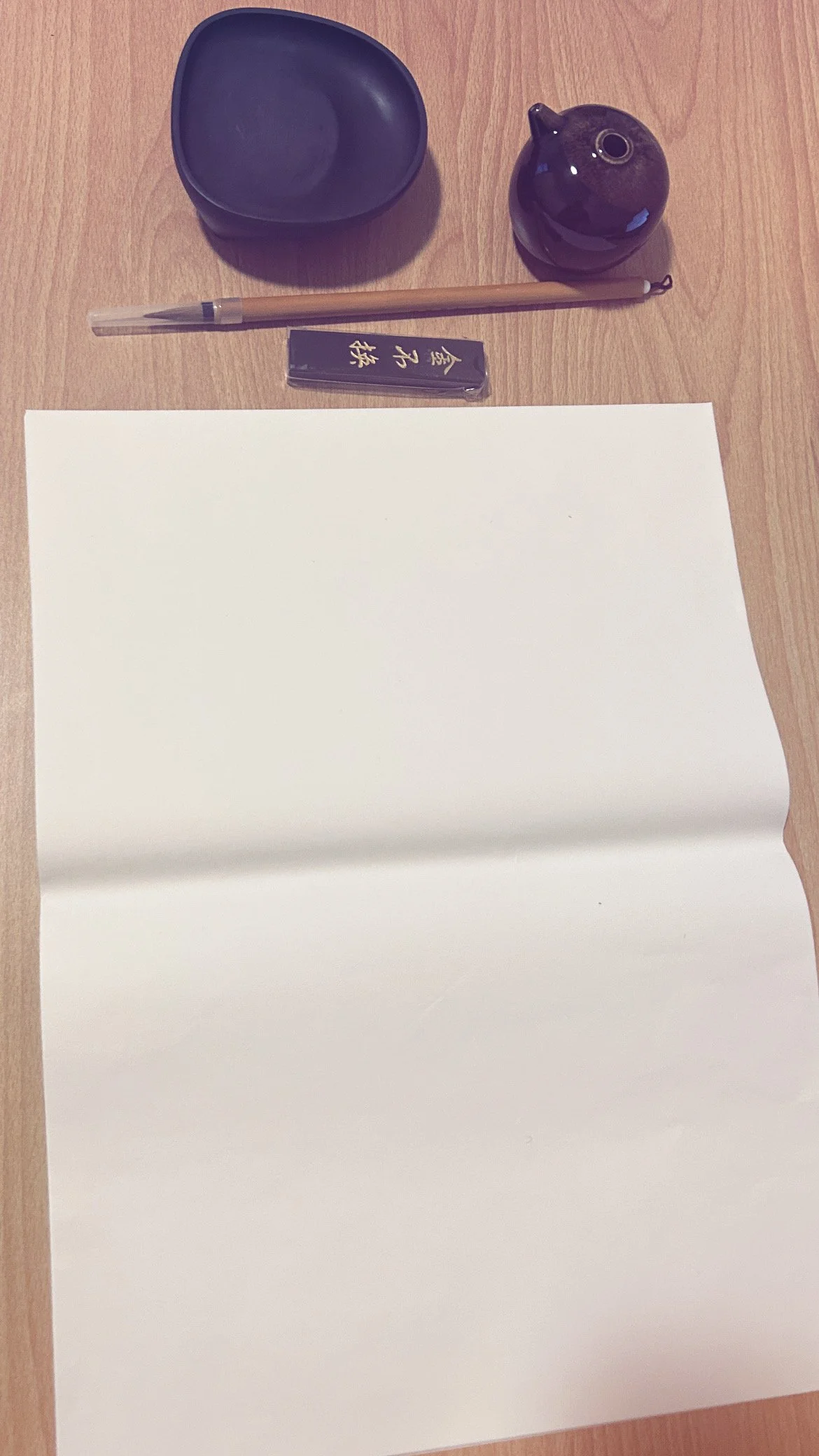
Figure 1. Materials: inkstone borrowed from Professor Kang, Hu Kaiwen oil-soot ink stick, water dropper, brushes and xuan paper. Modern substitutions: filtered water, machine-made paper and a digital timer.
I used a stone inkstone, a 31-gram oil-soot (油煙) ink stick from Hu Kaiwen (胡開文), an Anhui firm working in the Huizhou tradition Song Yingxing praised, and room-temperature water added a few drops at a time. Following current calligraphy practice, I held the stick upright, kept a thin film of water on the stone, and ground in even circles. At fixed checkpoints I made a test stroke and rated it from 1 (pale grey) to 5 (deep black), along with the feel of the stick, any grit, and my arm fatigue from 1 to 10. I recorded every trial on video. Dorothy Ko refuses to write about things she has not tried her hands at making, and notes that even photographs "fail to capture the qualities most important to the Chinese craftsman or connoisseur," such as "the softness of touch" of a good stone. [18] Grinding by hand was my way of reaching that kind of evidence.
Video 1. All three trials, condensed: Trial 1 baseline grinding (about 89 rotations per minute), Trial 2 slow/light versus fast/hard grinding, and Trial 3 writing 天 until the ink runs out. 11/16/26, St. Louis.
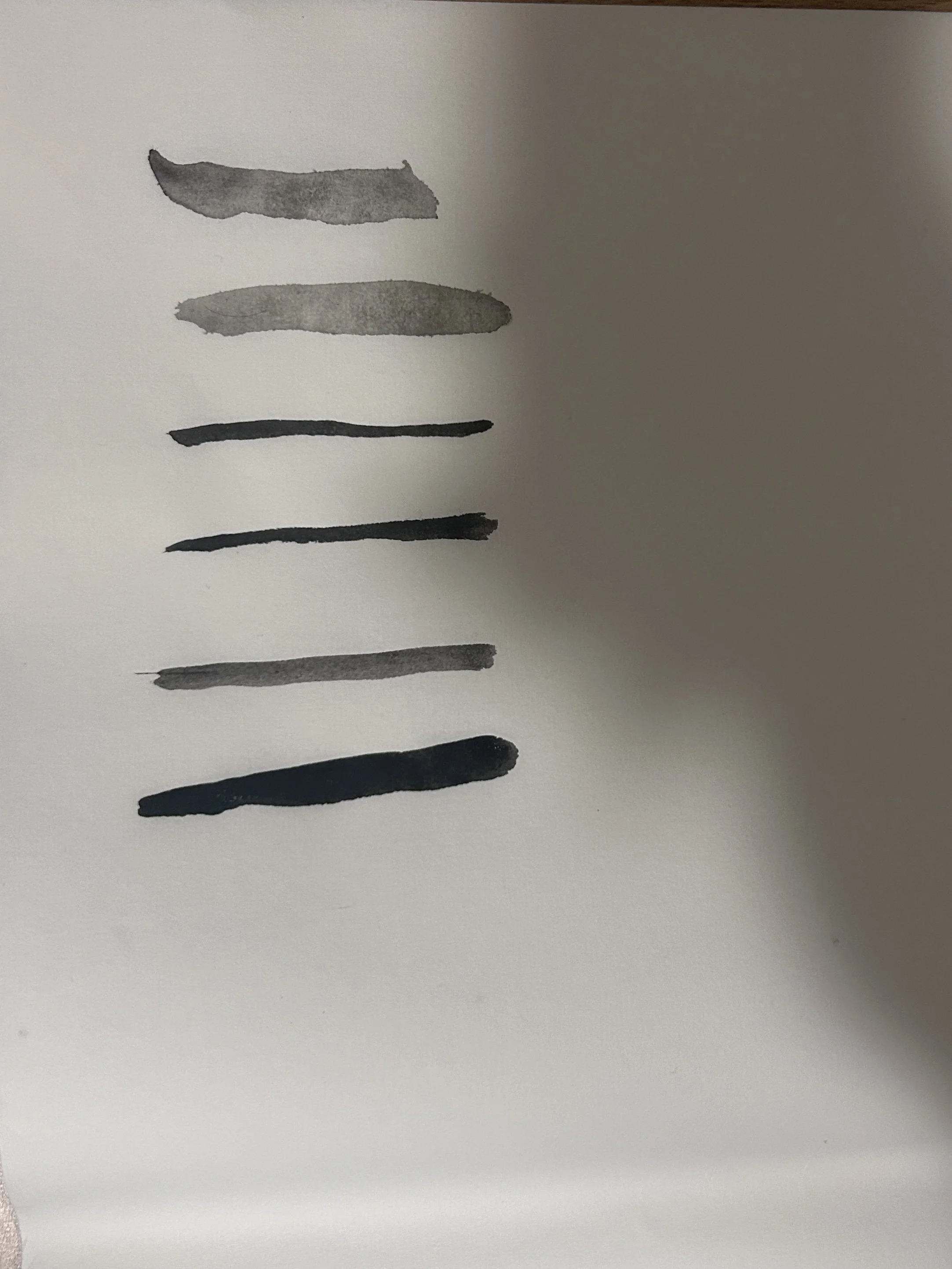
Trial 1: How long does usable ink take?
Figure 2. Test strokes at 1, 2, 5, 10, 15, 20 and 25 minutes. The ink reaches full darkness at 15 minutes and barely changes after.
I ground for 25 minutes at about 89 rotations per minute, roughly 2,225 rotations in all. For the first two minutes the ink was only "like grey" (1/5). It turned black but thin at five minutes (2/5), much darker at ten (4/5), and at fifteen was about as dark as regular ink (5/5). The extra ten minutes made it only slightly darker. The stone gave its own signal: the stick felt scratchy at first, then smoother, and was "mostly smooth" by 15 minutes. My fatigue rose from 1 to 5 at 15 minutes and 8 at 20. Fifteen minutes of work produced ink, but my arm paid for anything beyond it.
Trial 2: Does technique matter?
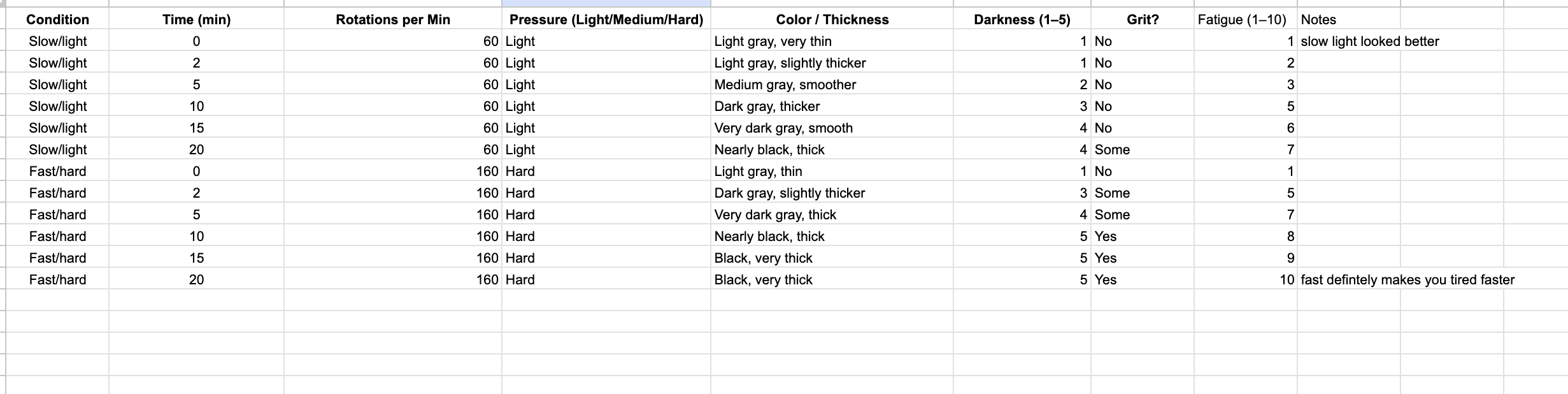
I compared slow, light grinding (60 rotations per minute) with fast, hard grinding (160 per minute), 20 minutes each.
Fast, hard grinding reached full darkness by 10 minutes, but grit appeared within two minutes and my fatigue hit 10 by the end. Slow, light grinding stayed smooth until the last checkpoint and was much less tiring but never got past "nearly black" in 20 minutes. My note at the time was that the slow ink "looked better." Trial 1's moderate pace of about 89 rotations per minute was the best of both: full darkness by 15 minutes. Good ink is a balance of speed, pressure and endurance, and the only way to find it is to feel it. Ko describes exactly this control: "By regulating the pressure applied and the amount of water added, the user controlled the viscosity of the ink, which in turn translated into a range of black and gray shades on paper." [19] My trial put numbers on her sentence.
The grit also complicates Song Yingxing. He blames gritty ink on the material: if "even a hair of pine resin" stays in the soot, the ink "always has dregs that never dissolve" (終有滓結不解之病). [20] My stick was the same in both conditions, yet only the fast, hard grinding produced grit early. Grit has a second source his text never mentions: the hand.
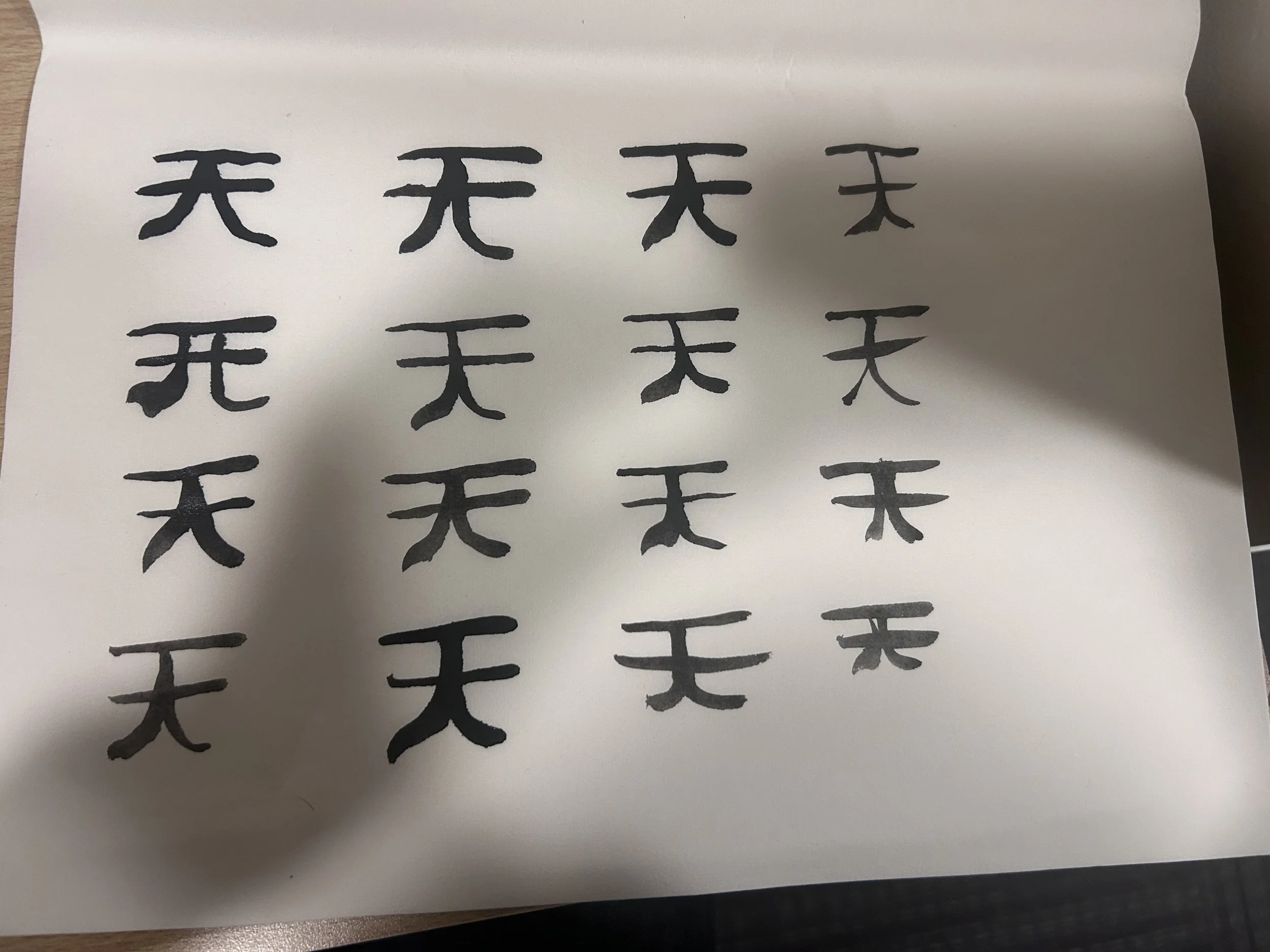
Trial 3: What does one character cost?
Figure 3. The character 天 (heaven), the first word of Tiangong kaiwu, written 15 times. Characters 1–7 used the first batch of ink; characters 8–15 came after regrinding.
I ground for 15 minutes, then wrote 天 until the ink ran out. The first batch lasted only seven characters. As the well emptied, each character took longer, from 19–22 seconds when ink was plentiful to 29 seconds when it was empty, because the brush needed more dipping and slower strokes. After regrinding for 5 minutes, eight more characters followed the same pattern, slowing from 22 to 40 seconds as the ink ran low again.
At the same time, my stroke quality rose from 1 to 5 over the first seven characters and stayed there. My hand was learning the character while the ink was running out. Two kinds of tacit skill, grinding and writing, were working against each other in the same few minutes.
The key number: 20 minutes of grinding produced 15 characters, or about 1.3 minutes of grinding per character, compared with about 25 seconds to write one. The first batch cost even more: 15 minutes for 7 characters, just over 2 minutes each. The 5-minute regrind went further, yielding 8 characters, probably because the stone was already wet and my hand had found its rhythm. Either way, preparing the ink took three to five times longer than writing with it.
Reflection: Knowledge in the Hand
Why is grinding missing from both texts? Song himself gives the answer in his preface: much of what people know, they learn only through "oral instruction and seeing with their own eyes" (必待口授目成而後識之). [21] Jacob Eyferth, in a reading from our class, argues that Chinese craft texts "needed to be explicated, emended, and enacted by a skilled person who had already absorbed their meaning." [22] Grinding is an extreme case: the people reading Shen and Song were the skilled people. Every examinee and clerk already knew the drag of a stick on stone, so no author needed to explain it.
My trials show what that unwritten knowledge contained. It was a set of cues: a scratch turning smooth, grey turning black, a well running dry, a brush slowing down. Dorothy Ko studies inkstone carvers to overturn an old Chinese habit of "valorizing the dao (principles) and disparaging vessels (instrumental or tangible things)," a "hierarchy of head over hands." [23] My results extend her point from the maker to the user. Even the scholar, the person the texts treat as a consumer, was doing small-scale material work with his own hands every time he wrote.
So what? First, writing in imperial China had a hidden labor cost. My ink took about 15 minutes to prepare and ran out after seven characters, so preparation shaped how much someone wrote and how fast. Second, it helps explain what connoisseurs valued. Shen Kuo judged Xu Xuan's calligraphy by holding it up "against the sunshine" to see "a drop of thick ink in the center of the stroke." [24] Quality was read in the ink itself, and that quality depended partly on how carefully it had been ground. Third, it shows that material knowledge was not only an artisan's possession. It was spread across every literate hand, and that is exactly why it went unrecorded.
Limits and Further Research
My stick is modern and its recipe unknown; my stone may not be the prized Duan or She stone; my water and paper are modern. I am a beginner, my 1–5 darkness ratings are my own judgment, and I wrote one simple character rather than a real text. An experienced calligrapher would almost certainly grind faster and smoother, so my times are an upper limit.
Another scholar could build on this in several ways:
Test Song's raking-light claim. He says fine oil-soot ink shows a red glow when "sunlight strikes it slantwise" (日影橫射). [25] Comparing pine-soot and oil-soot sticks in low-angle light would test it.
Compare stones. Grind the same stick on Duan stone and on ceramic.
Work with an expert. Time an experienced calligrapher on the same stick and stone.
Write 永. This character contains the eight fundamental brush strokes, so it would test how ink supply affects the full range of strokes.
Follow Shen Kuo's petroleum ink. Compare soot from different fuels.
Conclusion: What the Inkstone Teaches
The black lips of Shen Kuo's examinees now read differently to me. That ink was not just a material. It was 15 minutes of circling, a stone going from scratchy to smooth, and an arm growing tired before the first character was written. Song Yingxing recorded how ink was made, and Shen Kuo recorded how it was judged. Only the hand records how it was used, and grinding it myself let me read that part of the record.
Appendix: Experimental Data
Full logs for all three trials
Notes
Shen Kuo, Brush Talks from Dream Brook, trans. Wang Hong and Zhao Zheng (Reading: Paths International, 2011), no. 25.
Shen Kuo, Brush Talks, Author's Preface.
Song Yingxing, Tiangong kaiwu (1637), "Dan qing" 丹青, "Mo" 墨. Translations from Tiangong kaiwu are my own, compared with E-tu Zen Sun and Shiou-chuan Sun's 1966 translation.
Shen Kuo, Brush Talks, no. 156.
Shen Kuo, Brush Talks, no. 167.
Dorothy Ko, The Social Life of Inkstones: Artisans and Scholars in Early Qing China (Seattle: University of Washington Press, 2017), 3.
Shen Kuo, Brush Talks, Author's Preface.
Wang Hong and Zhao Zheng, "Translator's Preface," in Shen Kuo, Brush Talks.
Shen Kuo, Brush Talks, no. 421.
Song Yingxing, Tiangong kaiwu, "Zi xu" 自序 (author's preface).
Song Yingxing, Tiangong kaiwu, "Nai li" 乃粒 and "Zi xu."
Dagmar Schäfer, The Crafting of the 10,000 Things: Knowledge and Technology in Seventeenth-Century China (Chicago: University of Chicago Press, 2011).
Song Yingxing, Tiangong kaiwu, "Mo."
Song Yingxing, Tiangong kaiwu, "Zi xu."
Song Yingxing, Tiangong kaiwu, "Mo."
Ko, Social Life of Inkstones, 5.
Song Yingxing, Tiangong kaiwu, "Zhu" 朱.
Ko, Social Life of Inkstones, 7.
Ko, Social Life of Inkstones, 3.
Song Yingxing, Tiangong kaiwu, "Mo."
Song Yingxing, Tiangong kaiwu, "Zi xu."
Jacob Eyferth, "Craft Knowledge at the Interface of Written and Oral Cultures," East Asian Science, Technology and Society 4, no. 2 (2010): 203.
Ko, Social Life of Inkstones, 5.
Shen Kuo, Brush Talks, no. 289.
Song Yingxing, Tiangong kaiwu, "Mo."
Bibliography
Primary sources
Shen Kuo. Brush Talks from Dream Brook. Translated by Wang Hong and Zhao Zheng. Reading, UK: Paths International, 2011.
Song Yingxing 宋應星. T'ien-kung K'ai-wu: Chinese Technology in the Seventeenth Century. Translated by E-tu Zen Sun and Shiou-chuan Sun. University Park: Pennsylvania State University Press, 1966.
Song Yingxing 宋應星. Tiangong kaiwu 天工開物. 1637. Project Gutenberg eBook #25273, 2008. https://www.gutenberg.org/ebooks/25273.
Secondary sources
Eyferth, Jacob. "Craft Knowledge at the Interface of Written and Oral Cultures." East Asian Science, Technology and Society 4, no. 2 (2010): 185–205. https://doi.org/10.1007/s12280-010-9115-4.
Ko, Dorothy. The Social Life of Inkstones: Artisans and Scholars in Early Qing China. Seattle: University of Washington Press, 2017.
Schäfer, Dagmar. The Crafting of the 10,000 Things: Knowledge and Technology in Seventeenth-Century China. Chicago: University of Chicago Press, 2011.
