Introduction
Modern society often trivialises beauty and self-care, and usually considers it to be women’s concern. However, historical evidence shows that Korean beauty and self-care has long been influenced by philosophical values and gender expectations. Although it is common to associate self-care predominantly with aesthetic concerns, skincare in pre-modern Korea was also a gendered but widely practised discipline. This essay explores the methods, ingredients and labour involved in historical Korean self-care and highlights continuing gendered implications of beauty culture in the present day.
Beauty, Gender and Beauty Culture in Pre-modern Korea
During the Choson Dynasty (1392-1897), Neo-Confucian ideology was institutionalised and became inextricably linked with Korean ideas of beauty. Inner morality and gender roles were consequently reflected in a person’s outer appearance. Furthermore, women were expected to conform to highly prescriptive behaviour under Neo-Confucian principles of male precedence and the spatial separation of women’s ‘inner’ domestic sphere from men’s ‘outer’ public sphere in order to protect female and family reputations.
Rather than emphasising external beauty, Choson Neo-Confucian principles emphasised the importance of self-cultivation and filial piety in relation to bodily care. Women’s beauty was thus intrinsically connected to Confucian ideals of moral cultivation and bodily purity. Whilst it is commonly believed that upper class yangban women passively adhered to beauty values, Women and Confucianism in Chosŏn Korea illustrates that they were in fact highly pro-active in striving to perfect themselves in accordance with Confucian values. During Choson Korea, women’s beauty was measured against three key criteria – sambaek, samheuk and samhong. Achieving sambaek (especially light, smooth and clear skin) was of great importance as it was associated with good health and good nutrition and also represented a woman’s morality. However, Neo-Confucian values promoted female modesty, and so respectable yangban women avoided using conspicuous make-up as this was typically worn by those of lower status like the kisaengs. Women therefore emphasised preventative self-care in order to achieve a luminous, ‘natural’ complexion which embodied grace, modesty and moral purity.
As with women, skincare was also a part of pre-modern Korean men’s beauty culture. This was however based upon men’s scholarly self-cultivation rather than modesty. The archetypal Choson man was the seonbi, the virtuous scholar-official of the ruling yangban class whose social standing and purpose derived from lifelong learning, wisdom, and moral character. Confucian values regard the human body as a precious gift from one’s parents and so it was thought that men and women had a filial responsibility to ensure that their skin, hands and even hair was clean and in good condition. This in turn was seen to symbolise good inner morality. Historical evidence shows that men also engaged in facial cleansing and self-care. Like women, they highly valued light skin. Thus, contrary to modern perceptions that self-care is primarily a female pursuit, pre-modern Korean beauty culture was in fact a jointly undertaken Confucian discipline.
Practice and Expertise in Pre-modern Korean Self-Care
Whilst pre-Modern Korean skincare was far from simple, it was an important aspect of domestic life and was undertaken for hygienic, cultural and self-care purposes. Koreans created skincare products from commonplace farm and medicinal items including flours and powders from various grains and legumes (for example, jodu, red beans, soybeans and rice) and ingredients such as ttumul and plants. Creating these skincare products necessitated specific expertise and considerable manual effort. Medical texts such as Heo Jun’s Dongui Bogam (vol. 2 and 7) contain lengthy sections on Oehyongp'yon. These discuss herbal remedies, nutrition and facial massage procedures, all of which were employed to promote good circulation of qi and preserve youthful skin. Likewise, Lady Yi Bingheogak’s Kyuhap ch’ongsŏ includes skincare recipes alongside other household manuals. Alongside other domestic skills, women’s household expertise thus encompassed the making of skincare.
Labour and Gender in Choson Beauty Culture
Although both sexes valued good skin in pre-modern Korea, there was a strong gendered division in the labour undertaken to achieve this. Isolated from the men's world within the Choson household, upper-class yangban women ordered servants to undertake labour-intensive tasks. Women then personally undertook more refined processes, for instance, soaking eggs in soju for skincare purposes. Although seonbi men appreciated having clear and well cared for skin to demonstrate their Confucian self-cultivation, skincare product manufacture was solely the domain of women’s labour. Therefore, pre-modern Korean beauty culture successfully upheld gender roles. Women held the expert knowledge and directed the labour involved in skincare production. Both men and women then displayed good, clear skin in line with sambaek, to exemplify good morality.
Reconstruction of Madame Yi’s Beauty Recipe
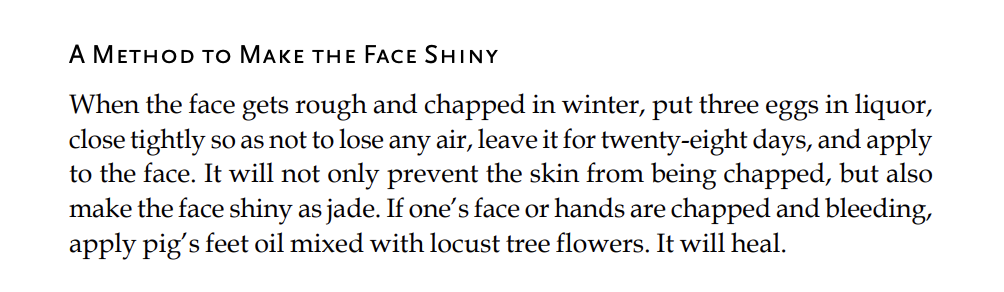
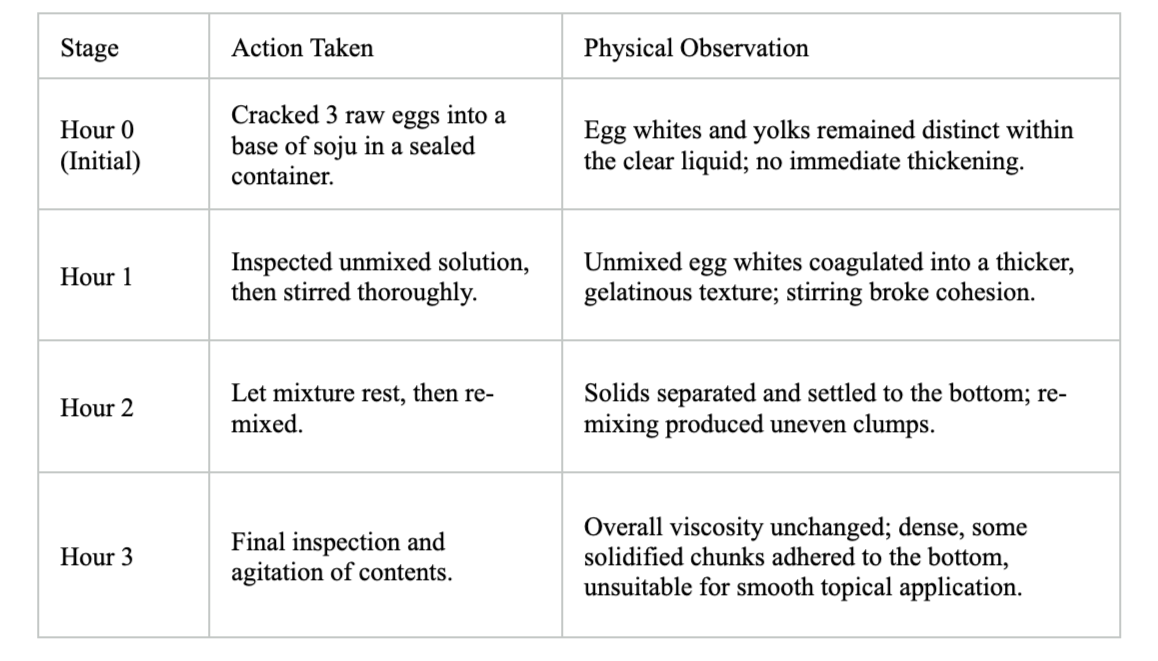
Experiment 1: Winter Egg-and-Soju Formulation (Compressed 3-Hour Simulation)
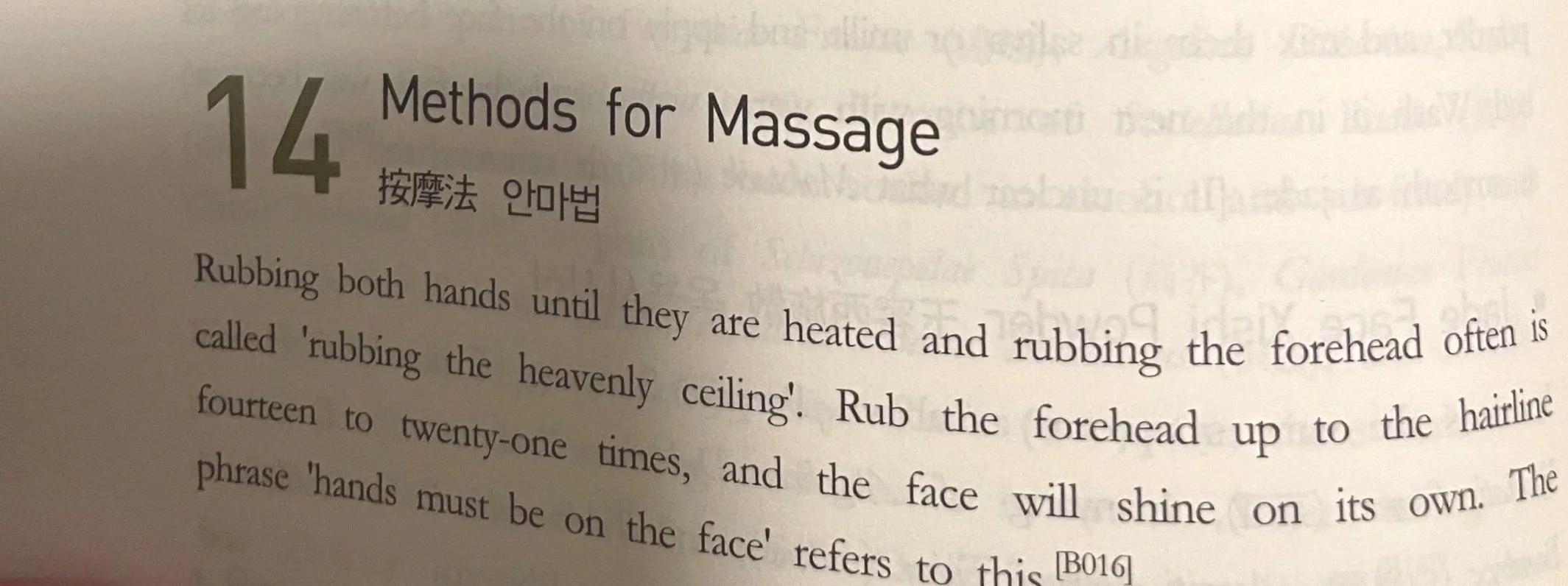
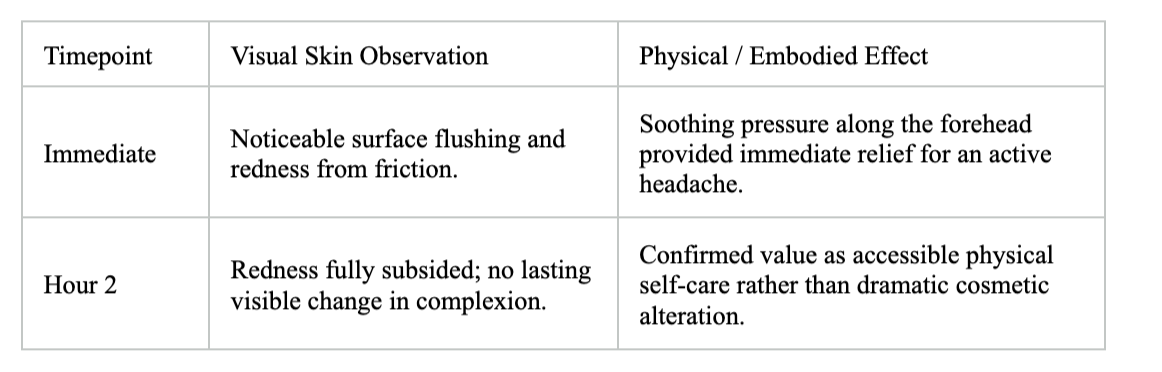
Experiment 2: Prescribed Choson Facial Massage
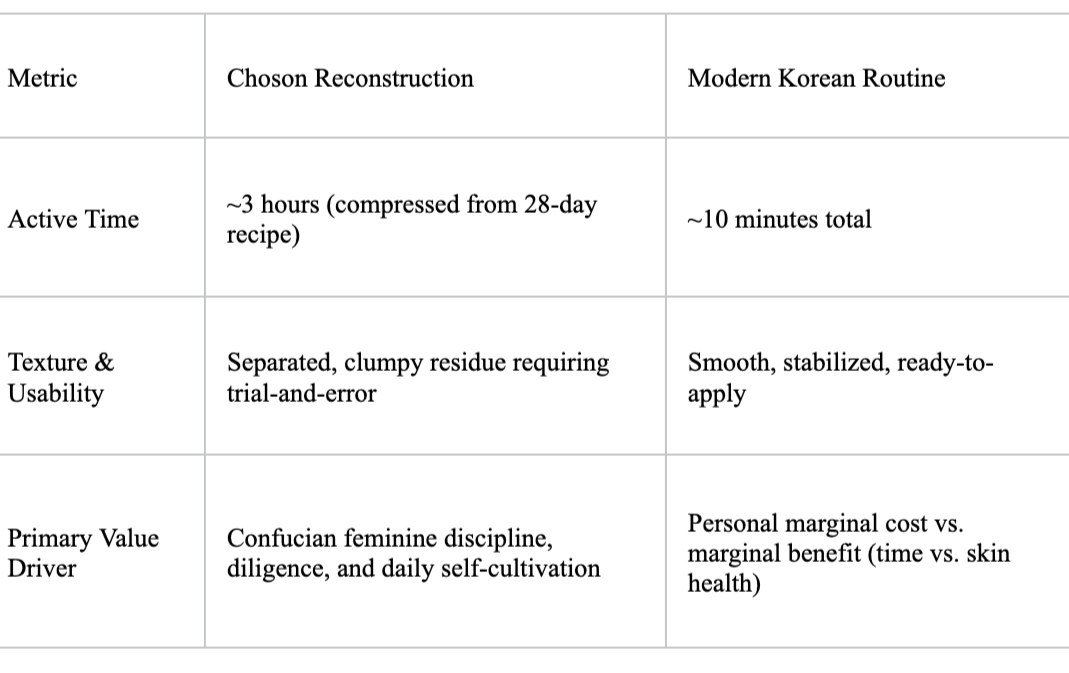
Comparative Benchmark (Modern Korean Skincare Routine)
Combining my recreations with the contemporary example highlights the evolution of Korean skincare. During Experiment 1, I was unable to formulate Madame Yi’s recipe into a homogeneous mixture, due to modern regulations around food safety. Instead I obtained heterogeneous solid matter, and so was able to appreciate first-hand the rationale for Choson women’s use of protracted period of time for fermenting their skincare and their ongoing management of it. Further, despite performing 21 massage strokes in Experiment 2, there was no permanent physical alteration to the skin following a two hour period. However, the massage did feel soothing during an active headache. Therefore, it can be seen that prior to modernity, beauty practice also functioned as self-care. Compared to today, where individuals assess for themselves whether the minor additional time exertion associated with skincare is justified by the corresponding, minor increase in skin health, pre-modern skincare was an extended, involved process which yangban women utilised to actively practice Confucian ideals of womanhood.
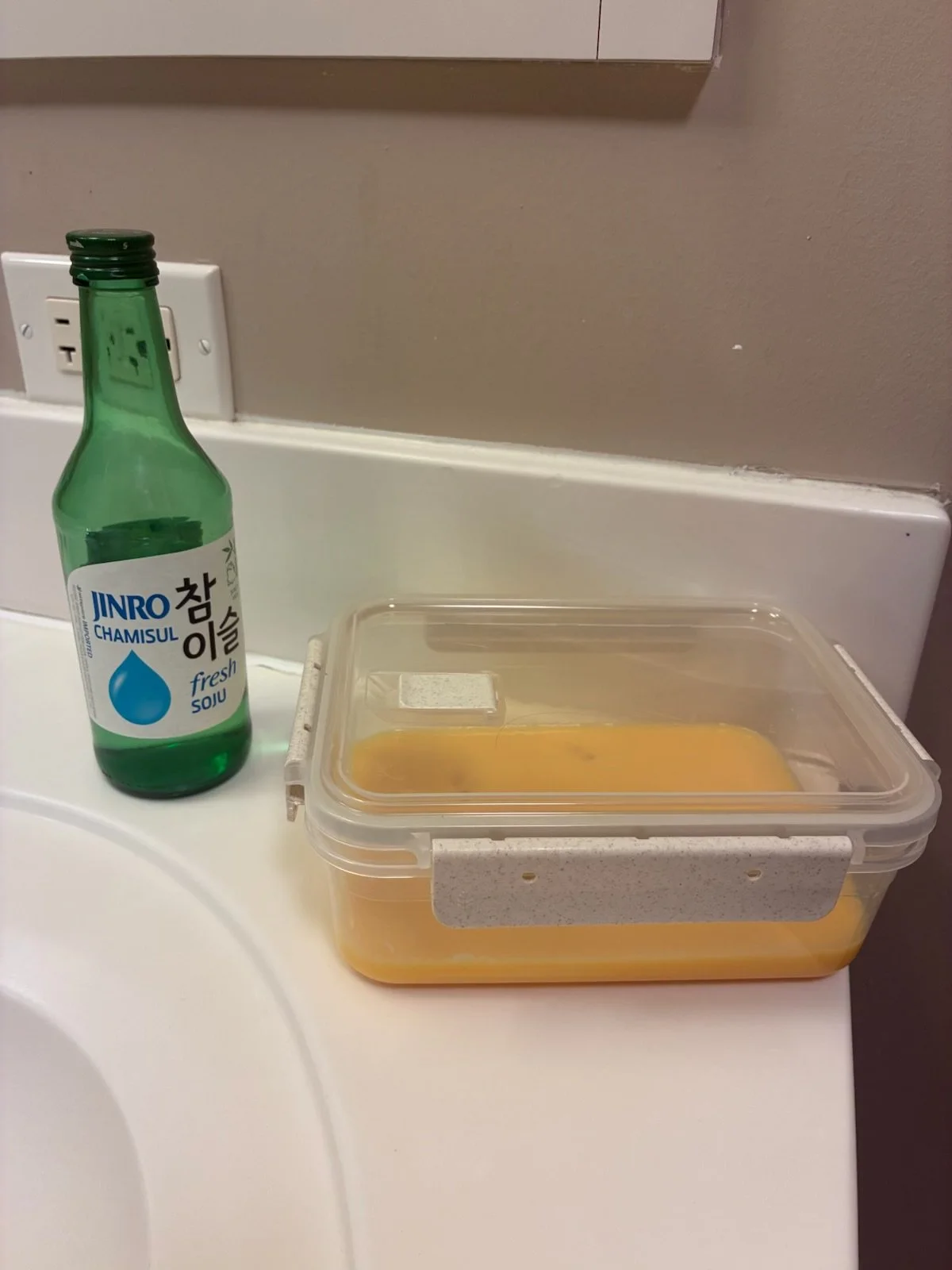
Actual Experimentation
Click below to view my process
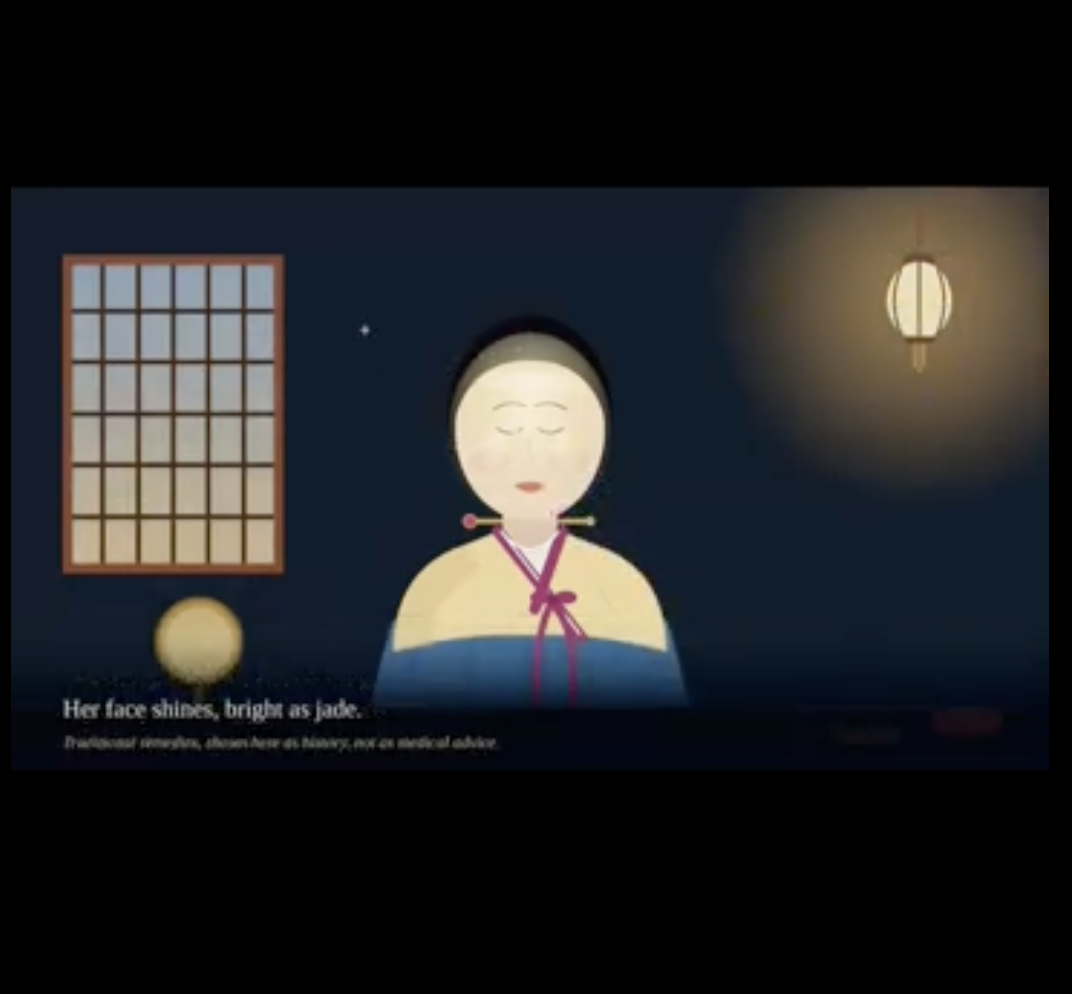
Modern Day Comparison
Click Below to View Comparison
Pre-modern and Modern K- Beauty Culture: Continuities and Changes in Gender Roles
There is strong historical continuity in the extent to which people continue to allocate time (albeit often to a much lesser degree than in pre-modern times) to skincare, predominantly for visual reasons. Many strive to obtain a bright, clear complexion which reflects current ideas such as sambaek. However, there is also significant change. Unlike previously, skincare is no longer strictly associated with social class and Confucian social roles. Although there is currently greater availability of skincare products and increased autonomy over skincare regimes, factors including ‘pretty privilege’ and societal beauty standards continue to encourage people to spend time on their skin. Shifting from the pre-modern domestic setting to modern dermatology demonstrates how my reconstruction has assisted my understanding of both continuing and evolving gender roles in beauty culture. Particularly prominent is the contemporary global emphasis on attaining ‘glass skin’, which is characterised by high hydration, non-pore-visibility and luminosity. Even amid modern pressures to conform to the oe mo ji sang ju ui principle, this ideal closely resembles the late Choson value of sambaek and Madame Yi’s aspiration to obtain clear and lustrous skin. Likewise, undertaking the Dongui Bogam facial massage and a modern skincare regimen emphasises that throughout history, healthy, clear skin has been associated with self-discipline and sophistication, rather than simply with the use of conspicuous make-up. Furthermore, my reconstruction of Madame Yi’s egg and soju skincare product highlights substantial material and gendered differences between late Choson domestic beauty labour and current beauty culture.
Contrastingly, the production of pre-modern Korean skincare was a domestic, manual discipline, exclusively undertaken by women. While daily skincare practice was a shared Confucian discipline for both yangban women and seonbi men, contemporary beauty culture has shifted away from inner morality toward external appearance and increasingly associates multi-stage skincare predominantly with women. Despite this, there are notable continuities in the ways in which gender is negotiated through beauty culture in modern South Korea. For instance, while the flourishing South Korean male beauty market is frequently perceived in the West as a novel facet of modern masculinity, this is in fact highly comparable to the Choson seonbi model. Highly attended to facial care was regarded as a marker of male self control, sophistication and status, and thus was not indicative of any deficiency in masculinity.
Conclusion
Both textual and practical investigation has shown that beauty is highly historically influenced. During late Choson Korea, skincare was strongly influenced by Neo-Confucian gender roles. Upper class women endeavoured to obtain naturally good quality, clear skin in order to display virtuous modesty. Seonbi men similarly maintained good quality, clear skin to exhibit scholarly sophistication. By engaging in the labour involved in Madame Yi’s skincare recipe and by linking primary sources such as Kyuhap Ch'ongso and Dongui Bogam to modern K-beauty culture, it has been possible to identify how the desire to obtain good quality, clear skin has continued through the ages. Nonetheless, the labour, hygiene and gendered associations attached to skincare have evolved. Overall, people’s daily beauty labour continues to be a highly significant area of activity, through which societies negotiate and re-negotiate gender roles.
Footnotes:
Martina Deuchler, The Confucian Transformation of Korea: A Study of Society and Ideology (Cambridge, MA: Harvard University Press, 1992), 231.
Youngmin Kim and Michael J. Pettid, eds., Women and Confucianism in Chosŏn Korea: New Perspectives (Albany: State University of New York Press, 2011), 24–25, 58–60.
Sambaek, samheuk, and Samhong (삼백, 삼흑, 삼홍): Classical Choson beauty criteria: "three whites" (skin, teeth, sclera), "three blacks" (pupils, eyebrows, hair), and "three reds" (cheeks, lips, fingernails). See Asia Society Korea, "The History of Korean Beauty Part 3: Joseon Dynasty," Asia Society, https://asiasociety.org/korea/history-korean-beauty-part-3-joseon-dynasty.
Hyungwon Kang, "‘Seonbi’ Tradition Defines Korean Value System," Visual History of Korea: The Archive (originally published in The Korea Herald, October 29–31, 2021), https://www.kang.org/the-korea-herald-9.
Hyogyong (효경) and Sangtu (상투): Hyogyong (Classic of Filial Piety) taught that preserving one's inherited body without harm was a filial duty; sangtu was the traditional topknot worn by married Choson men. See Kim, "조선시대 세안(洗顔)문화에 대한 고찰," 44–48.
Jodu (조두) and Ttumul (뜨물): Traditional Choson facial cleansers made from finely ground mung bean powder (jodu) and starchy water left from rinsing rice (ttumul). See Kim, "조선시대 세안(洗顔)문화에 대한 고찰," 48–56.
Oehyongp'yon (외형편): The "External Bodily Form" section of Heo Jun’s Dongui Bogam [Principles and Practice of Eastern Medicine] (1613; English print ed., Seoul: Ministry of Health and Welfare / Korea Institute of Oriental Medicine, August 31, 2013), Vols. 2 and 7, which details herbal decoctions, dietary regimens, and facial massage techniques for maintaining physical vitality and a youthful complexion.
Martina Deuchler, The Confucian Transformation of Korea: A Study of Society and Ideology (Cambridge, MA: Harvard University Press, 1992), 264.
Lady Yi Bingheogak, The Encyclopedia of Daily Life: A Woman's Guide to Living in Late-Chosŏn Korea (Kyuhap ch'ongsŏ), trans. and ed. Michael J. Pettid and Kil Cha (Honolulu: University of Hawai'i Press, 2021), 182.
Oemojisangjuui (외모지상주의): Literally "lookism," a term describing pervasive social emphasis on physical appearance in contemporary South Korea. See Young-bean Lee, "The Korean Eye of Beauty: An Exploration of Beauty in South Korea," The Yonsei Annals, November 5, 2023, https://annals.yonsei.ac.kr/news/articleView.html?idxno=11113.
Skin Deep: Gender, Confucian Self-Cultivation, and Beauty Labour in Pre-Modern Korea
Bibliography:
Asia Society Korea. "The History of Korean Beauty Part 3: Joseon Dynasty." Asia Society. https://asiasociety.org/korea/history-korean-beauty-part-3-joseon-dynasty.
Deuchler, Martina. The Confucian Transformation of Korea: A Study of Society and Ideology. Cambridge, MA: Harvard University Press, 1992.
Heo Jun. Dongui Bogam [Principles and Practice of Eastern Medicine]. 1613. English print ed., Vols. 2 and 7, Oehyongp'yon (External Bodily Form). Seoul: Ministry of Health and Welfare / Korea Institute of Oriental Medicine, August 31, 2013.
Kang, Hyungwon. "‘Seonbi’ Tradition Defines Korean Value System." Visual History of Korea: The Archive (originally published in The Korea Herald, October 29–31, 2021). https://www.kang.org/the-korea-herald-9.
Kim, Hyun-jung (김현정). “조선시대 세안(洗顔)문화에 대한 고찰” [A Study on the Culture of Washing Faces in the Chosŏn Dynasty]. 동아시아문화연구 65 (2016): 39–61.
Kim, Youngmin, and Michael J. Pettid, eds. Women and Confucianism in Chosŏn Korea: New Perspectives. Albany: State University of New York Press, 2011.
Lady Yi Bingheogak. The Encyclopedia of Daily Life: A Woman's Guide to Living in Late-Chosŏn Korea (Kyuhap ch'ongsŏ). 1809. Translated and edited by Michael J. Pettid and Kil Cha. Honolulu: University of Hawai'i Press, 2021.
Lee, Young-bean. "The Korean Eye of Beauty: An Exploration of Beauty in South Korea." The Yonsei Annals, November 5, 2023. https://annals.yonsei.ac.kr/news/articleView.html?idxno=11113.
