Chinese Ornamental Combs: Craftsmanship, Art, and Blessings Woven into the Hair
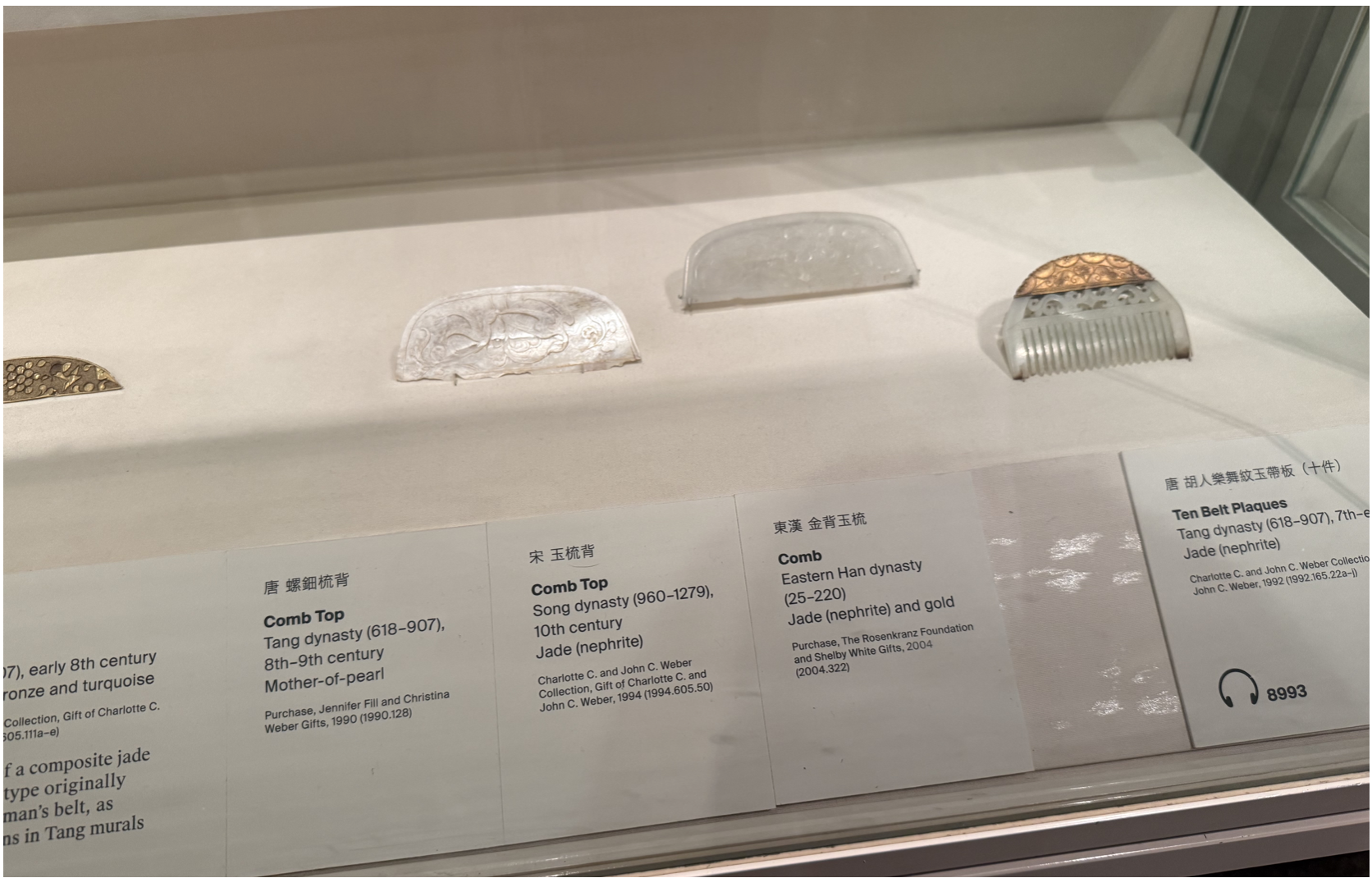
A comb seems like an artifact that couldn't be simpler — consisting of a body and teeth, used to comb hair. However, when you zoom in on the three combs presented in the ancient Chinese artifacts section of the MET, you can find distinct characteristics and underlying historical trends beneath their seemingly similar looks. The craftsmanship and meaning of Chinese combs write a storyline that continues for centuries, telling stories of cultural exchange, symbolic beliefs, and social identity. Chinese combs combine foreign and local craftsmanship to develop symbolic decorations, while their presence becomes a changing sign of social hierarchy and identity.
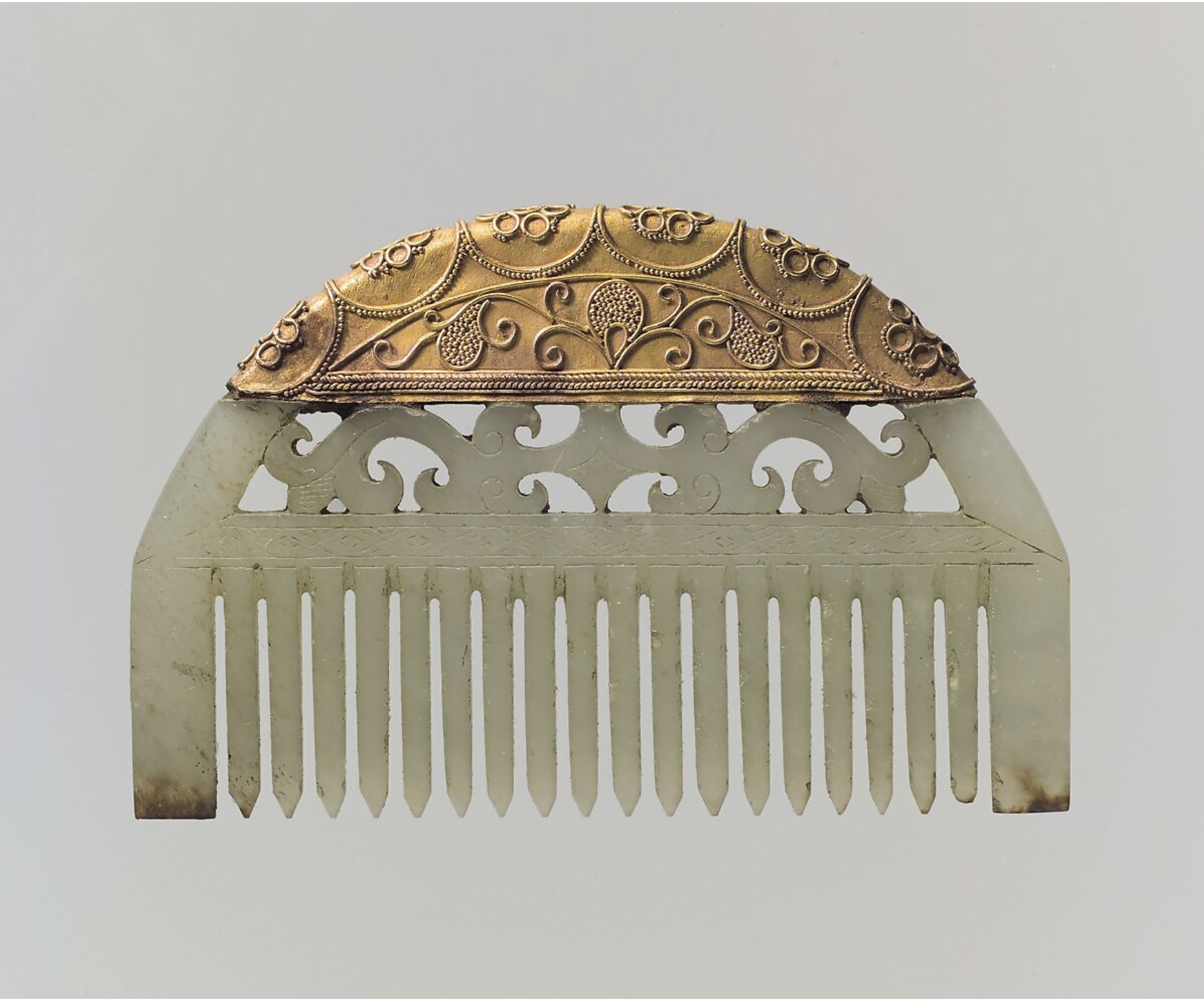
Comb 金背玉梳Period: Eastern Han dynasty (25–220)Culture: ChinaMedium: Jade (nephrite) and goldDimensions: H. 2 in. (5.1 cm); L. 3 in. (7.6 cm)New York. The Metropolitan Museum of Art. "Arts of Ancient China," May 1988–Present.Looking at them in chronological order, the first item is the Gold-backed Jade Comb, which was made during the Eastern Han dynasty. During the Qin dynasty, zhi (栉) was used as an early general term for combs. Later, it developed into two categories: shu (梳), which had widely spaced teeth and was used for combing hair, and bi (篦), which had closely spaced teeth and was used to remove dirt or lice eggs from hair. 1 These Chinese combs consisted of two main parts: the comb teeth, and the comb top that was used to hold the teeth. Decorative comb tops were also made. This Gold-backed Jade Comb is a shu (梳) with a decorative golden comb top, while the other two are just the comb top parts for decoration and holing. The remaining two could have been either shu (梳) or bi (篦).2
The craftsmanship of the Eastern Han comb shows how Chinese artisans not only delicately carried on Chinese techniques and aesthetics, but also combined them with foreign materials and elements to refine the comb as a symbol of elite material culture.
The comb consists of jade and gold. 3While jade had a long history of use in China, gold was considered a “new” element in China during the Han dynasty. Though the material itself may have come from gold sources within China, trade in gold objects from Europe and Central Asia via the Eurasian Steppe and the borderlands of China introduced gold craftsmanship and decorative styles. Gold artifacts showed increasing ritual and social importance and developed visual and material-cultural meanings, which were related to an ideological approach towards a better life.4
The Gold-backed Jade Comb is an example of how Chinese artisans combined Chinese and Western elements. It has the conventional Chinese form of a rounded back and straight, pointed teeth, while the comb top’s design of filigree and granulation on the gold mount reflects the influence of West Asian metalwork. Its floral design is an imported decorative element within the traditional openwork technique. 5The existence of this comb showed how the design of Chinese combs changed through a dynamic process, as both artisans and users of the comb were willing to embrace Western elements. They selected and learned foreign techniques and combined them with conventional ones. Though these changes did not improve the performance of the comb, they brought a sense of fashion and aesthetic appeal to the comb. The patterns may also represent certain wishes and symbolic meanings.
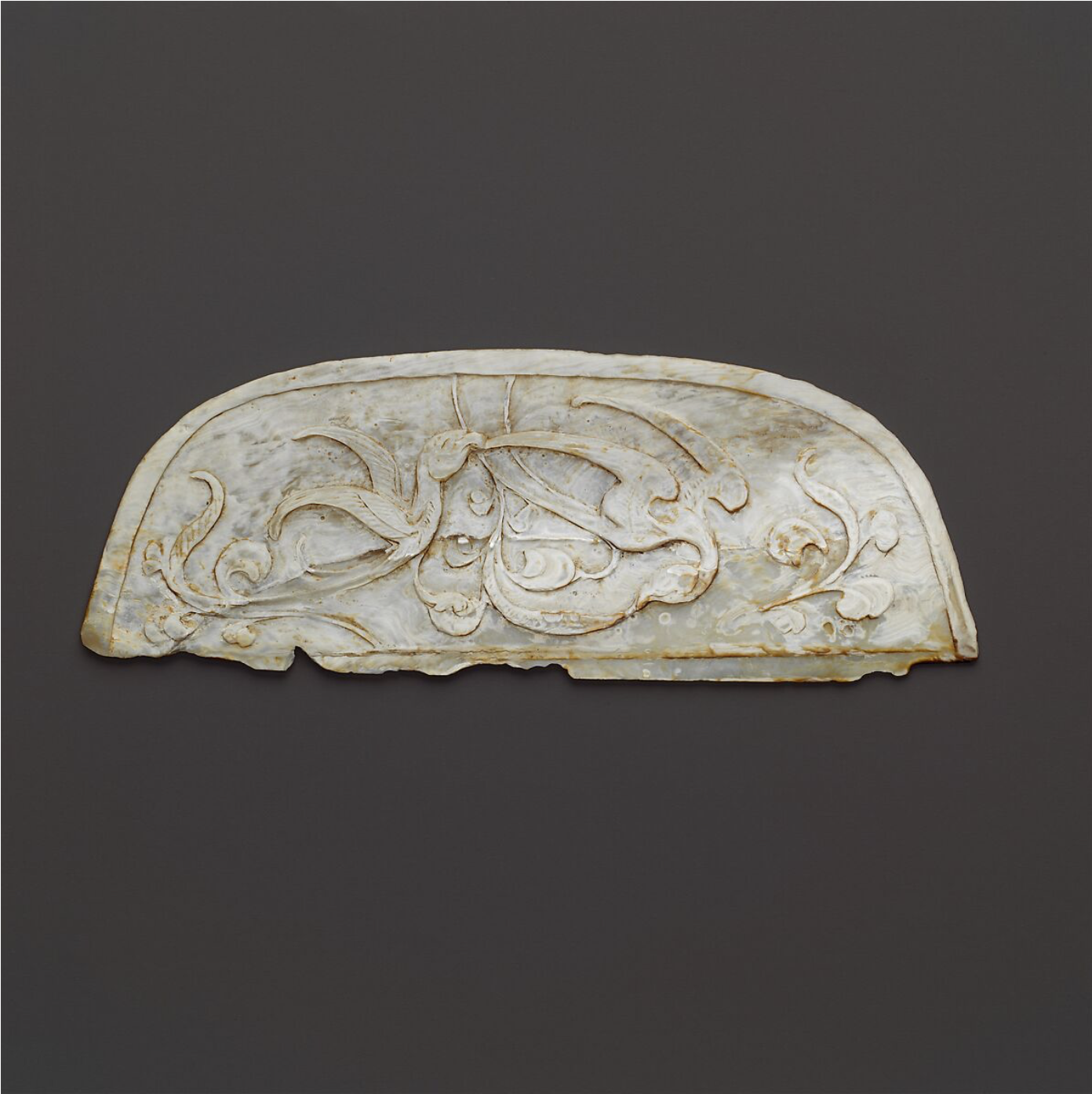
Figure2
Comb top 螺鈿梳背
Period: Tang dynasty (618–907)
Culture: China
Medium: Mother-of-pearl
Dimensions: L. 4 in. (10.2 cm)
New York. The Metropolitan Museum of Art. "Mother-of-Pearl: A Tradition in Asian Lacquer," December 2, 2006–April 1, 2007.
Talking about the meaning of the patterns on the comb, the second item presented stands out, which is the Mother-of-Pearl Inlaid Comb Back. As prominent accessories in women’s hairstyles during the Tang dynasty, ornamental combs’ designs and craftsmanship developed cultural meanings beyond mere visual beauty.
Following the ideology of Confucian culture, Han Chinese women during the Tang dynasty rarely wore earrings. By studying Zhang Xuan’s painting Court Ladies Preparing Newly Woven Silk, a classic example of Tang dynasty paintings depicting female beauty, we can observe that hair accessories were prominent accessories for women.6
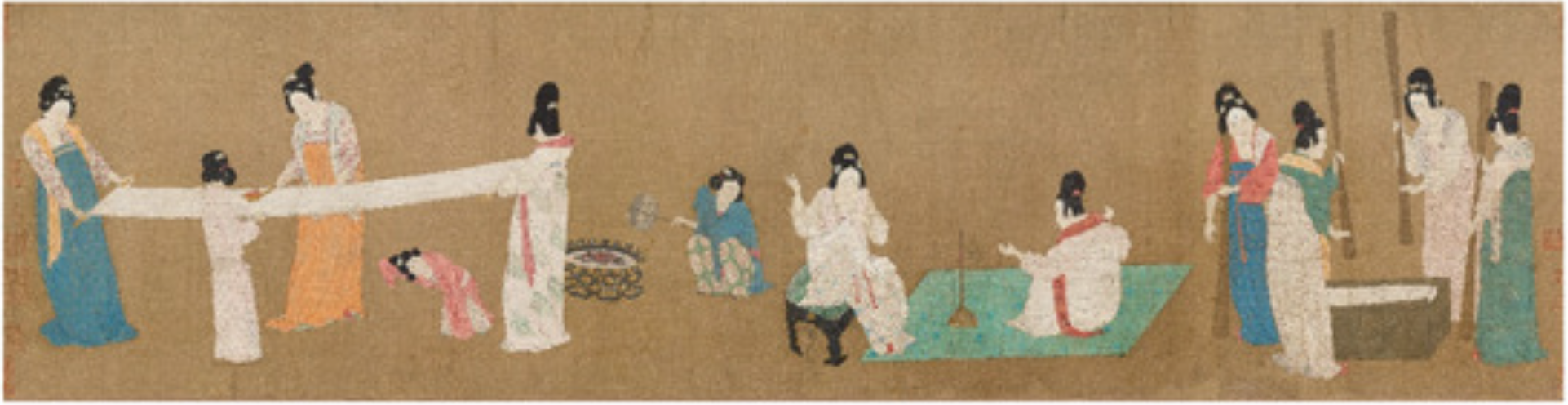
Zhang Xuan’s painting “ramming & washing silk painting”.When women needed to engage in production labor, accessories such as bracelets and necklaces could affect their work. To avoid inconvenience, hair accessories, including combs, hairpins, and dangling hair ornaments, were worn to enhance their beauty. Thus, the inserted comb not only functioned to comb the hair but also served as a major decoration for women, making their overall appearance more gorgeous and exquisite. The combs in the Tang dynasty were mainly made of luxurious materials such as gold, silver, wood, rhinoceros horn, ivory, or jade. This shows continuity in materiality since the Eastern Han dynasty. More diverse and meaningful patterns and designs were carved on the backs of different comb tops, with plant patterns such as entwined branches, curled grass patterns, Baoxiang patterns, and clustered flowers dominating. Carvings of birds and buddhist motif image are also present on comb backs.
The Mother-of-Pearl Inlaid Comb Back is made of mother-of-pearl, which is the most rare material we find that used to make comb, as it is the most fragile one. Using the techicque of The Mother-of-Pearl Inlaid Comb Back is made of mother-of-pearl, which is the rarest material we find used to make combs, as it is the most fragile one. Using the technique of high relief, this comb top is decorated with images of two birds in circular flight, each with a parrot beak and a long, forked tail, surrounded by raised floral scrolls. The reverse side of the comb back is carved with an image of a single large foliate motif of overlapping petals radiating from the base. The bird motif may represent wishes for harmony and happiness, perhaps success in marriage. The floral scrolls and overlapping petals may imply wealth and growth.
From the increasingly delicate designs that are possibly related to positive meanings, we can see how the prosperity of Tang civilization improved and liberated women’s lives, ideologies, and social status. The improvement of living conditions and the economy encouraged their spending on beauty practices, causing the development of women’s hair accessories during this period. Through such a lens of their lifestyles and aesthetic preferences, we can see how much they valued beauty and their wishes for a better life.8
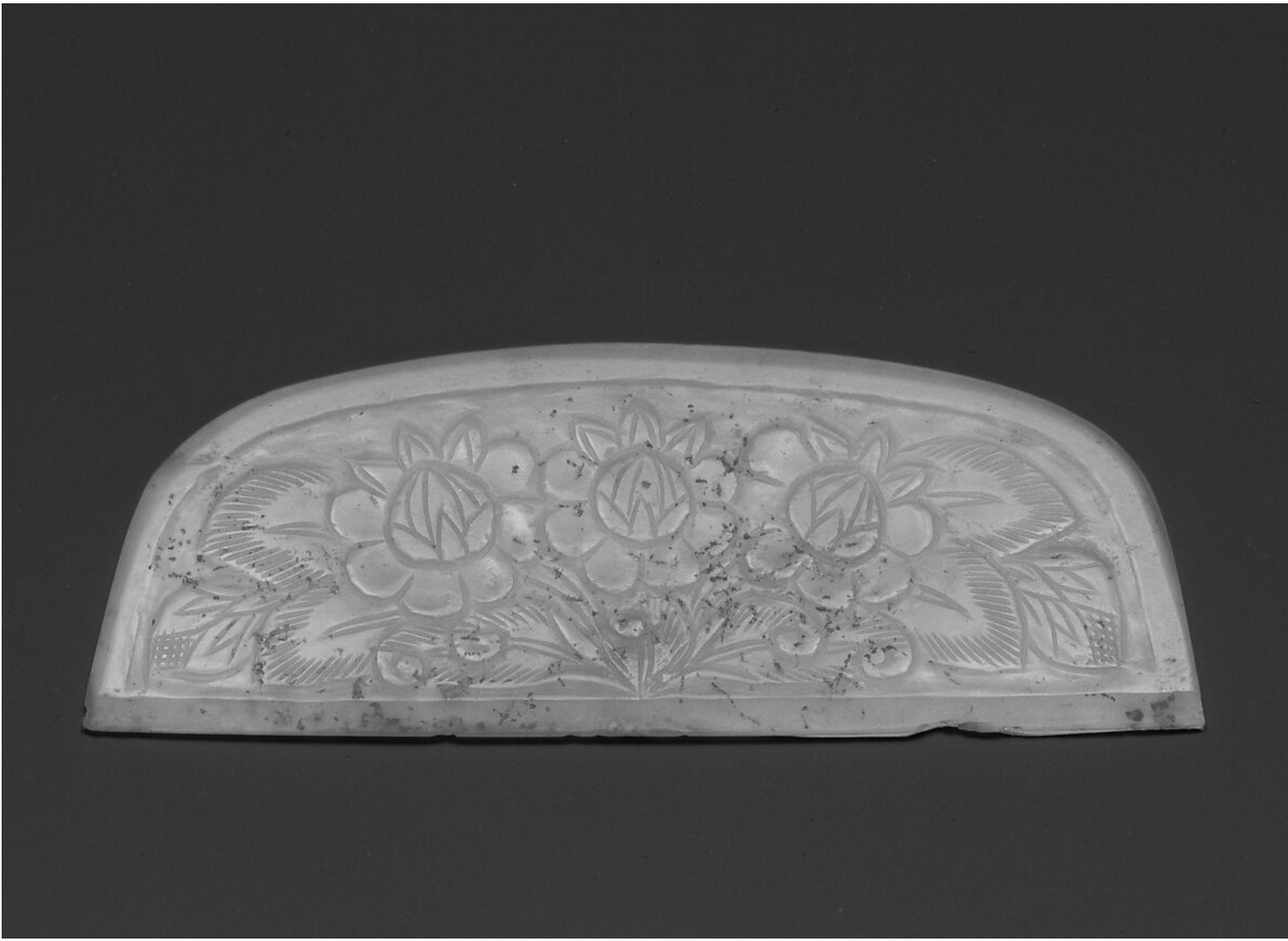
Comb top 玉梳背Period: Tang dynasty Song dynasty (960–1279)Culture: ChinaMedium: Jade (nephrite)Dimensions: H. 1 1/2 in. (3.8 cm); L. 4 1/4 in. (10.8 cm)New York. The Metropolitan Museum of Art. Gallery 207The last comb top comes from the Song dynasty.9 From studies and historical records, we can see that ornamental combs continued to develop as precious decorative crafts, becoming identifiers of women’s households’ social identity and purchasing power, while also holding personal emotions and cultural significance.
This comb is made of jade, the same material as the Eastern Han one, which could be a thousand years older than this one. Its floral pattern continues the design of the Tang comb. Despite these continuities, combs in China experienced a huge change during the Song dynasty.
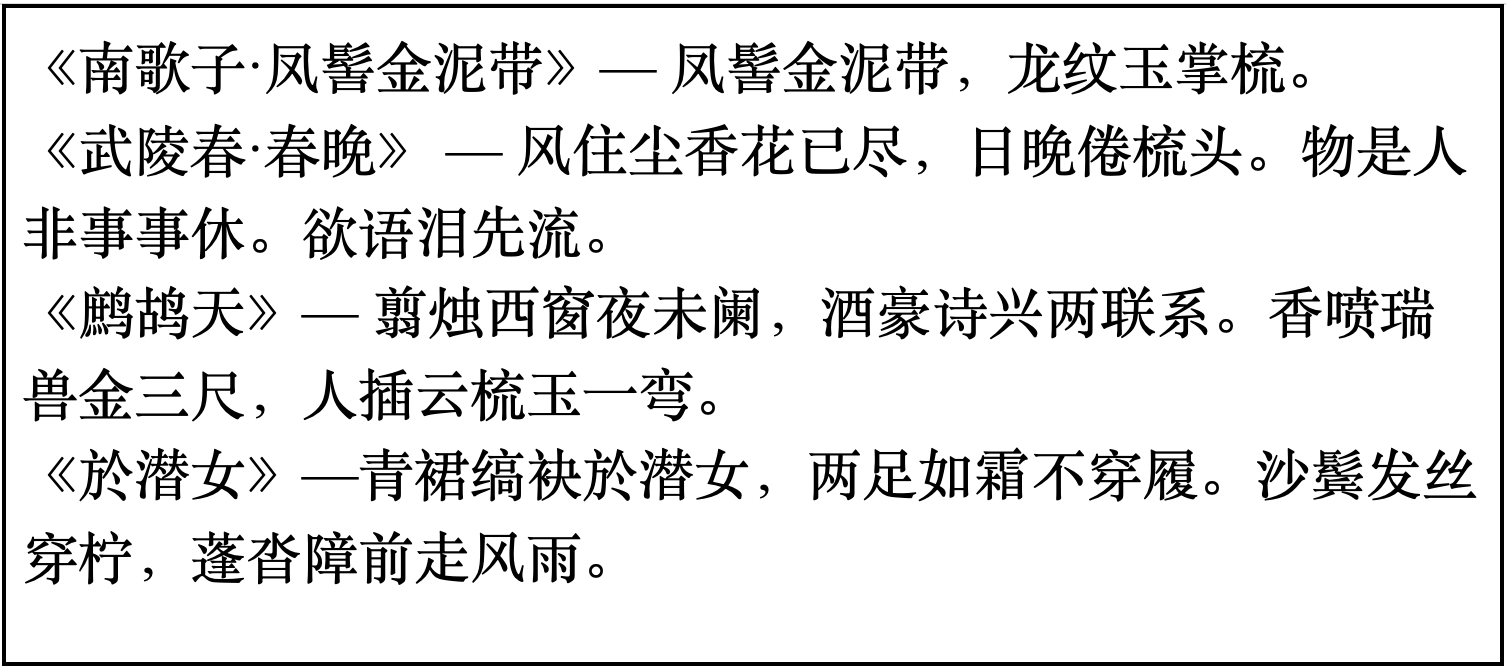
During the Song dynasty, combs were separated into two categories: one-piece combs with a single-piece structure and composite combs, of which we have three examples throughout the article. This division shows how combs were symbols of different social classes. The more affordable one-piece combs usually included wooden combs, gold-covered wooden combs, and openwork-carved wooden combs. On the other hand, composite combs used much more luxurious materials, including gold comb backs, gilded silver comb backs, and pearl-decorated or patterned comb backs. Our example above is a luxurious composite comb. Analyzing the changes in comb shape and size, we can see that the comb teeth became smaller while the comb tops became larger, allowing more space for decorative creation. 10
These changes show competitive consumption, with women from lower classes trying to mimic upper-class fashion consumption to show their social status: “Ornamental combs worn by Song dynasty women served as visible markers of power, social status, and wealth.” 11
Besides their functions in health-related uses and hair grooming, ornamental combs also served as a means of emotional and romantic expression during the Song dynasty. The examples above show several Chinese poems that include imagery of a comb. The second line translates to: “The wind has stopped, the dust is fragrant, and the flowers have come to an end. Every morning and evening, I am too tired to comb my hair. All things have changed, and nothing remains the same. Before I speak, my tears fall.” This example shows how grooming symbolized a sense of control over a woman’s life and beliefs. The famous female writer Li Qingzhao related grooming to sorrow and weariness, showing how combs were related to female emotions and life.
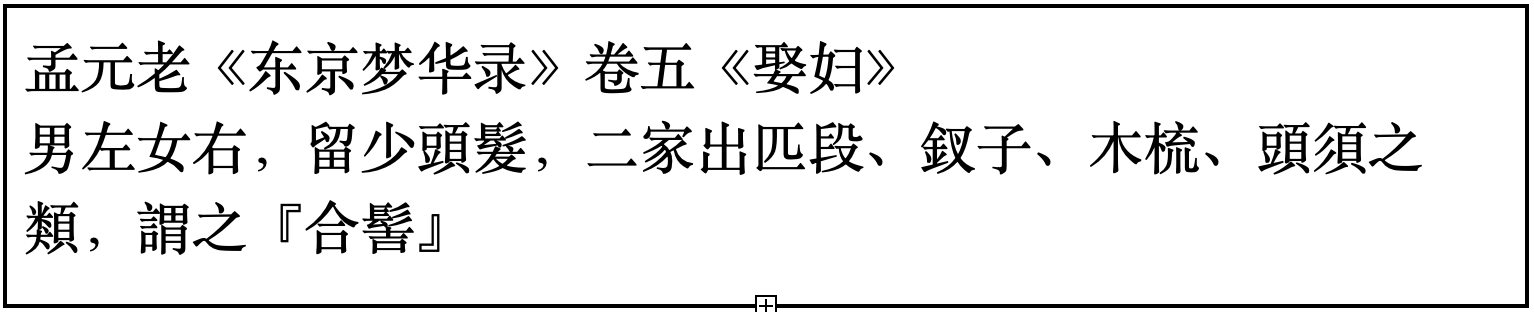
The above article also describes a ritual known as heji(合髻). 13 Translated as “joining the hair,” this ritual was used in weddings, where the bride and groom sat on opposite sides and each set aside a small portion of their hair. Then, both families provided items, including wooden combs, for the ceremony. This shows that the symbolic meaning of combs extended to ceremonial practices.
In conclusion, Chinese ornamental combs developed meanings and features far beyond those of simple hair-grooming tools. From the Han dynasty’s combination of exotic materials and artistic techniques in combs to the Song dynasty’s use of combs in marriage ceremonies, combs became evolving cultural symbols of aesthetics and identity. By studying the changes in these combs, we can see how Chinese culture evolved and maintained its traditions.
-
1. Han Yonglian (韩永莲), “史前梳子浅谈,” 文物鉴定与鉴赏, no. 7 (2023), https://doi.org/10.20005/j.cnki.issn.1674-8697.2023.07.024.
2. Guo Xiaoni (郭晓妮), “‘梳’、‘篦’对‘栉’的历时替换考,” 海南大学学报(人文社会科学版) 27, no. 4 (2009): 459–65, https://doi.org/10.15886/j.cnki.hnus.2009.04.007.
3. The Metropolitan Museum of Art, “Comb,” Eastern Han dynasty, nephrite and gold, accession no. 2004.322, https://www.metmuseum.org/art/collection/search/72544.
4. Shengyu Wang, “Exotica, Fashion and Immortality: The New Use of Gold in Han Dynasty China (206 BCE–CE 220),” Cambridge Archaeological Journal 32, no. 3 (2022): 345–60, https://doi.org/10.1017/S0959774321000482.
5. The Metropolitan Museum of Art, Recent Acquisitions: A Selection, 2004–2005, The Metropolitan Museum of Art Bulletin 63, no. 2 (Fall 2005): 50, https://resources.metmuseum.org/resources/metpublications/pdf/Recent_Acquisitions_A_Selection_2004_2005_The_Metropolitan_Museum_of_Art_Bulletin_v_63_no_2_Fall_2005.pdf.
6. Guangzhou Zhu et al., “Digital Restoration of Tang Dynasty Ladies’ Costumes in the ‘Ramming & Washing Silk Painting’ Based on AI and 3D Technology,” Electronics 14, no. 6 (2025): 1139, https://doi.org/10.3390/electronics14061139.
7. Judith Smith, A Decade of Collecting, 1984–1993: Friends of Asian Art Gifts (New York: The Metropolitan Museum of Art, 1993), 11, https://resources.metmuseum.org/resources/metpublications/pdf/A_Decade_of_Collecting_1984_1993_Friends_of_Asian_Art_Gifts.pdf.
8. Xie Jin (谢晋), “唐代女性发饰造型比较研究” (master’s thesis, 2012), https://www.zhangqiaokeyan.com/academic-degree-domestic_mphd_thesis/0203111247873.html.
9. The Metropolitan Museum of Art, “Comb Top,” Tang dynasty, mother-of-pearl, accession no. 1990.128, https://www.metmuseum.org/art/collection/search/44616.
10. The Metropolitan Museum of Art, “Comb Top,” Song dynasty, nephrite, accession no. 1994.605.50, https://www.metmuseum.org/art/collection/search/44351.
11. Huang Weiwei (黄薇薇) et al., “宋代女子发饰‘梳子’探析,” 服装设计师, no. 2 (2026), https://cnki.istiz.org.cn/kcms/detail/detailall.aspx?dbcode=CJFD&dbname=CJFD2026&filename=fzkj202602008.
12. Huang et al., “宋代女子发饰‘梳子’探析,” 58–59.
13. Huang et al., “宋代女子发饰‘梳子’探析,” 56.
14. Meng Yuanlao (孟元老), “娶妇,” in 东京梦华录, juan 5, https://www.zhonghuashu.com/wiki/東京夢華錄/卷五.