From Bean to Table: Soybean Processing and Culinary Culture in Imperial China
Introduction
Soybeans have been cultivated in China for thousands of years, but the significance behind the soybeans extends far beyond their role as an agricultural crop. By different processing techniques, soybeans could be transformed into a wide variety of products, including tofu, soy sauce, fermented soybean paste, and soybean oil etc. Even though these foods became an inseparable part in Chinese daily cooking, their production required specialized tools and practical knowledge. During the Song (960–1279) and Ming (1368–1644) dynasties, written documents and technical illustrations provide valuable evidence of how soybean processing developed as both a craft and an important part of Chinese people’s everyday life. This essay argues that the enduring prominence of soybean products in Chinese culinary history demonstrates how the cultural significance of a craft depended on agricultural resources, economic accessibility, and adaptability to diverse dietary needs.
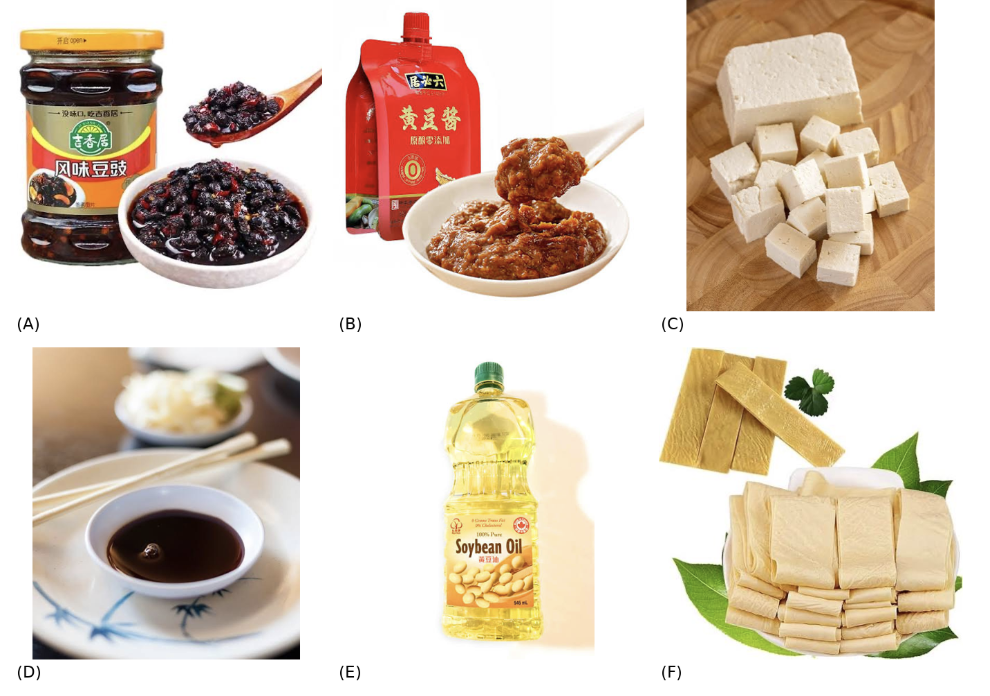
Figure 1. Examples of traditional Chinese soy-based foods and ingredients. (A) Fermented black soybeans (dou chi); (B) fermented soybean paste; (C) tofu; (D) soy sauce; (E) soybean oil; and (F) dried tofu skin (fu zhu)[1-6].
From Soybeans to Food: Techniques and Craft Knowledge
The journey of soybeans began in agricultural fields, where farmers cultivated and harvested mature beans before cleaning and drying them for storage or transportation. Depending on their intended uses, soybeans could undergo several different forms of processing. When soaked, ground, and boiled, soybeans could produce soymilk, which could subsequently be coagulated and pressed into tofu. In Bencao Gangmu (本草纲目), published in 1596, Li Shizhen described the tofu-making process: “水浸碎,滤去滓,煎成,以盐卤汁或山矾叶或酸浆、醋淀就釜收之” (Figure 1). This can be translated as: “The beans are soaked in water and ground, the residue is filtered out, and the liquid is heated. Brine, mountain alum leaves, sour liquid, or vinegar sediment is then added to coagulate it in the pot.” [7]
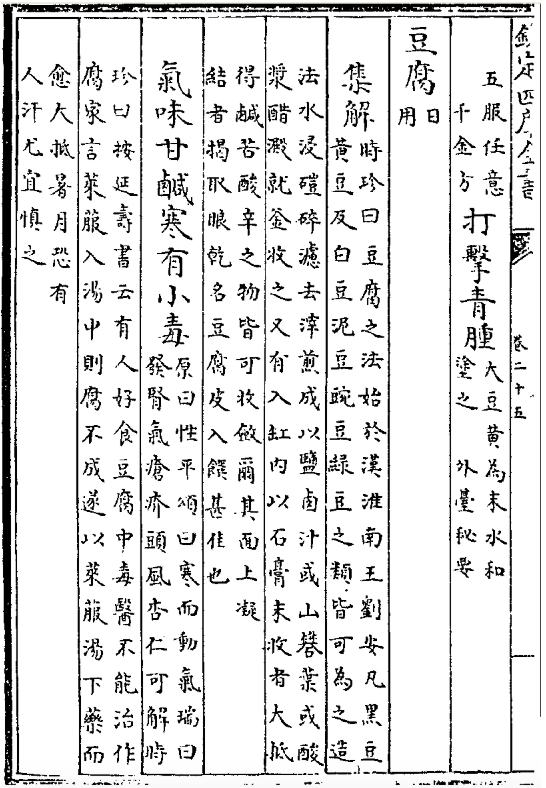
Figure 2. Tofu-making instructions in Li Shizhen’s Bencao Gangmu (本草綱目, 1596), juan 25, “Doufu” (豆腐).
Rather than presenting a single standardized recipe, Li listed several possible coagulants, suggesting that tofu making is a rather mature technique at the time, and craftspeople have found multiple materials to use in recipes to achieve similar products. The different choice of coagulating agent used could possibly be related to regional or taste difference. To be recorded in this Ming medical and natural history text, Bencao Gangmu, it also demonstrates that knowledge of this tofu making techniques was considered widespread or significant enough to be preserved in scholarly writing.
However, as Bencao Gangmu was primarily a pharmacological compendium rather than a record of everyday production practices, it focused on documenting ingredients and preparation methods rather than the social and economic circumstances surrounding tofu production. For example, it does not clarify whether tofu was primarily produced in specialized workshops or individual households, who typically participated in its production, or how it was distributed and sold. Furthermore, because the text was not intended to document the daily practices of individual craftspeople, it does not necessarily reveal how tofu makers acquired their skills or how consistently these methods were followed in practice.
Workers, Tools, and the Organization of Labor
Different from modern industrial manufacturing, the traditional way of processing soybean relied heavily on human labor, and control over different stages of production depended on craftspeople's experience. A woodblock illustration from Song Yingxing's Tiangong Kaiwu (天工开物, 1637) offers a valuable representation of soybean oil extraction (Figure 2)[8,9]. The image depicts an oil press constructed from a hollowed tree trunk, with processed beans placed inside. Workers inserted wooden wedges and used a suspended log to hammer them into position, generating pressure that extracted oil from the beans. The oil then drains into a container below. The remaining soybean cake could also be used as animal feed or fertilizer, so none will be wasted.
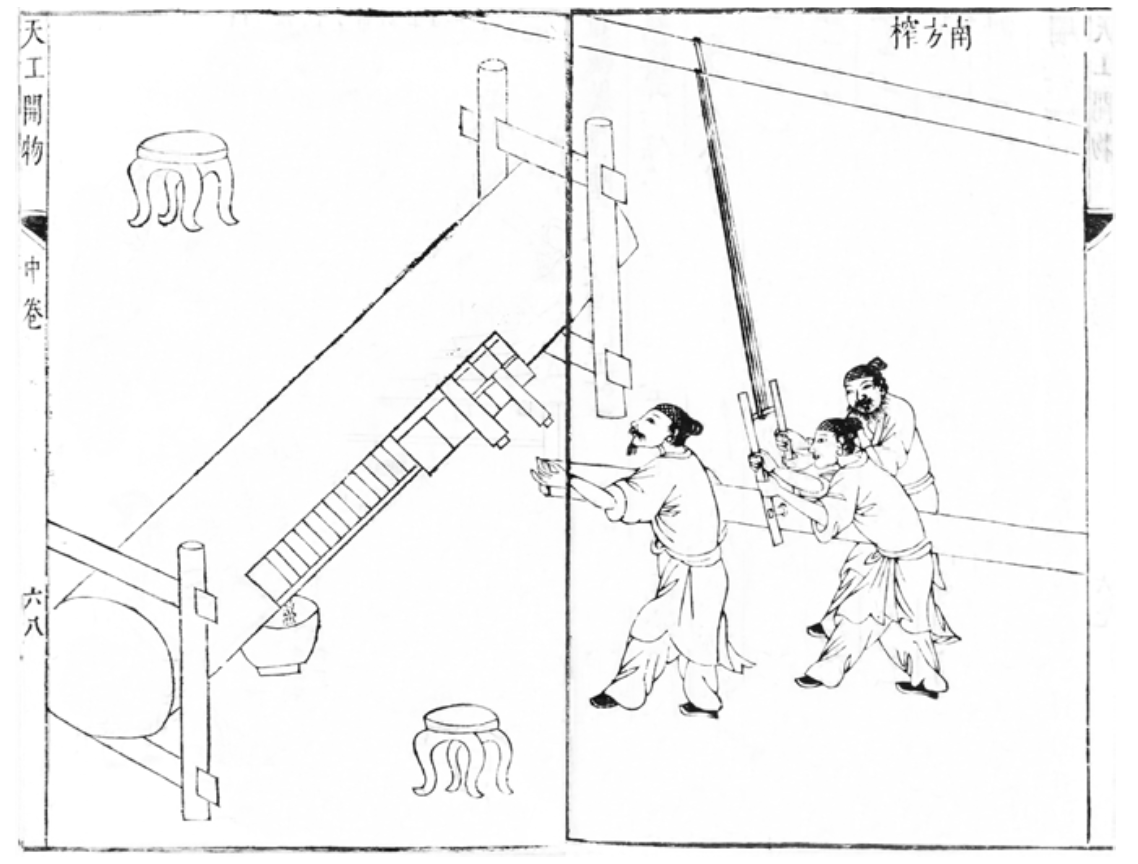
Figure 3. Oil-pressing apparatus and workers. Woodblock illustration from Song Yingxing, Tiangong Kaiwu (1637), juan 12, “Gaoye,” middle volume, 68. Bibliothèque nationale de France. Reproduced in Brian Lander and Thomas David DuBois, “A History of Soy in China,” 35–36, fig. 2.
The illustration is particularly revealing because it shows not only the machinery but also the workers operating it, covering our knowledge gap from Bencao Gangmu. Three individuals participate in the process, suggesting that oil extraction requires coordinated physical labor rather than the effort of a single craftsperson. The suspended hammer and wedges also demonstrate how mechanical design amplified human force. The process therefore depended on both specialized equipment and workers' ability to operate it effectively. Nevertheless, the illustration should not be treated as a complete representation of everyday working conditions. As an image published in a technical text, it reveals the visible mechanics of production but provides little information about workers' identities, training, compensation, or social status. This limitation illustrates how historical sources may preserve knowledge of a craft while leaving the experiences of its practitioners largely undocumented.
Historical Development and Economic Accessibility
The history of soybean processing was not a single, continuous process of technological development. Different products emerged at different times, and the origins of some techniques remain uncertain. One of the earliest surviving written references to tofu appears in the Qing Yilu (清异录), a text associated with the tenth century. The growing importance of soybean products was closely connected to their economic accessibility and place in everyday life. An account in the Qing Yilu referred to tofu as the “vice mayor's mutton,” describing a local official who purchased tofu because he could not afford mutton[10, 11]. This comparison revealed how tofu could be understood as an inexpensive alternative to meat, making it particularly useful to people with limited financial resources. Although the anecdote does not establish actual market prices compared to other protein choices or consumption patterns, it demonstrates that tofu's affordability was already part of its social representation.
Yet tofu was not exclusively associated with poverty, its consumption among different social groups suggests that its appeal soon extended beyond a single economic class. By the Song dynasty, tofu had become a recognizable part of Chinese food culture. During the Ming dynasty, detailed recipes recorded in Bencao Gangmu included not only tofu, but many other soybean products, such as soy oil, soybean paste, and douchi (豆豉, fermented soybeans) etc [12]. People had already known to manipulate differences in salt concentration, microorganisms, fermentation duration, and additional ingredients in order to obtain different flavors and textures from the soy beans. These distinctive fermented sauces are rather easy to preserve, commonly used as seasoning in cooking, or as dipping sauce for other food, consumed by Chinese people to this day.
Religious Practices and Dietary Adaptability
Religious practices also shaped the cultural significance of soybean products. In Buddhist communities that followed vegetarian dietary restrictions, tofu offered a versatile plant-based ingredient that could be incorporated into meals without relying on meat [13]. Its significance therefore extended beyond nutrition and affordability, as it also became compatible with religious values and culinary traditions. The possibility of preparing tofu in different forms made it adaptable to a range of dishes and dietary preferences.
At the same time, tofu's consumption outside Buddhist communities suggests that its popularity cannot be explained by religion alone. Rather, soybean products served different purposes across society: they could provide affordable food for ordinary households, ingredients for religious diets, and seasonings for everyday cooking. Their adaptability allowed soybean-processing crafts to become closely integrated into Chinese culinary practices. This relationship between food technology and dietary culture becomes particularly interesting when compared with dairy production, which also existed in imperial China but followed a different historical trajectory.
Soybean v.s. Dairy Production in Imperial China
Although tofu and cheese are made from entirely different raw materials, their production involves similar techniques. Both can require the transformation of a liquid into solid curds through the addition of coagulants, followed by draining and pressing. These technological similarities were explicitly recognized in Ming China. In Bencao Gangmu, Li Shizhen recorded a method of making ru fu, or dairy curds like cheese, by adding vinegar to heated milk, describing the process as “如豆腐法,” which means “like the method for making tofu.” [14] This comparison suggests that tofu-making was common sense enough to serve as a reference for explaining another food-processing craft. It also demonstrates that technical knowledge of soybean processing and dairy production was not necessarily understood as belonging to entirely separate traditions. However, the similarity does not establish that one technique was derived from the other.
In “Mr. Song's Cheeses: Southern China, 1368–1644,” Miranda Brown challenges the common assumption that dairy products were absent from traditional Chinese cuisine [15]. Brown argues that cheese was produced and incorporated into various dishes in China during the Ming dynasty, in a unique way different from the western technique at that time. Brown's research suggested that dairy products were fairly common in China during the Ming and Qing dynasty, and there were actually high technological similarities between methods of soybean products and dairy products production. However, it is generally agreed that tofu and other soy bean products had still more popularity.
One possible explanation lies in their relationship with agricultural production. Soybeans could be cultivated within established crop-farming systems, while dairy production required access to milk-producing animals and the resources necessary to maintain them. In regions dominated by intensive agriculture, the economic and ecological conditions supporting soybean cultivation may therefore have differed significantly from those supporting dairy production [16].
Soybean processing also produced ingredients with diverse culinary functions. Tofu could serve as an affordable alternative to meat, fermented soybean products provided seasonings, and soybean oil could be used in cooking. These products could be incorporated into everyday meals while accommodating different economic circumstances and dietary practices. Cultural and religious factors further reinforced their significance, particularly tofu's compatibility with Buddhist vegetarianism.
Nevertheless, the prominence of soybean products should not be understood as the result of a direct competition in which soybeans simply replaced dairy. As Brown demonstrates, cheese remained part of southern Chinese culinary traditions during the Ming dynasty, even though its presence became less visible in later understandings of Chinese cuisine. The contrasting histories of soybean processing and cheesemaking therefore suggest that the cultural prominence of a craft depended not only on technical knowledge, but also on the agricultural, economic, and social conditions in which it developed.
Conclusion
The history of soybean processing demonstrates that the significance of a craft extends beyond the technical methods used to produce its objects. From the practical knowledge recorded in Bencao Gangmu to the coordinated labor illustrated in Tiangong Kaiwu, soybean processing required skilled workers, specialized tools, and techniques developed over generations. Its products also acquired economic and cultural significance through their affordability, versatility, and compatibility with different dietary practices. The comparison with historical Chinese cheesemaking further reveals that technical similarities did not necessarily produce identical cultural outcomes. Ultimately, the enduring prominence of soybean products in Chinese culinary history reflects the interaction of agricultural resources, economic accessibility, and dietary adaptability, demonstrating how a craft became deeply embedded in the everyday life and cultural identity of a society.
Reference
1. Amazon, “Jixiangju Flavored Fermented Black Beans,” product collection, accessed October 18, 2026, https://www.amazon.com/clp/B0B74WNZ81.
2. Amazon, “Fermented Yellow Soybean Paste,” product listing, accessed October 18, 2026, https://www.amazon.com/dp/B0F28RY1QT.
3. Sarah’s Vegan Kitchen, “Homemade Tofu (How to Make Tofu),” accessed October 18, 2026, https://sarahsvegankitchen.com/recipes/homemade-tofu/.
4. BBC Good Food, “Soy Sauce,” accessed October 18, 2026, https://www.bbcgoodfood.com/glossary/soy-sauce-glossary.
5. Amazon, “Soybean Oil,” product listing, accessed October 18, 2026, https://www.amazon.com/dp/B08BJ1LYD2.
6. Amazon, “Dried Tofu Skin (Fuzhu),” product listing, accessed October 18, 2026, https://www.amazon.com/dp/B0C39PN5NR.
7. Li Shizhen (李時珍), Bencao Gangmu (本草綱目, 1596), juan 25, “Gu zhi si” (穀之四), “Doufu” (豆腐), “Jijie” (集解).
8. Song Yingxing (宋應星), Tiangong Kaiwu (天工開物, 1637), juan 12, “Gaoye” (膏液), oil-press illustration, middle volume, 68, Bibliothèque nationale de France, https://gallica.bnf.fr/ark:/12148/btv1b52505781g/f274.item.
9. Brian Lander and Thomas David DuBois, “A History of Soy in China: From Weedy Bean to Global Commodity,” in The Age of the Soybean: An Environmental History of Soy During the Great Acceleration, ed. Claiton Marcio da Silva and Claudio de Majo (The White Horse Press, 2022), 35–36, fig. 2, https://doi.org/10.3197/63800040695086.ch02.
10. Tao Gu (陶穀), Qing Yilu (清異錄), juan 1, “Guanzhi men” (官志門), “Xiao Zai Yang” (小宰羊).
11. William Shurtleff and Akiko Aoyagi, “History of Tofu,” in History of Soybeans and Soyfoods, 1100 B.C. to the 1980s (unpublished manuscript, Soyfoods Center, 2004), https://www.soyinfocenter.com/HSS/tofu1.php.
12. Li Shizhen (李時珍), Bencao Gangmu (本草綱目, 1596), juan 24, “Gu zhi san” (穀之三), “Dadou” (大豆) and “Dadou Huangjuan” (大豆黃卷); juan 25, “Gu zhi si” (穀之四), “Dadou Chi” (大豆豉), “Douhuang” (豆黃), “Doufu” (豆腐), and “Jiang” (醬).
13. C. Pu, “Formation of Chinese Buddhist Vegetarian Tradition,” Studies in Religion 15 (2022): 101–147, http://hdl.handle.net/10722/315847.
14. Li Shizhen (李時珍), Bencao Gangmu, juan 50, lower fascicle, “Shou zhi yi” (獸之一), “Rufu” (乳腐), “Jijie” (集解).
15. Miranda Brown, “Mr. Song's Cheeses: Southern China, 1368–1644,” Gastronomica 19, no. 2 (Summer 2019): 29–42, https://doi.org/10.1525/gfc.2019.19.2.29.
16. Brian Lander and Thomas David DuBois, “A History of Soy in China,” 29.
