The Early Years of Wadokei: A Sign of the [Changing] Times
Introduction
Enclosed in a tall, wooden case, its hour markers are stacked vertically, one on top of another. The indicator descends as the hours pass, not unlike the sun itself. This shaku clock’s open door reveals a seasonal timetable attached to the inside (fig. 1), which explains how to reposition the markers as the lengths of daylight and darkness changed. In summer, the daytime hours expand, pulling the indicators along with them; in winter, they contract, squeezing the indicators closer.
Keeping the clock correct therefore meant periodically changing what its face displayed, and as such, what might initially look like an unfinished clock is actually an instrument crafted to accommodate adjustment. It makes visible the relationship between craftsman, craft, and user, as the clock itself did not contain every faculty to tell time. Responsibility for its functioning was distributed between mechanical movement, information supplied by a table, and interpretation and upkeep by users and makers.
Through the shaku clock’s creation, evolution, and adaptation, one may also glimpse the changing culture of time and making in Tokugawa Japan. Tracing the arrival of clocks in Japan to their adaptation to an entirely different cultural orientation toward time itself, wadokei reveal the knowledge, status, and traditions inherent in timekeeping.
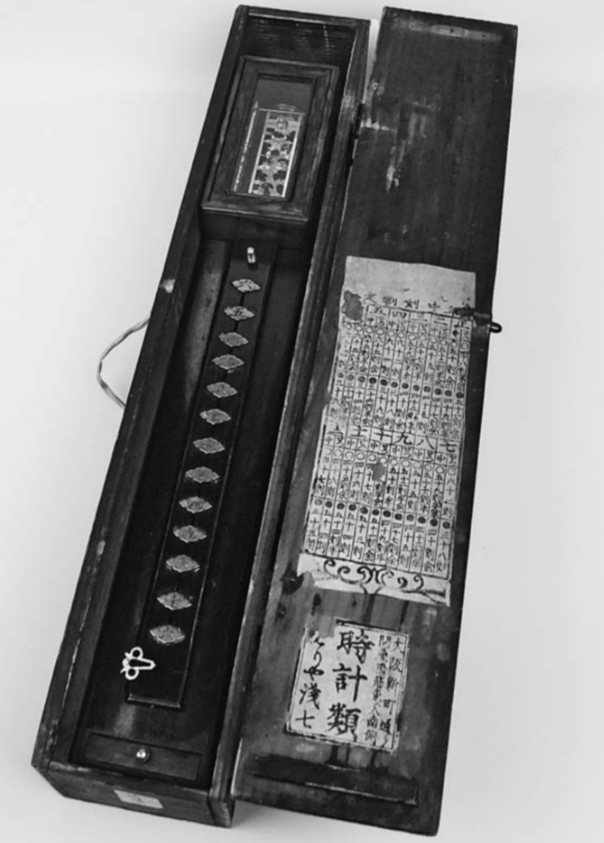
Figure 1. Shaku clock with movable hour markers and an attached seasonal timetable, Seiko Museum, Tokyo. Maker and date not identified in the cited source. Reproduced from Yulia Frumer, Making Time (2018), p. 51, fig. 2.6; image credited there to the Seiko Museum, Tokyo.
Temporal Hour System
During the Tokugawa period (1603–1868), society employed a temporal hour system. The day was divided into daytime (at dawn) and nighttime (at sunset), and those halves were further divided into six equal parts called koku (fig. 2). Therefore, summer daytime hours lasted longer than winter daytime hours; nighttime hours changed inversely (JCWA). It is crucial to note that through koku, variable hours coexisted with uniform measurement, meaning there was no such inability to conceive fixed time measurement as is sometimes assumed of non-Western cultures of the past.
Then, hour lengths were adjusted according to twenty-four seasonal divisions, sekki, rather than recalculated by every user every morning. Astronomical calculations supplied the relationship between these divisions and were provided in tables to users. However, when the sun rises, it does so gradually, meaning “[f]or society to function, there had to be an agreement as to which moment counted as the beginning of daytime” (Frumer 24). In other words, timekeeping was organized around collective decisions and conventions woven with a wider system of expert knowledge in astronomy. Japanese clockmakers reproduced that system of convention and calculation through mechanism and display.
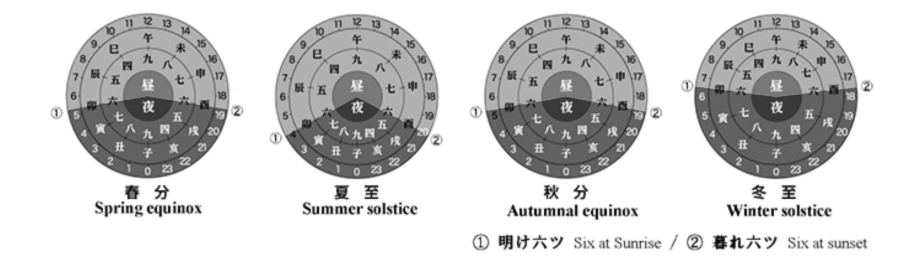
Figure 2. Chart of the Hour system during the Edo period. Reproduced from Japan Clock and Watch Association, The World of Japanese Traditional Clock.
Crafting and Adapting Time
Mechanical clocks entered Japan through sixteenth-century diplomatic and missionary encounters. In 1551, Jesuit missionary Francis Xavier presented a clock to Ōuchi Yoshitaka (a dominant figure in politics), the first Japanese record of clocks. From this point on, mentions of clocks as special gifts and highly requested fascinations of Japanese elites proliferated (Hiraoka). Of course, these clocks required repair and maintenance, the first of which was entrusted to Tsuda Sukezaemon, who was thereafter hired to work exclusively on clocks by shogun Tokugawa Ieyasu. Tsuda transmitted his craft knowledge to his children, “thus establishing a hereditary line of clock-makers… and initiating the profession of mechanical clock-makers in Japan” (Frumer 39). This shows how repair could generate knowledge and a continuing craft and employment lineage. Crucially, invention depended partly on (wealthy) patrons willing to support this specialized work. Okakae tokeishi were clockmakers retained by various regional lords who contributed to the development of Japanese clocks while enjoying stable status and compensation (Hayasaka).
Parallel to this, Ryuji Hiraoka traces domestic clock production to Jesuit instruction around 1601–1602, showing that transmission involved workshops and technical teaching as well as prestigious gifts. Hiraoka goes further to assert that “Jesuit clock-making led to the manufacture of wadokei,” as the craft began in a workshop attached to the Jesuit seminary in Kyushu. Here, some Japanese pupils mastered the craft to the extent that they were entrusted to make clocks by themselves and earned a considerable living doing so due to society’s high demand for such novelty items (Hiraoka). From here, it is “highly conceivable that [individual craftsmen such as] Tsuda learned the technology from them” (Hiraoka).
Other clockmakers learned the craft through reverse-engineering, which points to a process of understanding a foreign mechanism by relating it to familiar objects. For example, six-tooth gears were identified with a familiar six-sided structure–a snowflake–and thus called “snowflake gears”; digit placement on the dial were informed by Chinese cosmology and associations of hours, zodiac, and cardinal directions (Frumer 43). Such etymology and reorganization of information reveal how interpretation was shaped by existing cultural associations.
In particular, the shaku clock, its name derived from a device for measuring shaku (a unit equivalent to about a foot), was modeled after familiar timekeeping practices. Indeed, according to Frumer, a central concern was making a clock that measures the hours in the same manner as traditional devices such as the incense clock or the clepsydra (53). The shaku was meant to both resemble and be read as a clepsydra, a timepiece which regulates the flow of water to measure time in ancient times (Hwang et al.). This adaptation of new technology to familiar cultural systems of time-telling is one way in which clockmakers worked to adapt clocks to be most useful to society.
Additionally, the dial and graphlike design of the shaku, with its columns for the different seasons and appropriately-distanced hour markings, was informed by traditions of astronomical charts and graphs. For example, it was up to the owner to imagine the hundred- koku division on the vertical dial, and to adjust the movable digits according to the table attached to the inside, which reflected months and half-months (in other words, the sekki). This was the first solution to adapt clocks to temporal hour systems: (re)movable digits and dials. See fig. 3 for another example of removable dials.
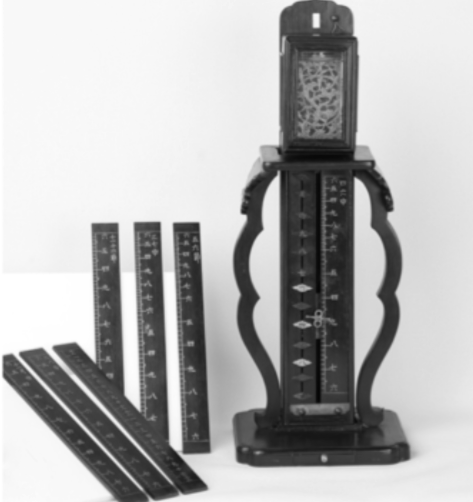
Figure 3. Small Stationary Pillar Clock with Balance Wheel and Replaceable and Segmented Dial Panel. Reproduced from The Seiko Museum Ginza.
Most strikingly, however, was the way the weighted foliot mechanism of Western clocks was adapted to accommodate the temporal hour system. Falling weight systems in European clocks were originally intended to maintain a steady speed of motion in adherence to the fixed hour system. However, Japanese clockmakers and reverse-engineers had no way of knowing this; all they knew was that moving the weights outward slowed the clock and moving them inward hastened it. Cleverly, they leveraged this capacity to vary the rate, using it not to standardize movement, but deliberately slowing the pace of the indicator between hour markers during summer’s longer daytime hours. In this way, Japanese clockmakers were able to accommodate Japan’s temporal hour system by reworking an original that was developed for an entirely different temporal system and culture, crafting it into their own technology for their own purposes and on their own terms.
Keeping Time
However, the weighted adaptation required continuing maintenance and interpretation, because each clock behaved differently and its regulator needed resetting for daytime and nighttime hours. It is here that knowing the instrument, for example by getting “a feel for” the weights’ positioning, became crucial (Frumer 45). This made the artisan’s or user’s learned, tacit expertise a condition for the clock’s accuracy. The craft of clockmaking therefore did not end when the clock left the workshop; it was perpetuated by repeated observation and judgement of artisans and users.
Additionally, written instructions could explain a mechanism without fully communicating the judgment required to make it work. Hosokawa Hanzō’s Karakuri-zui (fig. 4) is considered “the first publication in Japan to give sufficiently precise instructions to enable the construction of clocks” (Yorinau and Ichibe). However, Frumer contests that “no one could possibly have learned how to build a clock just by reading this book alone” (158). This is because much of the knowledge that goes into clockmaking did not concern mechanics; it also required knowledge of social norms of timekeeping, Chinese cosmology, a tacit, embodied “feel” for weight positioning, familial traditions of craftsmanship, and much more. This need for diverse forms of expertise in the making and upkeep of wadokei echoes Jacob Eyferth’s observation that “much knowledge is conveyed without recourse to writing.” The woodblock print pictured does not contain information about the day-to-day upkeep, the reading of seasonal charts, and instructions for the repositioning of the weights, all required knowledge lest the clock become obsolete. Clocks therefore embodied only part of the knowledge necessary for their operation; the rest remained with those who learned their particular behavior and mechanisms through practice and craft.
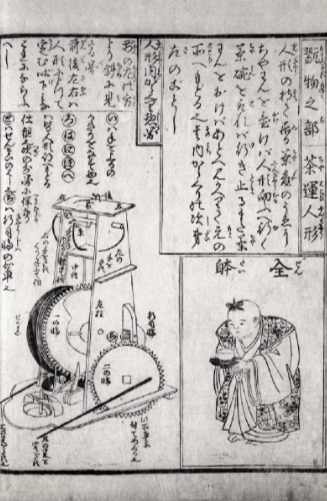
Figure 4. Hosokawa Honzō Yorinao, a woodblock print from Karakuri zui ('Illustrated Compendium of Clever Machines'). Reproduced from British Museum collection online.
Owners learned their instruments through repeated adjustment against community time-bells, while wealthy households could employ clockmakers to adjust their clocks twice daily. Thus, for wealthy owners, a clock was both a possession and a daily claim on skilled labor. Twice-daily servicing tied the clockmaker’s income to an enduring relationship with the user. In turn, the owner’s ability to use the clock depended on the artisan’s expertise. The clock could therefore display its owner’s wealth while concealing, behind its seemingly automatic functioning, a continuing dependence on artisanal labor. In this way, just like how the temporal hour system required collective agreement and decision-making about marking time, wadokei continued to facilitate social cooperation around timekeeping.
In this way, wadokei sustained customary temporal hours through inventive adaptation and skilled maintenance. The continuity of cultural practice of timekeeping was thus a daily achievement shared among artisans, instruments, and users. Its elaborate and painstaking reengineering and upkeep reveal just how much effort went into keeping familiar hours, while the knowledge outside of its wooden case kept the practice alive just as much as the falling weights and moving dial. Astronomical tables, community bells, and practiced judgment of adjusting wadokei structured relationships between people, time, and tradition. The values and achievement of the craft is visible in the movable markers themselves: before the clock could tell its user the hour, someone had to know where those hours came from and where they belonged at each moment in time.
Works Cited
Eyferth, Jacob. “Craft Knowledge at the Interface of Written and Oral Cultures.” East Asian Science, Technology and Society: An International Journal, vol. 4, no. 2, 1 June 2010, pp. 185–205, www.tandfonline.com/doi/full/10.1215/s12280-010-9115-4, 10.1215/s12280-010-9115-4.
Hayasaka, Isao. “和時計の文化史 : 時計のデザイン史(2).” デザイン学研究, vol. 1990, no. 78, 31 Mar. 1990, pp. 29–36, www.jstage.jst.go.jp/article/jssdj/1990/78/1990_KJ00007025477/_article/-char/ja/, 10.11247/jssdj.1990.29_1. Accessed 15 Oct. 2026.
Hiraoka, Ryuji. “Jesuits and Western Clock in Japan’s ‘Christian Century’ (1549–C.1650).” Journal of Jesuit Studies, vol. 7, no. 2, 29 Jan. 2020, pp. 204–220, brill.com/view/journals/jjs/7/2/article-p204_204.xml, 10.1163/22141332-00702004. Accessed 15 Oct. 2026.
Hosokawa Hanzo Yorinao and Suharaya Ichibei. “Hosokawa Honzō Yorinao, a Woodblock Print From Karakuri Zui (‘Illustrated Compendium of Clever Machines’).” Google Arts & Culture, 1796, artsandculture.google.com/asset/hosokawa-honzō-yorinao-a-woodblock-print-from-karakuri-zui-illustrated-compendium-of-clever-machines/kQGsIh-lt9hhZQ. Accessed 15 Oct. 2026.
Hwang, Zheng-Hui, et al. “Historical Development of Water-Powered Mechanical Clocks.” Mechanical Sciences, vol. 12, no. 1, 19 Feb. 2021, pp. 203–219, ms.copernicus.org/articles/12/203/2021/ms-12-203-2021.pdf, 10.5194/ms-12-203-2021. Accessed 15 Oct. 2026.
SEIKO GROUP CORPORATION. “Small Stationary Pillar Clock With Balance Wheel and Replaceable and Segmented Dial Panel.” The Seiko Museum Ginza, 1853, museum.seiko.co.jp/en/. Accessed 15 Oct. 2026.
“The World of Japanese Traditional Clock | Extensive Information About Time and Timepieces | JAPAN CLOCK & WATCH ASSOCIATION (JCWA).” Www.Jcwa.Or.Jp, www.jcwa.or.jp/en/etc/wadokei.html. Accessed 15 Oct. 2026.
Yulia Frumer. Making Time : Astronomical Time Measurement in Tokugawa Japan. Chicago ; London, The University Of Chicago Press, 2018.
